
You are using an out of date browser. It may not display this or other websites correctly.
You should upgrade or use an alternative browser.
You should upgrade or use an alternative browser.
View of roof for purchase of house
- Thread starter graemezz
- Start date

Poster #16,
Your wrong about Pagoda & what you confusedly call "header pike", as though "header pike" was one word.
You dont even understand that I'm using the correct term Pagoda to describe that kind of damaged roof. I'm not describing how the roof was built - I'm naming its damaged appearance.
Pagoda was used by roofers when I asked them to look at a roof job with a similar shaped damage.
I've also seen the term in a couple of RICS surveyors reports.
You dont seem to know what a "snapped header" is - & where & why they would be used on a gable.
The term "pike", a very common term, refers to the gable from the snapped header line up to the peak.
Your wrong about Pagoda & what you confusedly call "header pike", as though "header pike" was one word.
You dont even understand that I'm using the correct term Pagoda to describe that kind of damaged roof. I'm not describing how the roof was built - I'm naming its damaged appearance.
Pagoda was used by roofers when I asked them to look at a roof job with a similar shaped damage.
I've also seen the term in a couple of RICS surveyors reports.
You dont seem to know what a "snapped header" is - & where & why they would be used on a gable.
The term "pike", a very common term, refers to the gable from the snapped header line up to the peak.
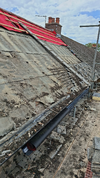
I stripped this off recently, they can look a lot worse underneath.I disagree in part, unless those plains are delaminating?
Apart from the unsightly ripped tarred building paper, it looks healthy enough from what I can see. There is a chance that ferrous fixings were used for the battens and (if any) for the tiles. If that is the case, then it could do with a re-roof.
The ex-con tile gapping on the verge is a normal sight for unfixed or unrestrained tiles.
The missing R/H corner tile (hanging) could be repaired with some cleverly shaped lead.
Attachments
US roof construction is significantly different from the UK - in particular tiles and slates are rarely used - instead roofing felt shingles are the normal roof covering. These have a typical 15 year life and routinely get replaced at this interval. The low weight of the shingles allows US roofs to be constructed from much lighter timbers than a typical UK roof.Poster #16,
Your wrong about Pagoda & what you confusedly call "header pike", as though "header pike" was one word.
You dont even understand that I'm using the correct term Pagoda to describe that kind of damaged roof. I'm not describing how the roof was built - I'm naming its damaged appearance.
Pagoda was used by roofers when I asked them to look at a roof job with a similar shaped damage.
I've also seen the term in a couple of RICS surveyors reports.
You dont seem to know what a "snapped header" is - & where & why they would be used on a gable.
The term "pike", a very common term, refers to the gable from the snapped header line up to the peak.
So I'm not convinced that advice from the US is applicable to UK roofs.
Poster #19,
Wrong, very wrong, everything that you said is wrong.
US roof construction is not "significantly different from the UK".
More roof tiles are used in California & the SW of the USA than in the UK.
East coast housing uses, besides tiles, large amounts of slate roofing.
The average life of US asphalt shingles is about 30yrs often its much longer - up to 50yrs.
Believe me, roof framing uses some hefty sections from 6x to 12x
at 16" center's.
So, with respect, I'm not convinced that you know what you are talking about.
Wrong, very wrong, everything that you said is wrong.
US roof construction is not "significantly different from the UK".
More roof tiles are used in California & the SW of the USA than in the UK.
East coast housing uses, besides tiles, large amounts of slate roofing.
The average life of US asphalt shingles is about 30yrs often its much longer - up to 50yrs.
Believe me, roof framing uses some hefty sections from 6x to 12x
at 16" center's.
So, with respect, I'm not convinced that you know what you are talking about.
In my early 20's I worked in the USA for a few years including California. I'd say he's not totally wrong. A lot of jobs I worked on used shingle roofs, although Spanish tiles were popular in Southern California. One of the main differences was using ply to board over the rafters. When trussed rafters first came over to the UK from the USA, there was a problem with racking because we didn't do that here.
Oh I do - I live in the US west and have a house with a shingle roof. Everyone on my neighbourhood has needed these shingles replaced after around 15 years and, after strong winds, individual rows of shingles often need replacing before that. The trussed rafter roofing timbers on my house are significantly smaller than the ones I had on my previous UK house which had a rafter & purlin roof with purlins of around 12" by 6". I've never seen these in modern West US houses - but maybe they exist in older US East houses which I agree sometimes have tiles or slatesPoster #19,
Wrong, very wrong, everything that you said is wrong.
US roof construction is not "significantly different from the UK".
More roof tiles are used in California & the SW of the USA than in the UK.
East coast housing uses, besides tiles, large amounts of slate roofing.
The average life of US asphalt shingles is about 30yrs often its much longer - up to 50yrs.
Believe me, roof framing uses some hefty sections from 6x to 12x
at 16" center's.
So, with respect, I'm not convinced that you know what you are talking about.
I'm sticking with my comment that US house roofs (at least in the West) are significantly different from UK ones - which arises from direct experience of houses in both countries.
Poster #21,
Roof sheathing is common in Scotland.
Roof sheathing in England is often used on complicated roofs and large structures.
UK trusses have been braced since day one - as the trusses were plumbed up, temporary bracing was pinned to stabilise them before the interior bracing was fixed.
Roof sheathing is common in Scotland.
Roof sheathing in England is often used on complicated roofs and large structures.
UK trusses have been braced since day one - as the trusses were plumbed up, temporary bracing was pinned to stabilise them before the interior bracing was fixed.
Poster #22,
You appeared to "think" that I was referring to USA roofs when I mentioned Pagoda etc. - you clearly missed the reference to "RICS surveyors" or do you imagine that they operate in the US?
"US roof construction" in your post #19 becomes"the US west"in your post #22 - either America is shrinking or your claimed experience is diminishing?
You claim "everyone on my neighbourhood etc" - how do you know, do you go around knocking on "everyone's" doors for info about peoples roofs? FWIW: Americans would say in not "on" & spell neighborhood without the letter "u".
I specifically used the term "roof framing", nothing about trusses.
Do you understand the difference?
FWIW: US trusses (& UK trusses), are often specifically sized (including section sizes) for the job.
2" x 4"s & larger truss sections are commonly used in the SF Bay area, & the vast housing tracts of central Ca.
You appeared to "think" that I was referring to USA roofs when I mentioned Pagoda etc. - you clearly missed the reference to "RICS surveyors" or do you imagine that they operate in the US?
"US roof construction" in your post #19 becomes"the US west"in your post #22 - either America is shrinking or your claimed experience is diminishing?
You claim "everyone on my neighbourhood etc" - how do you know, do you go around knocking on "everyone's" doors for info about peoples roofs? FWIW: Americans would say in not "on" & spell neighborhood without the letter "u".
I specifically used the term "roof framing", nothing about trusses.
Do you understand the difference?
FWIW: US trusses (& UK trusses), are often specifically sized (including section sizes) for the job.
2" x 4"s & larger truss sections are commonly used in the SF Bay area, & the vast housing tracts of central Ca.

DIYnot Local
Staff member
If you need to find a tradesperson to get your job done, please try our local search below, or if you are doing it yourself you can find suppliers local to you.
Select the supplier or trade you require, enter your location to begin your search.
Please select a service and enter a location to continue...
Are you a trade or supplier? You can create your listing free at DIYnot Local
Similar threads

- Replies
- 3
- Views
- 22K
- Replies
- 2
- Views
- 4K