
You are using an out of date browser. It may not display this or other websites correctly.
You should upgrade or use an alternative browser.
You should upgrade or use an alternative browser.
Washer/dryer tripping consumer unit
- Thread starter Keitai
- Start date
Toaster and kettleWhat else is plugged into that double adaptor? Do you run that at the same time the washer dryer is on?
It's working now thxsView attachment 426277
Try rewiring the plug, there seams to be a lot of heat damage on the neutral (the blue wire), also there are strands sticking out for the live wire (the brown wire). a loose terminal could maybe be to blame. That is what I would try first.
Didn't cut it back at all just rewired new plug. Don't think there's enough slack on cord, it's already stretched to limit. It's working ok now. I might be able to cut 20mm back possibly. Shall I ONLY use that socket for washer dryer and remove multi socket? Put toaster and kettle elsewhere? Or only use one appliance on multisocket at a time(possibly hard to remember though).Keitai, the black burning on the blue neutral core and heat damage on the brown isn't a mysterious glitch—it is a classic textbook symptom of resistive contact overheating caused by drawing continuous high current through a multi-way adaptor.
Here is the physical and electrical reality of what was happening before you took that plug off:
1. The Double Adaptor Problem (Thermal Runaway)
A washer-dryer is one of the heaviest domestic electrical loads you can plug in. During water heating and tumble-drying cycles, the heating element draws a sustained 9A to 12.5A (2,000W to 2,800W) continuously for an hour or more at a time.
Standard plug-in double adaptors are only rated for 13A total across both outlets, and their internal brass contact strips rely on cheap stamped spring fingers. Under a continuous 10A+ draw, any slight resistance ($R$) between the adaptor pins and the socket causes localized heat ($P = I^2 R$). That heat bakes the plug from the inside out, softening the plastic body and breaking down the PVC insulation on the neutral (blue) and line (brown) cores until they char and start arcing to the earth pin or casing—which is what tripped your consumer unit RCD.
2. Never Run Heating Appliances on an Adaptor or Extension
High-draw heating appliances (washing machines, tumble dryers, dishwashers, kettles) must never be plugged into adaptors, multi-way blocks, or coiled extension leads. They must be plugged directly into their own dedicated 13A wall socket outlet.
3. Inspect the Wall Socket Itself
Because the adaptor got hot enough to melt and char the wire inside the plug, there is a very high probability that heat has conducted straight into the wall socket faceplate. When a wall socket experiences high heat, the phosphor-bronze spring clips inside lose their spring temper (they become annealed and soft). Once soft, they can no longer grip the pins of a new plug tightly, creating loose contact resistance all over again.
- Inspect the front of the wall socket for yellowing, brown scorching, or cracking around the pin apertures.
- When you plug the new plug into the wall, does it feel tight and firm to push in, or loose and floppy? If it slides in without firm resistance, replace the double socket faceplate before running a full wash cycle.
4. Check the Cable Flex
When you fitted the new plug, did you cut the appliance flex back past the discoloured, stiff section? Overheated copper strands oxidise and become brittle, and heat-damaged PVC insulation loses its dielectric strength. You should cut the lead back by at least 75–100mm to clean, flexible copper and unburnt insulation before fitting a heavy-duty BS 1363/A plug (like an MK Toughplug) with an ASTA-marked 13A fuse.
Didn't cut it back at all just rewired new plug. Don't think there's enough slack on cord, it's already stretched to limit. It's working ok now. Shall I ONLY use that socket for washer dryer and remove multi socket? Put toaster and kettle elsewhere? Or only use one appliance on multisocket at a time(possibly hard to remember thoughKeitai, the black burning on the blue neutral core and heat damage on the brown isn't a mysterious glitch—it is a classic textbook symptom of resistive contact overheating caused by drawing continuous high current through a multi-way adaptor.
Here is the physical and electrical reality of what was happening before you took that plug off:
1. The Double Adaptor Problem (Thermal Runaway)
A washer-dryer is one of the heaviest domestic electrical loads you can plug in. During water heating and tumble-drying cycles, the heating element draws a sustained 9A to 12.5A (2,000W to 2,800W) continuously for an hour or more at a time.
Standard plug-in double adaptors are only rated for 13A total across both outlets, and their internal brass contact strips rely on cheap stamped spring fingers. Under a continuous 10A+ draw, any slight resistance ($R$) between the adaptor pins and the socket causes localized heat ($P = I^2 R$). That heat bakes the plug from the inside out, softening the plastic body and breaking down the PVC insulation on the neutral (blue) and line (brown) cores until they char and start arcing to the earth pin or casing—which is what tripped your consumer unit RCD.
2. Never Run Heating Appliances on an Adaptor or Extension
High-draw heating appliances (washing machines, tumble dryers, dishwashers, kettles) must never be plugged into adaptors, multi-way blocks, or coiled extension leads. They must be plugged directly into their own dedicated 13A wall socket outlet.
3. Inspect the Wall Socket Itself
Because the adaptor got hot enough to melt and char the wire inside the plug, there is a very high probability that heat has conducted straight into the wall socket faceplate. When a wall socket experiences high heat, the phosphor-bronze spring clips inside lose their spring temper (they become annealed and soft). Once soft, they can no longer grip the pins of a new plug tightly, creating loose contact resistance all over again.
- Inspect the front of the wall socket for yellowing, brown scorching, or cracking around the pin apertures.
- When you plug the new plug into the wall, does it feel tight and firm to push in, or loose and floppy? If it slides in without firm resistance, replace the double socket faceplate before running a full wash cycle.
4. Check the Cable Flex
When you fitted the new plug, did you cut the appliance flex back past the discoloured, stiff section? Overheated copper strands oxidise and become brittle, and heat-damaged PVC insulation loses its dielectric strength. You should cut the lead back by at least 75–100mm to clean, flexible copper and unburnt insulation before fitting a heavy-duty BS 1363/A plug (like an MK Toughplug) with an ASTA-marked 13A fuse.
I think it's the constant aggressive pulling plug out of socket and plugging in kettlebor toaster, I always had two appliances in multi socketIs there really so little slack available that the spinning drum is pulling on the flex? And is that the reason that the cable wires haven't been properly remade? If so both need addressing.
Running your washer dryer (c 2kW) and kettle (c 3kW) at the same time is a current draw of c 20A on that single adaptor/socket which exceeds it's design limit of 13A.
I just replaced a socket under my sink that had swelled and cracked with the heat of just a (2kW element) washing machine permanently plugged in there. Hard to see in the photo but it had swelled both inside and out & the switch was jammed. Replaced with metalclad to help dissipate any heat.
Loading up a single socket with 5kW or more is dangerous.
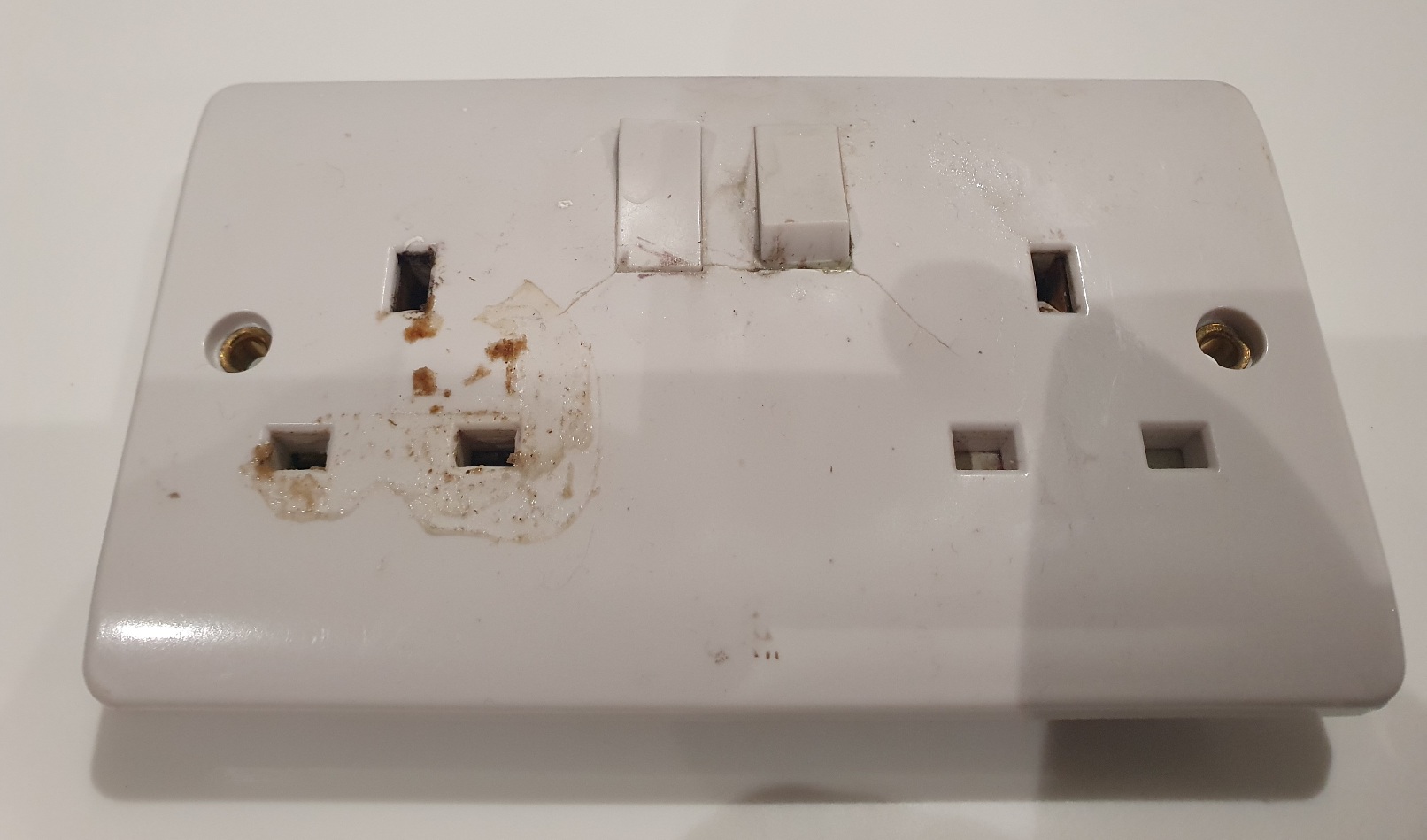
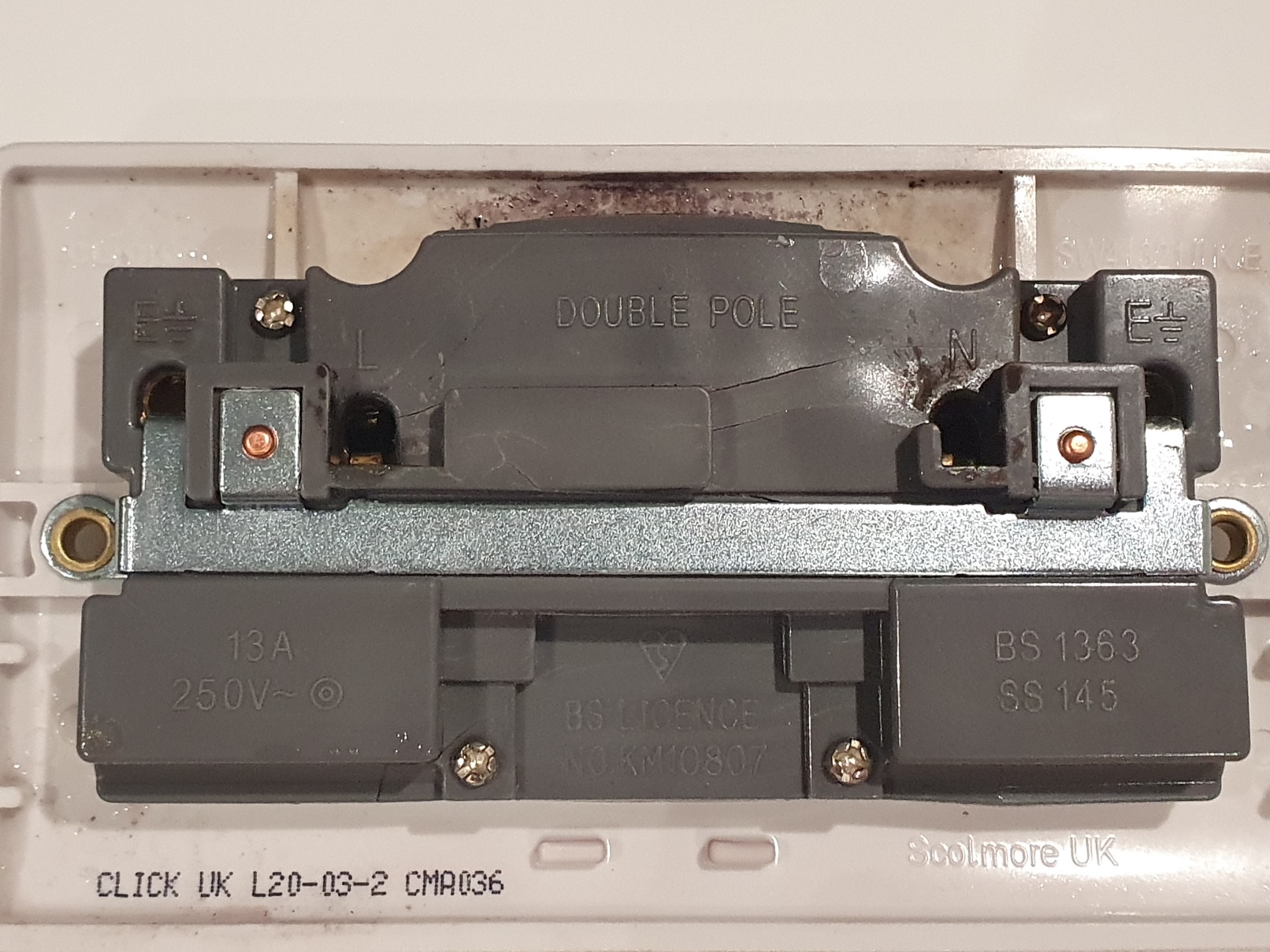
I just replaced a socket under my sink that had swelled and cracked with the heat of just a (2kW element) washing machine permanently plugged in there. Hard to see in the photo but it had swelled both inside and out & the switch was jammed. Replaced with metalclad to help dissipate any heat.
Loading up a single socket with 5kW or more is dangerous.

- Joined
- 27 Jan 2008
- Messages
- 29,816
- Reaction score
- 3,696
- Location
- Llanfair Caereinion, Nr Welshpool
- Country

A standard double socket is rated 20 amps for the pair, special sockets, i.e. with filters, USB etc, may be down to 13 amp the pair.
I had a socket also swell and trip the RCBO, down to a leaking roof however, nothing plugged in.
The picture point to loose cables, I have had sockets where the screws in the termials bind, the tapping of the thread not as it should have been, using a standard screwdriver one can often feel there is a fault, but using a torque screwdriver removes the feel you get, so easy to miss a faulty tapped thread.
OP has up to three high load devices running on his single socket (see post #1).A standard double socket is rated 20 amps for the pair, special sockets, i.e. with filters, USB etc, may be down to 13 amp the pair.
I had a socket also swell and trip the RCBO, down to a leaking roof however, nothing plugged in.
The picture point to loose cables, I have had sockets where the screws in the termials bind, the tapping of the thread not as it should have been, using a standard screwdriver one can often feel there is a fault, but using a torque screwdriver removes the feel you get, so easy to miss a faulty tapped thread.
I'm still finding various faults with the plumbing, electrics and construction of our new build house erected in 2021, inc an immersion heater run on a 5A lamp flex that went to the Samsung ASHP controls as plumber didn't realise the ASHP calls for help from the immersion when it runs it's Legionnaires cycle once a week.

- Joined
- 11 Jan 2004
- Messages
- 47,157
- Reaction score
- 4,126
- Country
It's well worth cutting back the flex to fresh, bright copper and soft, undamaged insulation.
If there isn't enough slack to do this, then I would get a new extension lead.
I would also check the socket, as history tells me that heat transfers from one damaged component (plug or socket) to the other.
I personally would not run heavy loads via an extension lead. It's best to have them plugged directly into wall sockets.
It's well worth cutting back the flex to fresh, bright copper and soft, undamaged insulation.
If there isn't enough slack to do this, then I would get a new extension lead.
I would also check the socket, as history tells me that heat transfers from one damaged component (plug or socket) to the other.
I personally would not run heavy loads via an extension lead. It's best to have them plugged directly into wall sockets.
I'm gonna leave that socket for the washer/dryer only. No multi socket. Leave it permanently plugged in. I think the pulling out and plugging in to switch appliances putting strain on wiring.Running your washer dryer (c 2kW) and kettle (c 3kW) at the same time is a current draw of c 20A on that single adaptor/socket which exceeds it's design limit of 13A.
I just replaced a socket under my sink that had swelled and cracked with the heat of just a (2kW element) washing machine permanently plugged in there. Hard to see in the photo but it had swelled both inside and out & the switch was jammed. Replaced with metalclad to help dissipate any heat.
Loading up a single socket with 5kW or more is dangerous.
View attachment 426396
View attachment 426397
Issue I've got now is kettle and toaster and under microwaves on wall.
And an induction hob. Is there an oven too? How many circuits are feeding that area?
Is there a ring suitable for chasing out the existing single into a new double socket?
Is there a ring suitable for chasing out the existing single into a new double socket?

DIYnot Local
Staff member
If you need to find a tradesperson to get your job done, please try our local search below, or if you are doing it yourself you can find suppliers local to you.
Select the supplier or trade you require, enter your location to begin your search.
Please select a service and enter a location to continue...
Are you a trade or supplier? You can create your listing free at DIYnot Local
Similar threads

- Replies
- 13
- Views
- 2K