When It Goes Wrong

No idea! I'm not a firefighter and can only go on what I was told in a real fire situation and by other firefighters in discussion after training sessions I did for them on the dangers of our equipment! So perhaps you need to find a firefighter's forum and ask there
I had a very quick look last night, and found this rather fascinating (US) one (here) ...which gives figures for the minimum safe distances for the 'nozzleman' to be from live electricity (voltages from 1.1kV up to 22kV) when one is squirting water onto it!

Kind Regards, John
 
I will, when I make my way to my local purveyor of extremely fine beverages and quality snacks for the discerning gentleman, commence a conversation with Fireman Sam, a rather, shall I say, coarse acquaintance of mine. Durham County fire station is his employ and is within but a mere meander of our domicile.

I will endeavour, after several quaffs of fine ale, to illicit from him a discussion upon the procedural details that the above fire control establishment would employ upon this new fangled discovery known as electrickery.

(spits dictionary out!!)
After all that you end with a preposition.

No wonder the country is in a mess.
 
I'm aware of that and know there is a test rig at the National Fire Training Centre!

We still advise not to do it (nor have a found a firefighter willing to try)

What concerned us more was the lack of knowledge of what exactly they were dealing with
 
Just thinking back to the discussion I had, the scenario was more a "what if a firefighter inadvertently direct water on live equipment" than "we can safely deliberately direct water onto live equipment"!
 
Just thinking back to the discussion I had, the scenario was more a "what if a firefighter inadvertently direct water on live equipment" than "we can safely deliberately direct water onto live equipment"!
There presumably must be some experts, and expert knowledge, in relation to these issues - in the fire service and/or electricity supply industry. I would also be pretty amazed if there were not written instructions/guidelines/regulations in the fire service for dealing with these sorts of incidents.

Kind Regards, John
 
Is that on a private piece of land

Yes it is, and in the middle of the Lake District so it had to fit in with the surrounds

Where abouts in the lakes Westie?

Iirc powder and foam cannot be used on HV fires (assuming that the gear was live)
I wouldn't want to get too close to it to put anything like that on it with it live, I have seen some substations which have installed fire suppression systems which use inert gasses

I attended, some years ago, a fire in a major supermarket with an outdoor substation adjacent to the store.
Was that in Workington or Penrith? They know how to have a fire up here in supermarkets!! The Workington one was owing to an electrical fault on a newly installed electrical dept iirc.
 
The Workington one was owing to an electrical fault on a newly installed electrical dept iirc.

Yes a light fitting, during the incident I was talking to one of the staff who saw it start!
 
Bit off topic, but while Westie is here...

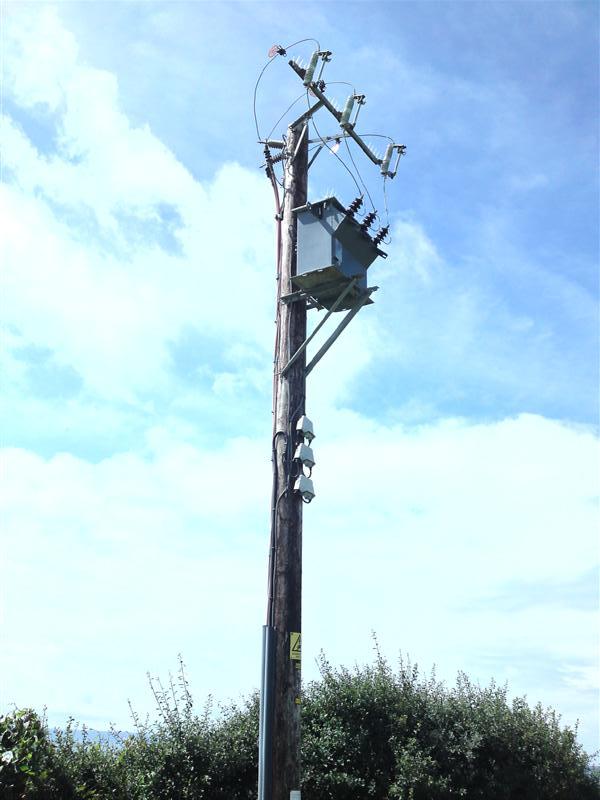
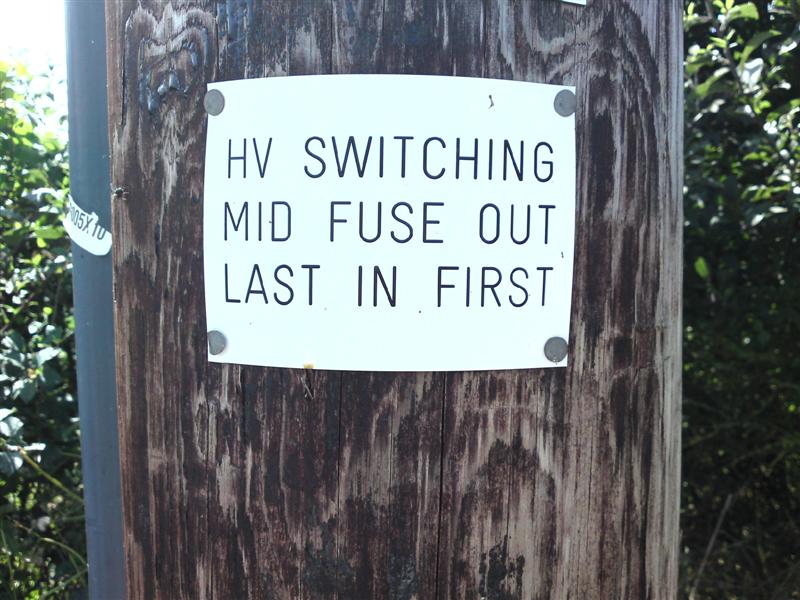
This transformer was installed on a site we did a while back. An HV cable running between two substations runs through the field, and this pole mounted TX was stuck up and tee'd from it. WPD only exceptionally fit small TX's on the ground.

The sign puzzled me?

1280335480.jpg


1280335426.jpg
 
Electrical fire in sub station(Carlisle)14 Jan 2013
At 15:58 one fire engine from Carlisle East and one fire engine from Carlisle West were called to a report of an electrical fire. On arrival firefighters confirmed there was a small fire involving an electricity sub station. Two firefighters wearing breathing apparatus used one two CO2 extinguishers to put out the fire. A large industrial fan was used to clear the smoke.


Fire at an electrical sub station in Ambleside(South Lakeland)4 Jan 2013
At 12:49 one fire engine each from Ambleside and Windermere attended a report of a sub station on fire in nook Lane, Ambleside. The fire was caused by a transformer exploding. The sub station, measuring 6m x 3m was destroyed by the subsequent fire. Once the electricity company had isolated the supply firefighters used one hose reel jet and small tools to damp down the building.

Two fires in under two weeks :shock:
 
The sign puzzled me?

And me!!

I suspect that when the fuse is tripped it will be in close proximity to the dropper wire going to the left hand terminal of the transformer.


Yes I saw that entry of the 14th, I'll look at our log on Monday to see what it was
 
I take it the HV fuses are those things on the top? Not as simple as so if one is dropped it doesn't short across the insulator terminals on the transformer??
 
The fuses pivot on their bottom contacts so it tripped (opened) will swing down, this, I think, will bring the top contact close to the other dropper. Bearing in mind that though the operating rods are insulated the heads are aluminium, thus further reducing clearance.
 

If you need to find a tradesperson to get your job done, please try our local search below, or if you are doing it yourself you can find suppliers local to you.

Select the supplier or trade you require, enter your location to begin your search.


Are you a trade or supplier? You can create your listing free at DIYnot Local

 
Back
Top