• Looking for a smarter way to manage your heating this winter? We’ve been testing the new Aqara Radiator Thermostat W600 to see how quiet, accurate and easy it is to use around the home. Click here read our review.

Which fuse rating to use in a plug

Joined
26 Apr 2023
Messages
96
Reaction score
13
Country
United Kingdom
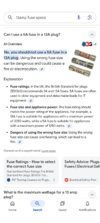
One of the responses to the "Strange Socket In Hospital" thread prompted me to search for the specs of 13 amp fuses.

One of the suggested questions was
"Can I use a 5A fuse in a 13A plug?"
With the AI Overview saying it is dangerous to use a lower ampage fuse.
Does anyone know how accurate the AI response is?

"No, you should not use a 5A fuse in a 13A plug. Using the wrong fuse size can be dangerous
No, you should not use a 5A fuse in a 13A plug. Using the wrong fuse size can be dangerous and could cause a fire or electrocution."
 

Attachments

  • Screenshot_20250208-221946.png
    Screenshot_20250208-221946.png
    484.9 KB · Views: 66
One of the responses to the "Strange Socket In Hospital" thread prompted me to search for the specs of 13 amp fuses.

One of the suggested questions was
"Can I use a 5A fuse in a 13A plug?"
With the AI Overview saying it is dangerous to use a lower ampage fuse.
Does anyone know how accurate the AI response is?

"No, you should not use a 5A fuse in a 13A plug. Using the wrong fuse size can be dangerous
No, you should not use a 5A fuse in a 13A plug. Using the wrong fuse size can be dangerous and could cause a fire or electrocution."
Using the wrong size fuse can be dangerous, but so can taking notice of AI answers like you shared.

The fuse should be the correct size for the appliance and the flex supplying it whether that be 2, 3, 5, 7, 10 or 13 amps.
 
With the AI Overview saying it is dangerous to use a lower ampage fuse.
If you click on the chain icons within the answer, it takes you to the webpage, and highlights the text that it gains it's citation from i.e.

Screenshot_20250208_225314_Chrome.jpg


The AI has interpreted your question as literally using a fuse that is the wrong size (it's 5A when it should be 13A) - as its sources don't differentiate the fact that a lower size fuse may be safer, the AI can't make that judgement.

Which also leads to....

Screenshot_20250208_225731_Chrome.jpg
 
One of the responses to the "Strange Socket In Hospital" thread prompted me to search for the specs of 13 amp fuses.

One of the suggested questions was
"Can I use a 5A fuse in a 13A plug?"
With the AI Overview saying it is dangerous to use a lower ampage fuse.
Does anyone know how accurate the AI response is?

"No, you should not use a 5A fuse in a 13A plug. Using the wrong fuse size can be dangerous
No, you should not use a 5A fuse in a 13A plug. Using the wrong fuse size can be dangerous and could cause a fire or electrocution."
I believe only 3 amp and 13 amp fuses are 'recognised' for a 13 amp plug top.

Absolutely no reason why you can't use a 5 amp fuse if you think ir appropriate.

Appliances with pre-ftted plugs have been known to be fitted with 7 or 10 amp fuses.

AI?????????????????????????????????????

Tell AI to do it to themselves.

Using a fuse too LOW for it's load should blow, but could still cause damage, aa illogical as that seems.
 
Last edited:
I was brought up to us a fuse that not only is slightly smaller than the cable (in other words, the fuse protects the cable), but so the fuse is no larger than the current of the appliance.

The habit dies hard - yet we see so many low current/low energy appliances fitted with plugs containing fuses that are 'technically' oversized.
 
Last edited:
Look at the appliance label to find out how much current it draws. If it only gives a rating in watts, divide it by 230. Use the lowest rated fuse that is greater than that. If you suspect an appliance has had its flex replaced, or you are replacing the flex, do not install a flex incapable of flowing the required power, and do not install a fuse capable of flowing a power greater than the flex can

In a shutoff situation, the weakest link in the system needs to set on fire; the intention is that that is the fuse wire, inside its fire sterile environment, not the flex or the appliance in their non-fire-sterile environment
 
I was brought up to us a fuse that not only is slightly smaller than the cable (in other words, the fuse protects the cable), but so the fuse is no larger than the current of the appliance. ... The habit dies hard .....
As I've often observed, it's never died for me - it seems that I must be one of the greatest users of 1 A and 2 A BS1362 fuses :-)

It probably virtually never makes any difference but, as far as I am concerned, there are no downsides of using the lowest possible rating of fuse - so'why not?'. Eric may disagree (about the absence of downsides), saying (correctly) that a lower-rated fuse will get hotter, but I don't personally see that as an issue!
 
Lower Amp rated fuse may cause unnecessary blowing of the fuse if the load of the appliance is high for example a microwave.

The fuse (might blow) as they are slow blowing. Not a danger but you will need to change the fuse.

Use the wrong voltage rating fuse then you're cooked.
 
Lower Amp rated fuse may cause unnecessary blowing of the fuse if the load of the appliance is high for example a microwave.
The fuse obviously has to be appropriate for the load (both running and, where appropriate, start-up - although fuses tend to be too slow to worry about very brief start-up currents).

However, there are so many things around theses days that using only a small fraction of 1 A - so it seems unnecessary to use 3 A fuses for them.
Use the wrong voltage rating fuse then you're cooked.
Eh? What is the 'voltage rating' of a fuse? All a fuse will know about is the potential difference across it, which will be tiny (and dependent only on the current, regardless of 'supply voltage').
 
Eh? What is the 'voltage rating' of a fuse? All a fuse will know about is the potential difference across it, which will be tiny (and dependent only on the current, regardless of 'supply voltage').
The voltage rating typically relates to the interrupt rating of the fuse. Meaning the voltage at which the fuse is guaranteed to safely disconnect the load.

This doesn't happen by default. If you take a fuse rated for 120V and put it in a 240V system, it will work fine until it blows. And when it blows there is the possibility that an arc will form inside the fuse and continue conducting current.

The current carrying capability of an arc can be orders of magnitude higher than an intact fuse.

C'mon John! :)
 
The fuse obviously has to be appropriate for the load (both running and, where appropriate, start-up - although fuses tend to be too slow to worry about very brief start-up currents).
Which won't/never matter on a domestic property.
 
Does anyone know how accurate the AI response is?
Like most AI created gubbins, it's based on various elements of truth, but those are taken from different sources and different time periods, so when combined the result is a confused jumble of ideas with no context.

A long time ago, fuses in plugs were rated to the flex attached, which was directly related to the power requirements of the device at the end of the flex.
3,5,13 were the usual values and were suggested for a whole range of different appliances. 3A for the side lamp, 5A vacuum cleaners and fridges, 13A for ye olde 3 bar electric fire and so on.
Other ratings existed for various specific purposes such as 7 or 10 for office furniture which contained electrical outlets.
All very well and desirable when the circuit contained a 3036 rewireable fuse, which even if it did contain the correct fusewire would be so slow to react, any appliance flex would be on fire without local protection.

Today, the vast majority are either 13A or 3A, the flex on certain items like kettles is routinely undersized due to the intermittent nature of such loads, and fused plugs in general are mostly irrelevant.
With modern circuit breakers, most short circuit faults will cause the 32A breaker to disconnect before the fuse fails.

Overload is mostly irrelevant with a single item attached.
2 way adaptor cubes typically are unfused, so no help there.
3 way types are usually fused, but attaching 3 items to overload and open a 13A fuse would require a special effort of 3 modern electric heaters on full in a room which was at sub zero temperatures.
That only leaves multi way extension leads, where the fuse could theoretically provide some protection against overload, but in reality this rarely happens as 13A fuses require a very substantial long term sustained current to open on overload, and in most cases the plugs/adaptors melt long before the fuse opens. Also see a sub-plot regarding the poor standards of education and social understanding where many people are entirely unaware of what fuses are actually for and would probably just replace the fuse when it failed rather than consider why.

Other niche uses such as 3A FCUs for gas heating systems are mostly based in ancient traditions rather than actual engineering, and would be far better served by having dedicated circuits for such things.

 
If you take a fuse rated for 120V and put it in a 240V system, it will work fine until it blows. And when it blows there is the possibility that an arc will form inside the fuse and continue conducting current. ... The current carrying capability of an arc can be orders of magnitude higher than an intact fuse.
C'mon John! :)
Thanks. Every day of life is a 'learning' experience'! What you say is, indeed, pretty obvious, but not something I'd ever thought about. Most things become fairly 'obvious' once one knows them :-)

Having said that, this discussion has all been about BS1362 fuses and, although you raised the issue of 'voltage rating' I presume that no such fuses (well, no BS1362-compliant ones!) are not 'rated' at less than 240 V, are they?
 

If you need to find a tradesperson to get your job done, please try our local search below, or if you are doing it yourself you can find suppliers local to you.

Select the supplier or trade you require, enter your location to begin your search.


Are you a trade or supplier? You can create your listing free at DIYnot Local

 
Back
Top