Willis Heating System

The stratification, in a Willis arrangement, is simply much more effective than in the usual, near vertical element arrangement.
I could agree with that, BUT, as I just wrote my cylinder's 'bottom element' is horizontal, and the top one (which one would use for Willis-like functionality) is very short.
With the usual element, you get heated water rising, then falling again as it cools, around the outer edge of the cylinder. Hence, you get much more mixing of hot and cooler water. Compare that, with the Willis system, where the heated water, simply goes in the top of the cylinder, with no convection currents from an element to mix it.
True - but, again, not in the case of my short 'top element', which I still believe provides much the same functionality as does the Willis system.

Mind you, my top element does not appreciably heat the water below it - which is why I'm still pondering the matter of the lower parts of the cylinder with a Willis heater. With mine, the thermostat turns off the top element as soon as the top bit of water (down to bottom of element) reaches the target temp - which I'm tempted to think may be an advantage in comparison with Willis?
 
Sorry, I didn't see your submission, before typing my own - but at least we agree on the control methods :-)
Your English is better than mine, you put it spot on.
I don't understand. Warmer water will rise 'to the top', regardless of how (or where) it got warm.
But it will mix, so hot water at the bottom of the tank will warm water on its way up, so the whole tank warms together, but putting separate it is not mixing on the way up.
The method involving least kw energy is instant, local heat, which is electric. Better, would be an instant gas water heater, at every hot tap, but simply no practical.
I remember the gas geezers on the wall, they did work, but today we want the combustion products to be piped outside to reduce humidity, there is a trade-off, seven hot taps, in five locations, two kitchens, two bathrooms, and a shower room, so only really practical to fit in one location, the front kitchen, but with a dishwasher, we really do not use enough hot water to be worth the effort.
I could agree with that, BUT, as I just wrote my cylinder's 'bottom element' is horizontal, and the top one (which one would use for Willis-like functionality) is very short.
I only have one boss on the cylinder, so only one immersion heater, I did change this from 11 inch to 27 inch, I had not expected to use much more energy, OK, to heat it up to start with, but once hot thought the difference would be small, I got it wrong again dad, using over double the energy (kWh) to the short one. This may have been due to running out of DHW with the short one, or the short one having the temperature set lower.

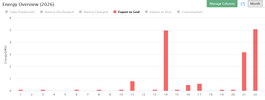
If the Willis heats from the top down, even with just 200 watt, it would be far better, as soon as my battery is charged, it will start heating DHW, but if the lower wattage results in the water not being as warm, then it would be a waste of money, today 5.1 kWh exported so it would have done well, but 1771784075080.pngas seen, 6 poor days, summer is better, but still can't be sure no more than two poor days in a run, so I use off-peak, and heat the whole tank, so in real terms my iboost+ is a bit useless, and if one has to guess how much one needs each night, then no real point using the Willis.
 
But it will mix, so hot water at the bottom of the tank will warm water on its way up, so the whole tank warms together, but putting separate it is not mixing on the way up.
It would, but neither the Willis system nor my installation (when in 'Willis mode') should have any hot water at the bottom - since the only heating, or introduction of heated water, is at the top.
 
Not really - the Willis stat, or stats, can be placed at any water level you desire.
If you say so. Since the stats seem fairly crucial to the Willis system, I asked if anyone knew how/where they were sited, but have so far not had any answers.

Are you saying that the Willis system has a 'moveable' thermostat?
 
Let's not forget that a heat source in a tank of water can and will heat the entire tank eventually but unless there is a reasonable circulation taking place within the tank the top will be hotter than the bottom. This is far more prevalent in a tall thin tank where circulation is more restricted. This is why destratification pumps are installed which basically pull hot water from the top of the tank and put it back into the bottom (some arguement exist on whether top to bottom or bottom to top is best - I've encountered both and both seem to work so sit on the fence) or mechanical moving paddles installed in the tank. Many heating coils are fitted with vanes arranged to start the heated water moving in a circular motion to form a helical/rotating current.

The Willis system introduces this circulating current by default.
 
Are you saying that the Willis system has a 'moveable' thermostat?

Not at all - what I said was the stat(s) could be located where ever desired, to suit the demand for hot water. A series of switches, could be used to select which stat, the element worked on. Alternatively, a timer could be used, but the advantage is - that the Willis system provides a quantity of water, at temperature, very quickly.
 

If you need to find a tradesperson to get your job done, please try our local search below, or if you are doing it yourself you can find suppliers local to you.

Select the supplier or trade you require, enter your location to begin your search.


Are you a trade or supplier? You can create your listing free at DIYnot Local

 
Back
Top