Quick history question - MK fitting design.

I started my apprentiship in 1987 and was weened on Mk
i have a head full of list numbers going round in there (very sad i know )
I can remember being given one of the first logic plus sockets in april 1996 but sure it went on for a year or two after but eventually logic was withdrawn altogether because contractors were still buying the old logic range and would not embrace curved corners now the industry standard.
I must say the old logic was better made (BRITISH ) and reliable.
It was very brave to ditch a range known as an industry standard.
They also continued to use the old list numbers but adding an extra K
mk2747 WHI became MKK2747
 
It was very brave to ditch a range known as an industry standard.
I thought that at the time, supprised the didnt let the old range run longer, but i guss you have to move with the times as you dont want to be seen as a manufactorer of old fashioned fittings that only electricans like!

Atleast they got rid of the awful screw-terminals when they ditched the mk sentry, although a lot moaned about that at the time.

Daniel
 
Interestingly while the full size logic was ditched the "mini-logic" surface mount sockets still seem to be made (at least they were last time I looked, MKs website seems unusablly slow for me at the moment)
 
those MK logic sw sockets were only SP not DP switching = expensive crap (but the shutter guard is excellent though)
 
Hi - newbie here. I've read this topic with interest as I'd always wondered the very same questions myself - more in relation to when the curved plates were phased out.

I have a 1963 MK catalague which shows the classic single socket with curved edges and a recessed switch that was available for many years from the 1950s through to the 1970s. Basically I'm referring to the one where the switch on the socket is slightly set back, with the recess being curved at the top and bottom. As a kid I remember seeing brown versions of these in my grandad;s house (built late 1950s) and ivory versions in my uncle's house (built around 1970). My primary school (built 1976) had white plasttic/chrome metal clad versions of these too.

We had our house rewired in 1981 when I was around 5 years old and I remember the very "square edged" modern looking sockets with the 'On' moulded into the switch and the textured red piece on top of the switch, visible only when the switch was in the on position. I do remember (as someone mentions above) this design being refreshed in the 1980s with the moulded 'On' being removed, the MK logo being recessed into a rectangle and the texture disappearing from the red bit at the top of the on switch. I noticed this as an extension at school in the late 1980s had MK sockets fitted and these differed to those we had at home - that is why I'm aware of the refresh.

Wundaboy suggested that the logic range was first released in 1975. I'd always guessed something more like 1977 - similar time to when the Ford Cortina suddenly went from a very curved appearance to a much squarer profile on the Mark IV launch!

I think there is an early/mid 1970s design that many people forget about, which either came inbetween the curved and first logic designs or ran in parallel with the last few years of the curved design. My grandad stayed in a nursing home that was built in 1974 (remember 25th aniversary in 1999) which had single sockets like those on the very informative Flameport website (top of page http://www.flameport.com/electric/old_wiring_accessories/mk_socket_outlets.cs4). However the room light switches were of the very square flat rocker logic type with the chunky (wide) switch, so this design of lighswitch was around mid 1970s - introduced before the sockets changed, as wundaboy suggests from his 1972 MK catalogue.

The primary school I attended was built in 1976 and the singles sockets were the chrome/white metal clad versions of the traditional curved MK design with recessed switch, suggesting that the traditional curved design ran in parrallel to that on the Flameport site, or simply that a metal clad version of this socket was not available, so they just continued the orginal design for metal clad until the logic socktes arrived (in what I think is 1977ish). The metal clad lightswitches in the '76 shchool were gridswitch but with the earlier angled rocker, rather than flat, suggesting that gridswtich has always moved later (from dolly, to angled rocker, to flat rocker).

Any other thoughts appreciated - had to chip in as this has always been a mystery for me too.

Something which may be of interest, my 1963 MK catalogue has both the 'dolly' (described above as toggle) and 'rocker' versions of their traditional 1950s - (mid 70s??) lightswitch plate included and states that the 'rocker' (being the angled rocker not flat rocker like logic) was being introduced that year as an alternative to the dolly. I always thought that the angled rocker had replaced the dolly but much later in the 1960s. Perhaps they ran in parallel for a while? Although, thinking about it, my uncle's house (built 1970) had all dolly versions, not rocker. All a mystery.

I would love to see MK catalgoues from every year as they are of great value when trying to work out when work may have been done!

 
Would love to see some scans from old MK catalogues if anybody can post some up here ?

Perv... :wink:


The red bit on the switches of the square cornered sockets were more textured on the older ones.

The colour of earth wires/sleeving changed from green to green and yellow around the mid 70s.

You were not allowed to use it after 31 December 1977.

But I bet loads did!
 
Something which may be of interest, my 1963 MK catalogue has both the 'dolly' (described above as toggle) and 'rocker' versions of their traditional 1950s - (mid 70s??) lightswitch plate included and states that the 'rocker' (being the angled rocker not flat rocker like logic) was being introduced that year as an alternative to the dolly. I always thought that the angled rocker had replaced the dolly but much later in the 1960s. Perhaps they ran in parallel for a while? Although, thinking about it, my uncle's house (built 1970) had all dolly versions, not rocker. All a mystery.

I

I take it you mean the 'television screen' sort of shape switches.

To my mind, the second version worked 'upside down' to the first version.
 
I take it you mean the 'television screen' sort of shape switches.

To my mind, the second version worked 'upside down' to the first version.

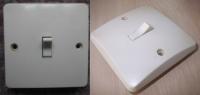
Yep Sparkwright - kind of a televsion screen shape but each edge with a minor arc facing into the centre - totally different from the socket plates. I have to agree about the second "angled rocker" version working upside down, certainly in the way it looks when in the respective on/off postions. In the pic below the dolly indicates off, yet the angled rocker indicates on (assuming they are not a 2 way)!

Although, if you were to glue about an inch of dowel to the centre of a current flat rocker design then it would point up for off and down for on, just like an original dolly! Woah... I've thought about this way too much!

First version and alternative version introduced from the 1963 catalogue. NB these pics are not from the catalogue. Sadly my second hand catalogue has been written in - right over the dolly plateswitch pic!


If you need to find a tradesperson to get your job done, please try our local search below, or if you are doing it yourself you can find suppliers local to you.

Select the supplier or trade you require, enter your location to begin your search.


Are you a trade or supplier? You can create your listing free at DIYnot Local

 
Back
Top