I am looking at a cheap and simple multimeter, and trying to work out what sampling rate does. I really want a meter with MIN/MAX display when measuring a car battery during engine start. I don't think this meter has the feature because of the price. But it does have a MIN and MAX indicator. These probably have something to do with the sampling rate. Can anyone explain what is the 6000 sampling rate about, and where/what do I use it for?


You are using an out of date browser. It may not display this or other websites correctly.
You should upgrade or use an alternative browser.
You should upgrade or use an alternative browser.
Multimeter sampling rate
- Thread starter DiyNutJob
- Start date
Sorry , nothing to do with sampling rate - it simple says maxium number the screem will show (never sure why not simply 9999.Can anyone explain what is the 6000 sampling rate about
So generally a 2000 Count Multimeter (3 ½ digit Multimeter) will have range 200.0 mV, 2.000 V, 20.00 V, 200.0 V.
The count refers to the limit of the highest value the Multimeter will display for each range.
So this is a 6000 Count Multimeter and will have range 600.0 mV, 6.000 V, 60.00 V, 600.0 V. 6000 V
Also this multimetyer does not seem to have a MAX MIN lock (no buttons to do that). Likley the screen has it to show something else.
And being auto ranging - it will be slow.
SFK
Last edited:
Here's a partial copy of the manual:

I won't make any comments about quality, or whether it meets standards, etc.
("CAT TV600V" anyone? )
)
However, sampling rate is "about 3 times per second":

The sampling rate refers to how often the meter retakes a measurement/updates its display.
The "6000 counts" refers to the display i.e. it could display 5.999V, before moving up to 6.00V
The Min/Max display doesn't relate to the sampling rate (much!).
...and looking at the manual, the meter doesn't have a min/max function. The LCD is generic, accounting for different models. It also includes elements for temperature and frequency, that this meter doesn't measure.
Personally, I would prefer a meter with a rotary selector, rather than relying on a button press.
Aneng M118A Multimeter manual : ANENG : Free Download, Borrow, and Streaming : Internet Archive
Handleiding vir een Aneng M118A Multimeter.
archive.org
I won't make any comments about quality, or whether it meets standards, etc.
("CAT TV600V" anyone?
)However, sampling rate is "about 3 times per second":
The sampling rate refers to how often the meter retakes a measurement/updates its display.
The "6000 counts" refers to the display i.e. it could display 5.999V, before moving up to 6.00V
The Min/Max display doesn't relate to the sampling rate (much!).
...and looking at the manual, the meter doesn't have a min/max function. The LCD is generic, accounting for different models. It also includes elements for temperature and frequency, that this meter doesn't measure.
Personally, I would prefer a meter with a rotary selector, rather than relying on a button press.
Last edited:
Also this Amazon meter does have a data hold with Max Min buttons.
But I am not sure it will do exactly what you need as these only take a few measurements a second.
So not enough data sets as you crank the car.
I would be using a scope.... or go old school with an Analogue Multimeter:
But I am not sure it will do exactly what you need as these only take a few measurements a second.
So not enough data sets as you crank the car.
I would be using a scope.... or go old school with an Analogue Multimeter:
Probably a combination of factors - some relating to the n bits in the ADC/time sampling circuits, and some relating to marketing and price points - 6000 counts is better than 4000, but not as good as 10000 etc.never sure why not simply 9999

- Joined
- 27 Jan 2008
- Messages
- 29,262
- Reaction score
- 3,591
- Location
- Llanfair Caereinion, Nr Welshpool
- Country

In the main we look at 9 volt being lower limit for cranking a car engine, but this will depend on the current used, many starters have bronze bushes which wear, and as the wear the armature gets closer to the pole shoes, and when the engine is cold the forces involved can bend the armature slightly so it touches the pole shoes, and the current required jumps up. It is called a lazy starter, but what it means is one measurement is not enough, need to measure both current and voltage.
For many years I used a Durite meter which one held onto the cable it had two positions to place cable, one for charging and one for cranking, very basic meter, and not accurate, but did the job, today I have a clamp on meter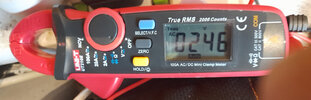 but limited to 100 amp, so still tend to use the old one first. As to what a multi-meter able to read 500 amp would cost not sure, but really does not need to be accurate, Screwfix to get 400 amp DC looking at £81, and no data hold. So this
 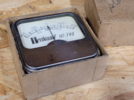 type is to my mind good enough. But it seems Durite no longer market them.
For many years I used a Durite meter which one held onto the cable it had two positions to place cable, one for charging and one for cranking, very basic meter, and not accurate, but did the job, today I have a clamp on meter
but limited to 100 amp, so still tend to use the old one first. As to what a multi-meter able to read 500 amp would cost not sure, but really does not need to be accurate, Screwfix to get 400 amp DC looking at £81, and no data hold. So this type is to my mind good enough. But it seems Durite no longer market them.I Should of thought of that - used have lots fun selecting and scaling ADCs.some relating to the n bits in the ADC/time sampling
I initially wondered why on earth the OP wanted to do this, since what primarily matters is whether or not the battery is able to satisfactorily turn the starter/engine - which one would know without undertaking any measurements.In the main we look at 9 volt being lower limit for cranking a car engine, but this will depend on the current used ...
However, it then occurred to me that the OP's interest might be in whether, during operation of the starter motor, the battery voltage remained high enough to power all the electronics which are these days needed for an engine to work.
Kind Regards, John
- Joined
- 27 Jan 2008
- Messages
- 29,262
- Reaction score
- 3,591
- Location
- Llanfair Caereinion, Nr Welshpool
- Country
Traditionally ignition coils were 9 volt, and a ballast resistor was used to reduce the voltage to 9 volt, which was bypassed when cranking.
I would have thought most essential devices would continue to work on 9 volt, things like petrol gauges were often 11 volt, and inverters were often designed to switch off at 11.8 volt to stop over discharge.
My energy meter has a poor refresh rate, but it still highlighted some thing switches on every day around midday I assume coms to Jaguar on my wife's car.
I would have thought most essential devices would continue to work on 9 volt, things like petrol gauges were often 11 volt, and inverters were often designed to switch off at 11.8 volt to stop over discharge.
My energy meter has a poor refresh rate, but it still highlighted some thing switches on every day around midday I assume coms to Jaguar on my wife's car.
These days, it's all about the electronic ignition, fuel injection, crankshaft/camshaft sensors, 'engine management systems' etc. etc. etc., (not to mention all of the 'security features') all of which are electronic and all of which are essential for the engine to run.Traditionally ignition coils were 9 volt, and a ballast resistor was used to reduce the voltage to 9 volt, which was bypassed when cranking. .... I would have thought most essential devices would continue to work on 9 volt, things like petrol gauges were often 11 volt, and inverters were often designed to switch off at 11.8 volt to stop over discharge.
If the starter is capable of turning the engine at a voltage lower than the minimum which any one of those electronic gizmos needs, the engine won't start, even those it has been turned satisfactorily by the starter motor. I gather this is all called "progress"

Kind Regards, John
The meter is very good if I didn't have a cheap meter already. It is much better than my 30 year old beginner's maplin meter. The MIN/MAX function is often available on the £20 price range meters. So, I will have to splash out for it.
Mine cranked with hesitation in 8Vs.In the main we look at 9 volt being lower limit for cranking a car engine
I am trying to run my coming up to 19 year old factory battery to infinity. So I am interested in the numbers for the terminal phase of the battery's life. My dash has a tiny display for various readings. The volt reading flashes by too quickly to be satisfactory. So, a min/max meter is needed. Also getting something better than what I have has been nagging at me at various times when I need to use the meter.I initially wondered why on earth the OP wanted to do this
As I've said, it's really not so much a matter of whether or not the battery can satisfactorily turn the engine over (since that will be obvious without any measurements) but, rather, whether the minimum voltage that will turn the engine over is adequate for all the electrnics which are essential to the engine actually running.Mine cranked with hesitation in 8Vs.
As above, I'm not personally convinced that 'the numbers' will necessarily help you all that much. As above, the two crucial questions are whether or not the battery can satisfactorily turn the engine and whether or not there is enough voltage during that period for the engine to actually start - regardless of the numbers - and, conversely, unless you know things I don't know, you would not know whether any particular 'number' would or would not be adequate for the vehicle's electronics to function satisfactorily.I am trying to run my coming up to 19 year old factory battery to infinity. So I am interested in the numbers for the terminal phase of the battery's life. My dash has a tiny display for various readings. The volt reading flashes by too quickly to be satisfactory. So, a min/max meter is needed. Also getting something better than what I have has been nagging at me at various times when I need to use the meter.
There would be something to be said for there being a second battery to run the electronics which was not involved in supplying power to the starter motor (which might not need much more than a diode to implement).
Kind Regards, John
My definition of a successful crank would be the engine running and car driving. So knowing the volt range for the crank cycle will give clues on whether the battery is degrading over time. Also knowing the voltage range for the recently maintained battery (through charging), will give clues on how close the in-use battery is needing maintenance. I am interested in the volt range when the battery becomes non-viable. I believe the numbers can be used for assessing the health state of different batteries, with the car being the constant.As I've said, it's really not so much a matter of whether or not the battery can satisfactorily turn the engine over (since that will be obvious without any measurements) but, rather, whether the minimum voltage that will turn the engine over is adequate for all the electrnics which are essential to the engine actually running.
Last edited:
Well, that's obviously the bottom line of 'what matters' but you will obviously know whether or not that is the case without making any measurements.My definition of a successful crank would be the engine running and car driving.
It probably will (depending upon the nature of the degradation). Some ageing batteries can start a car engine easily immediately after being charged, hence probably would have a very reasonable voltage during the starting process, but then cease to be able to start the engine a few hours or days later - clearly some sort of 'degradation', but not of a type which would necessarily be reflected in the initial 'voltage numbers'.So knowing the volt range for the crank cycle will give clues on whether the battery is degrading over time.
When you say 'maintenance', do you simply mean 'recharging', or are you talking of something more complex than that?Also knowing the voltage range for the recently maintained battery (through charging), will give clues on how close the in-use battery is needing maintenance. I
The ultimate indicator of a battery which has become 'non-viable' is presumably that it will not start the engine when newly charged and/or when it's ability to start the engine after a charge rapidly disappears.am interested in the volt range when the battery becomes non-viable.
I suppose that's true, provided that the batteries are very similar. The voltage of a battery with too low a current-supplying capacity (for the starter motor) would fall to a very low level if one tried to start the car with it, even the the battery were 'very healthy.I believe the numbers can be used for assessing the health state of different batteries, with the car being the constant.
Anyway, you clearly know what it is that interests you, so I wish you luck in finding a meter which can give you the numbers you'd like to see.
Kind Regards, John
- Joined
- 27 Jan 2008
- Messages
- 29,262
- Reaction score
- 3,591
- Location
- Llanfair Caereinion, Nr Welshpool
- Country
You interest me. Late 60's early 70's I was very interested with the lead acid battery, the jell battery used on radios in the second world war were still available and working, and it seems traction batteries used with milk floats were expected to last 25 years, it was only the car lead acid which seemed to have a short life.
It was the attempt to get high amps which reduced the battery life. There have been many attempts to extend the life, use of anatomy to hold the active material on the grid, then reduce it to stop gassing, and then the valve regulated lead acid also called absorbed glass mat.
The main problem now is over charging, once electrolyte or the water in the electrolyte is lost, there is no way to replace it, mounting in the boot helps, out of the engine heat, helps, but in the main it is engine management controlled charging.
This however only works if the car is in regular use, recharging a battery from mains, is diffrent, normally set around voltage, but fixed voltage is no good, need to equalise the cells, so pulse charging is main way, but even that can cause damage.
But it is clear to convert sulphate into acid takes time, there are no short cuts.
It was the attempt to get high amps which reduced the battery life. There have been many attempts to extend the life, use of anatomy to hold the active material on the grid, then reduce it to stop gassing, and then the valve regulated lead acid also called absorbed glass mat.
The main problem now is over charging, once electrolyte or the water in the electrolyte is lost, there is no way to replace it, mounting in the boot helps, out of the engine heat, helps, but in the main it is engine management controlled charging.
This however only works if the car is in regular use, recharging a battery from mains, is diffrent, normally set around voltage, but fixed voltage is no good, need to equalise the cells, so pulse charging is main way, but even that can cause damage.
But it is clear to convert sulphate into acid takes time, there are no short cuts.

DIYnot Local
Staff member
If you need to find a tradesperson to get your job done, please try our local search below, or if you are doing it yourself you can find suppliers local to you.
Select the supplier or trade you require, enter your location to begin your search.
Please select a service and enter a location to continue...
Are you a trade or supplier? You can create your listing free at DIYnot Local


