• Looking for a smarter way to manage your heating this winter? We’ve been testing the new Aqara Radiator Thermostat W600 to see how quiet, accurate and easy it is to use around the home. Click here read our review.

Steel container below the fusebox?

Joined
15 Mar 2023
Messages
10
Reaction score
0
Country
United Kingdom
Hi All,
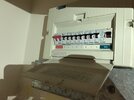
We live in a flat built in the 90s. Just under the consumer unit, we have a rectangle shaped metallic box which is slightly wider than the fusebox.
Do you know what this is and what is inside it? (Apologies, the picture is not the best, as it only shows the metallic box partially, but hopefully you can still see what I mean)

Thanks for your help!
j
 

Attachments

  • Fuseboard.jpeg
    Fuseboard.jpeg
    190.3 KB · Views: 244
That appears to be a piece of trunking and I expect it to only contain wires. I may be the result of extending the wires at a consumer unit unit change and contain lots of joints.
A wider photo may make it more obvious to us.
 
Steel wire armour (SWA) glands tend to warp the plastic of old consumer units, putting some trunking underneath it allows the use of SWA glands without warping the plastic. It is simply a box, nothing more.
 
That appears to be a piece of trunking and I expect it to only contain wires. I may be the result of extending the wires at a consumer unit unit change and contain lots of joints.
A wider photo may make it more obvious to us.
One would hope that trunking hasn't been used to contain electrical connections.
 
Because it's ****. Also the Wiring Rules in the south of Ireland are sensible enough to explicitly prohibit it. So that should be evidence enough that it's poor practice.
So please explain the difference between a folded sheetsteel box containing connexions and purchased from a shop and a bespoke folded sheetsteel box containing connexions and constructed out of parts purchased from the same shop.

From the initial description I would happily describe it as a bespoke enclosure provided for the purpose of extending the wiring, I have mentioned a wider photo may indicate if this is likely to be the situation.

In other words I'm proposing this may very well be an adaptable box that looks like trunking.
 
I took a closer look based on your comments and made some more pictures. It seems to me as if the thick cables were going into the consumer unit from a cavity in the wall and not from the trunking box. I might be wrong, but what's the point of the galvanised steel trunking box? Why not input the cables straight into the CU?
 

Attachments

  • CU_1.jpg
    CU_1.jpg
    157.1 KB · Views: 153
  • CU_2.jpg
    CU_2.jpg
    219.5 KB · Views: 132
  • CU_4.jpg
    CU_4.jpg
    206 KB · Views: 137
  • CU_3.jpg
    CU_3.jpg
    175.7 KB · Views: 144
Last edited:
I took a closer look based on your comments and made some more pictures. It seems to me as if the thick cables were going into the consumer unit from a cavity in the wall and not from the trunking box. I might be wrong, but what's the point of the galvanised steel trunking box? Why not input the cables straight into the CU?
That seems to rule out my thoughts of loads of connexions.
Other than taking off the lid - Which I do not recommend due to the risk of damage to wiring - we will never know. However I'll suggest it is (or possibly was) put there for a reason.
 
I had an installation with a piece of metal trunking passed by ECA and that had jointed cables in it.

There's no difference between that and an adaptable box, providing ingress protection is up to scratch.
 
Because it's ****. Also the Wiring Rules in the south of Ireland are sensible enough to explicitly prohibit it.
Prohibit what? - electrical connections within an earthed metal enclosure?

Do they have metal-cased CUs/DBs in that country and, if so, are they not allowed to have 'electrical connections' within them (and if not, how on earth do they use such things?) ?
 
I had an installation with a piece of metal trunking passed by ECA and that had jointed cables in it.

There's no difference between that and an adaptable box, providing ingress protection is up to scratch.
Replacing stage lighting dimmers in a school I had to extend 24 circuits cables. I used a piece of removed trunking, attatched it to the side of the trunking run with 4 brass bushes to form an enclosure to make the joints, I even added a dymo label.
It all had to be inspected, the inspector was of the same silly opinion it was not permitted and I was called back to alter it, he suggested I used 4 6"x4" adaptable boxes (some of the wires wouldn't have reached). The conversation bounced back and forth until the futility of the situation was accepted by him.
 
Replacing stage lighting dimmers in a school I had to extend 24 circuits cables. I used a piece of removed trunking, attatched it to the side of the trunking run with 4 brass bushes to form an enclosure to make the joints, I even added a dymo label. ... It all had to be inspected, the inspector was of the same silly opinion it was not permitted and I was called back to alter it, he suggested I used 4 6"x4" adaptable boxes ...
The world seems to have its fair share of people with very suspect brains!

Do you have any idea what explanation/justification your inspector, or the authorities in the south of Ireland, have for metal trunking to be apparently 'not allowed', whereas any other form of metal enclosure would seemingly be acceptable?
 
A metal or an insulated enclosure has or lacks properties to safely or unsafely make connections.
If it is made from a conductive enclosure such as metal then the only problem I can envisage is "Is the insulation sufficient?".
If yes the what is the problem?

If I had have said "What on Earth is the problem?" then somebody might start on about earthing or bonding, so I refrained from that bit. LOL.
 
I have seen a tendency, over many years, for electrical inspectors/assessors to make sound judgements that subsequently get misquoted or even completely misunderstood, I have seen inspectors/field officers often make pedantic totally irrelevant comments and determinations based on such non logic too - I`m talking most commonly of NICEIC mainly because for many years they were the most common organisation around, up to and including the advent of Part P. So, many myths became folklore.

"You can`t have two circuits on one fuse!" is one.
"A connection inside a metal enclosure must be bolted down securely and not left floating!" is another.

then you get the ordinary person totally misquoting a comment such as
"This cable only needs to be 2.5 but it has been done using 4.0 conductors" then becomes misquoted to "The inspector says the wrong cable has bee use so we have to rewire it all!"
 

If you need to find a tradesperson to get your job done, please try our local search below, or if you are doing it yourself you can find suppliers local to you.

Select the supplier or trade you require, enter your location to begin your search.


Are you a trade or supplier? You can create your listing free at DIYnot Local

 
Back
Top