Quality related ones like re-frozen ice cream?
I have actually been on a tour of a place doing ice cream - I vaguely recall it was a dairy and did other stuff like yoghurts etc.
If you just try freezing the mixed ingredients than you will get a "gritty" texture with ice crystals. The way it's normally done is the mix is passed down a metal tube that's cooled from the outside. Inside the tube is a scraper that rotates and scrapes the ice cream off the inside of the tube before large ice crystals can form, and by the time it comes out the other end it's "creamy" ice cream. I vaguely recall Kenwood did an ice cream maker attachment for the Chef - basically the same principle, keep the mix moving while a crushed ice & salt mix freezes it.
Much LED lighting is, AFAIK, fairly tolerant of voltage fluctuations, and frequency changes. But rough waveforms that don't look sine-wavey enough?
How long is your piece of string

Some will not be in the slightest bit bothered, some won't like it - and there's no real way to know other than to try it.
At one end of the spectrum, nothing in the lamp other than a rectifier, current limiting resistor, and a string of LED chips. These will vary in brightness with voltage, so as the fridge starts and stops, your lights will change brightness.
Others use a capacitor (before the rectifier) to drop the voltage. In principle these will pass more current with a choppy waveform. Enough to be a problem, no idea.
Then you get to the ones that are basically an SMPS and a bunch of LED chips, I would expect these to be very forgiving - unless the waveform it's fed tricks it into thinking it's behind a dimmer.
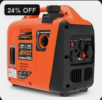
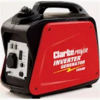
I've run a fair bit of kit off my genny (cheap, "unbranded" frame type) over the years - that includes taking laptop and (laser) printer with me to run a motorsport event, or taking my genny to a client to run their servers during a planned power outage. Most IT kit has an SMPS at the input, and these are generally fairly tolerant of both voltage and waveform.
The biggest problem I've ever had with it was with a kettle ! With no load, adding a 3kW kettle (it's a 3kW genny) could make it get "bogged down". Apply the load, the genny ups the output power, load slows the engine, and it's basic (mechanical) auto throttle can't react quickly enough. So it finds itself on the back of the engine's torque curve, well below normal speed, and with insufficient torque to get back up to normal speed. But that's quite an extreme case - from 0 to 100% load instantaneously.
Ah, now it gets interesting.
This is all heresay, but in various places I've read of some boilers being a bit finicky about the power supply. Apart from waveform, apparently some are really finicky about the neutral being earthed - something to do with the flame detection system. So some gennys will be a problem as they aren't 0-220V with neutral tied to earth, but 55-0-165V with the centre tap of one 110V winding earthed.
Is an inverter generator a safer bet than a basic one and a good external inverter?
Good question. I would suggest internal to the genny or external is more down to inverter quality and how it's output interacts with the load than where it is physically located. But, an inverter attached to a battery has a much more stable supply than one supplied directly from a genny.
With no inverter, i.e. a basic "bring the windings out to a socket" type, I wouldn't expect problems as the waveform should be sine wave (or at least a sine wave with perhaps some distortion) as that's inherent to the machine.
Inverters come in many types - but it's common to generate a variable width pulse at a higher than mains frequency so that when it's smoothed it is sine wave (this is nice and cheap to do), cheaper still is a basic square wave. I'd expect both of these to create problems with at least some loads.
Pure sine wave inverters are the ideal, but they were harder to build and cost more. These days the power electronics is so cheap that I'd expect most to be pure(ish) sine wave.



 ) when they drafted the legislation outlawing unlicensed factional distillation - but I don't know if that's true!