Under sink tap

Joined
18 Apr 2025
Messages
15
Reaction score
0
Country
United Kingdom
Howdy!


In my kitchen under the sink I would like to install a tap for using a power washer. The reason I’m thinking of adding it under the sink rather than outside is that it saves some of the work cutting and running it all through the outside wall. Also wouldn’t need to worry about the pipe freezing over in the winter.

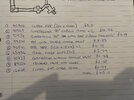
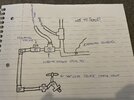
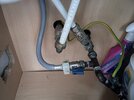
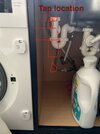
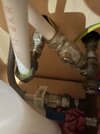
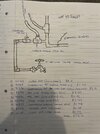
I’ve added some photos of under my sink as it is and a quick sketch and parts list.

I was thinking of adding a tee valve in place of the existing isolator that currently goes into the washing machine feed and then adding a separate isolating valve for the new tap so that a) I can work casually on the sections after the bale with no rush once it’s fitted b) if there are any issues later down the line I can simply isolate the tap.

I was considering mounting the tap to the inside of the cupboard next to the washing machine (as my superb art skills show in the pic) but wasn’t sure if this would have the strength to hold it.

Any thoughts/suggestions welcome.

Have I covered everything?
 

Attachments

  • IMG_8822.jpeg
    IMG_8822.jpeg
    288.4 KB · Views: 51
  • IMG_8821.jpeg
    IMG_8821.jpeg
    288.9 KB · Views: 44
  • IMG_8820.jpeg
    IMG_8820.jpeg
    284.4 KB · Views: 40
  • IMG_8733.jpeg
    IMG_8733.jpeg
    266.5 KB · Views: 39
  • IMG_8731.jpeg
    IMG_8731.jpeg
    209.7 KB · Views: 53
  • IMG_8722.jpeg
    IMG_8722.jpeg
    233.5 KB · Views: 48
I cut up some polystyrene and stuck together with silicone. It covers the outside tap in winter. I never turn outside tap off. Just seems daft to do that imo. I need the tap all year

I'd run tap outside. I'd not want one under sink. They leak a bit when being used and you won't know. If you can't fit yourself get local plumber. Have ago yourself. Don't dog things up though all keen or you will have leaks.


Tap cover.
1000012931.jpg
 
I appreciate the reply but I should have also made it clear that I can’t have an outside tap due to what’s on the other side of the wall, it’s a small space at the front of the house and I have things in front of the wall that can’t be moved/worked around.
Thats why I was going for the inside option
 
You can feed a power washer from an outside water butt or a portable plastic container.
 
You can feed a power washer from an outside water butt or a portable plastic container.
True but has to be above the height of washer, needs a filter and wouldn’t have the same pressure as a tap.

Any reason my original plan of an internal tap would not work?
 
The issue with the tap is not with it but with what is connected to it, if you are using say a hozelock plug on connector they can fail suddenly... who has not had a gusher and they can also drip in use even if properly connected. Also as the tap is under a cupboard these too can drip and fail with no route to the drain.

You might be better off fitting a good lever ball or gate valve with complete isolation and then fit enough hose using a permanent coupling to get you out the house to the hozelock.

I would also fit a one way check valve to prevent any back flow.
 
The issue with the tap is not with it but with what is connected to it, if you are using say a hozelock plug on connector they can fail suddenly... who has not had a gusher and they can also drip in use even if properly connected. Also as the tap is under a cupboard these too can drip and fail with no route to the drain.

You might be better off fitting a good lever ball or gate valve with complete isolation and then fit enough hose using a permanent coupling to get you out the house to the hozelock.

I would also fit a one way check valve to prevent any back flow.
Thank you, that’s exactly why I was after.

Maybe I will try and work around the permanent fixtures outside after all.

Any tips for an outside tap if I can go down that route after all?
 
Also can I still run an outside tap with the same items I suggested in my original post and fit a tee valve instead of the isolator that already feeds into the washing machine?
 
Err not really tee valves are for dual appliances eg a dish washer and a washing machine.

I would take a feed to where you want the tap, is the kitchen the closest point with a cold water feed... do you have a downstairs loo ?
 
Err not really tee valves are for dual appliances eg a dish washer and a washing machine.

I would take a feed to where you want the tap, is the kitchen the closest point with a cold water feed... do you have a downstairs loo ?
Yeah kitchen is the closest point to the cold water feed and no downstairs loo.

Looking at the photos where would it be best to run it off of and what would I need?
 
You can tee off where you find it easiest...ie just before the washing machine connector.As for bits... whats your skill level. All Plastic is the easiest, compression fittings and plastic pipe, all copper and compression, or soldered copper fittings and pipe in ascending order of difficulty.

If the outside world is behind that cupboard, drill through the wall and run some clipped insulated ( ie the round foam stuff ) pipe along to where you want the tap.

So a tee, isolator and double check valve ( or if space is tight a combined one - https://www.bes.co.uk/double-check-valve-with-isolation-valve-15mm-15584/ ) pipe, elbows, clips and insulation and the tap.
 
You can tee off where you find it easiest...ie just before the washing machine connector.As for bits... whats your skill level. All Plastic is the easiest, compression fittings and plastic pipe, all copper and compression, or soldered copper fittings and pipe in ascending order of difficulty.

If the outside world is behind that cupboard, drill through the wall and run some clipped insulated ( ie the round foam stuff ) pipe along to where you want the tap.

So a tee, isolator and double check valve ( or if space is tight a combined one - https://www.bes.co.uk/double-check-valve-with-isolation-valve-15mm-15584/ ) pipe, elbows, clips and insulation and the tap.
Thank you, that’s perfect.

I’m thinking copper compression fittings throughout as I guess i’m going to have to run copper through the wall anyway and was thinking of using a hose union back plate for a nice finish on the outside and to fit the tap to.

If I was running a hose using back plate with copper pipe included I assume I would still need the insulation. How thick should the installation be and is there an easy way to run it through the wall or just get the hammer drill out with masonry bit and take my time?
 
If I know roughly where the pipe will be going in and there are no services in that area could I go from outside and drill in?

Last couple of questions I promise!

The pipe has earthing, does that mean I need to turn off the electrics whilst fitting the tap?

Can the tee come off any run of pipe where there is most room and it’s convenient for space or does it have to be a in a certain place after/before certain fittings?
 
Sorry been at work... no you do not need to turn off the electricity unless you disconnect the earth strap, tee off where is easiest and to be fair the side you drill from is really a question of where you can best do it from so the pipe work lands in the right place.
 

If you need to find a tradesperson to get your job done, please try our local search below, or if you are doing it yourself you can find suppliers local to you.

Select the supplier or trade you require, enter your location to begin your search.


Are you a trade or supplier? You can create your listing free at DIYnot Local

 
Back
Top