• Looking for a smarter way to manage your heating this winter? We’ve been testing the new Aqara Radiator Thermostat W600 to see how quiet, accurate and easy it is to use around the home. Click here read our review.

Getting electric shocks in kitchen - immediately after walls have been plastered. (Only when contact made with fresh plaster)

Joined
9 Jan 2025
Messages
15
Reaction score
2
Country
United Kingdom
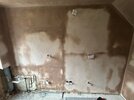
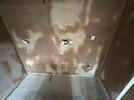
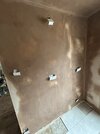
Having kitchen refurbished. Got to the stage where old kitchen cupboards ripped out and had to replace some plasterboard sheets as the olds tiles had ripped them to pieces. All was good up to today when the kitchen was plastered and now I seem to get a small electric shock when touching any of the fresh plaster. I do not receive any shock when touching old plaster next to the fresh plaster. To note, the RCB in the fuse box doesn't go when I get these shocks.

I have checked each socket and they are all secure and no bare cores in contact with the wall.

Any ideas on what this could be? Is it possible the issue will phase off as the plaster dries out? My thoughts are to go over each socket connections and then let the plaster dry out and test for shocks in a couple of days…if it persists then I will contact an electrician.
IMG_3312.jpeg
IMG_3310.jpeg
 
I've had that happen when there was a bare wire in wall and the damp plaster acted as a conductor.

You need to trace the fault.
Probably need an electrician if you can't find it yourself.

Cable locator will help
 
I'm not disagreeing with tracing the fault, but when the plaster dries there probably won't be any more shocks!
On the other hand, feeling the plaster in various places might lead you to the rough area of the damaged cable. Perhaps an electrician with the appropriate meter will locate the area more precisely?
 
I think by probing the wall with a meter and noting voltage to earth, you could find out where the voltage is highest, possibly zeroing in on the fault.

A nail or screw penetrating a cable is a likely cause.

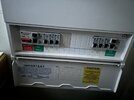
Please show us a photo of your "fuse box" with the lid open, and the thing you call an "RCB."
 
Any ideas on what this could be?
Per John, I'd say a fixing penetrating a wire. Disconnect one wire from each socket so you can test runs individually to give an idea of fault location. As cables run in safe zones then check each safe zone for screws using a magnet, and look to remove said screw
 
I think by probing the wall with a meter and noting voltage to earth, you could find out where the voltage is highest, possibly zeroing in on the fault.

A nail or screw penetrating a cable is a likely cause.

Please show us a photo of your "fuse box" with the lid open, and the thing you call an "RCB."
Hi JohnD,

I’ll try and have a go doing that. I’ll report back what I find. As you can see the plaster is already starting to dry already.

Here’s the photo of the fuse box…
 

Attachments

  • IMG_3315.jpeg
    IMG_3315.jpeg
    225.9 KB · Views: 76
  • IMG_3317.jpeg
    IMG_3317.jpeg
    270.8 KB · Views: 78
  • IMG_3316.jpeg
    IMG_3316.jpeg
    238.6 KB · Views: 61
  • IMG_3318.jpeg
    IMG_3318.jpeg
    238.7 KB · Views: 81
I'm not disagreeing with tracing the fault, but when the plaster dries there probably won't be any more shocks!
On the other hand, feeling the plaster in various places might lead you to the rough area of the damaged cable. Perhaps an electrician with the appropriate meter will locate the area more precisely?
Hi JBR,

Thanks. I will try a few methods and if no luck then I will get a plasterer. But as you said, If the plaster dries then shocks should disappear.
 
Hi JBR,

Thanks. I will try a few methods and if no luck then I will get a plasterer. But as you said, If the plaster dries then shocks should disappear.
The shocks should disappear, but the fault that is causing it will remain. I'd want to know what's causing it The last thing you want is a fire because of a damaged cable to a cable to fail and a load of disruptive work have to be done to find the fault once the kitchen and decoration is complete.

An electrician should be able to isolate the fault fairly easily.
 
For a person to get a significant shock there has to be two points of contact to the person. To receive a shock these two points have to be at different potentials ( voltages ) such as Live and Earth

The exception is when the shock is a short duration shock caused by the discharge of static electricity that has built up on the person's body.

If the "shock" from the wet plaster is short duration then it is possible that it is a discharge of static electricity that has built up on the person's body/clothing and not due to a fault in the house wiring,

Walking on what appears to be a sheet of plastic floor protection could be the source of the static electrical charge on the person's body,
 
The shocks should disappear, but the fault that is causing it will remain. I'd want to know what's causing it The last thing you want is a fire because of a damaged cable to a cable to fail and a load of disruptive work have to be done to find the fault once the kitchen and decoration is complete.

An electrician should be able to isolate the fault fairly easily.
I agree. I'd call in an electrician who can isolate the problem BEFORE the plaster dries!
 
For a person to get a significant shock there has to be two points of contact to the person. To receive a shock these two points have to be at different potentials ( voltages ) such as Live and Earth

The exception is when the shock is a short duration shock caused by the discharge of static electricity that has built up on the person's body.

If the "shock" from the wet plaster is short duration then it is possible that it is a discharge of static electricity that has built up on the person's body/clothing and not due to a fault in the house wiring,

Walking on what appears to be a sheet of plastic floor protection could be the source of the static electrical charge on the person's body,
I agree with bernardgreen.

While you should not use yourself as a test device,
nest time that you receive such a shock (when you touch the wet plaster),
stand perfectly still - do not move your feet - and touch the plaster again.

If the second time you touch the wet plaster you receive no shock,
what you experienced was a static discharge and not an electrical fault.

However, if repeated "touching" (while not moving) produces the same "shock",
there is some (extremely difficult to understand) electrical fault !


Further:-
We do not know if you are male or female !
If female, it is more likely that you may be waring synthetic "clothing".
If so, such clothing is likely to generate a Static Electrical charge - especially if the weather is warm and dry.

While I am male and not prone to waring synthetic clothing, at one time I was working in an office building which has been newly refurbished - with synthetic material carpets.
At the same time, I was waring a new pair of shoes - with synthetic soles.
Whenever I touched the Lift Button with my finger (when leaving the building) I received a Static Electrical shock.

After the first couple of times, I did not use my finger to touch the Lift Button
but used a coin or a key to do this,
so that I would not feel the Static Discharge.
 
Hi everyone,

Thank you for all the advice and comments.

I spent the majority of yesterday cleaning about metal backboxes and inspecting and resecuring all the wires in each socket. I always added an earth cable to bond my water supply as the existing cable had been damaged. I then went out a bought a non contact voltage tester. I ran the voltage tester around the wall in the areas I knew I screwed in plasterboard (specifically in the electrical zones) and the pen started lighting up. I removed the screw and then called an electrician round just to be sure. No more shocks are occurring and when the Electrican did his tests, he said everything was normal and nothing out of the ordinary. Apparently 3-4 volts on the plaster, which is apparently normal? So I believe it to be the screw I removed as it could have nicked a wire.

I’ll keep checking for shocks over the coming days but I believe the issue has been rectified…fingers crossed.

Thanks all.
 
Hi everyone,

Thank you for all the advice and comments.

I spent the majority of yesterday cleaning about metal backboxes and inspecting and resecuring all the wires in each socket. I always added an earth cable to bond my water supply as the existing cable had been damaged. I then went out a bought a non contact voltage tester. I ran the voltage tester around the wall in the areas I knew I screwed in plasterboard (specifically in the electrical zones) and the pen started lighting up. I removed the screw and then called an electrician round just to be sure. No more shocks are occurring and when the Electrican did his tests, he said everything was normal and nothing out of the ordinary. Apparently 3-4 volts on the plaster, which is apparently normal? So I believe it to be the screw I removed as it could have nicked a wire.

I’ll keep checking for shocks over the coming days but I believe the issue has been rectified…fingers crossed.

Thanks all.

If your screw had penetrated a cable, the cable is damaged and has not been rectified.

Did you point out the screw to the electrician?

3 or 4 volts will not have given you a shock or been detectable with your finger.
 
While I am male and not prone to waring synthetic clothing, at one time I was working in an office building which has been newly refurbished - with synthetic material carpets.
At the same time, I was waring a new pair of shoes - with synthetic soles

A new build office building in London had a serious problem with staff receiving shocks from static electricity.

The "high tec" solution was to install discharge pads around the place. A metal plate grounded via high value resistor allowed the person to touch the pad and discharge themselve slowly with out any sensation of a shock.

The low tech solution was provided by a cleaner, this was to spray the carpets with a dilute solution of Comfort Fabric Condition every so often. This made the carpet conductive enough to dissapate / prevent the build up of static charges.
 

If you need to find a tradesperson to get your job done, please try our local search below, or if you are doing it yourself you can find suppliers local to you.

Select the supplier or trade you require, enter your location to begin your search.


Are you a trade or supplier? You can create your listing free at DIYnot Local

 
Back
Top