• Looking for a smarter way to manage your heating this winter? We’ve been testing the new Aqara Radiator Thermostat W600 to see how quiet, accurate and easy it is to use around the home. Click here read our review.

Add light switch to garage

Joined
28 Nov 2014
Messages
12
Reaction score
0
Location
Clwyd
Country
United Kingdom
Hi all,

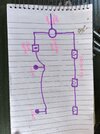
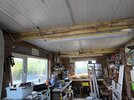
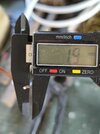
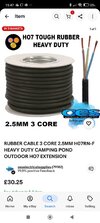
I'm planning to run a cable from the house to the garage to power a few sockets and a few lights. The load cable will be a 2.5mm 3 core H07RN-F which will go into a junction box in the garage and from there will continue to the sockets. For the sockets I used a 1.9mm?(thats what the calliper says) flat twin and earth cable.I'll mainly use sockets for general DIY like using mitre saw,chargers and ocasionally the table saw.For the lights I used a round 2x1.5mm2 cable.My question is,can I add a light switch so I can turn the lights on/off or shall I put a plug at the end of light cable and plug them into a socket?I have added a sketch that hope it makes sense? Thanks
 

Attachments

  • 1746714341117.jpg
    1746714341117.jpg
    331.4 KB · Views: 69
  • 1746715786090.jpg
    1746715786090.jpg
    420.9 KB · Views: 63
  • 1746715786108.jpg
    1746715786108.jpg
    219.5 KB · Views: 51
  • 1746715786120.jpg
    1746715786120.jpg
    239.6 KB · Views: 53
  • 1746715786130.jpg
    1746715786130.jpg
    99 KB · Views: 53
  • 1746715786137.jpg
    1746715786137.jpg
    392.4 KB · Views: 60
  • Screenshot_2025-05-08-15-47-30-522_com.ebay.mobile.jpg
    Screenshot_2025-05-08-15-47-30-522_com.ebay.mobile.jpg
    132.7 KB · Views: 51
Its 2.5mm not 1.9mm.

Why a junction box? Why not straight into first socket?

You can either use a switched FCU or plug them in that's up to you.

Oh and it will all need rcd protection
 
I think it will be easier to turn lights on from the switch rather than from a socket. If there was no light switch I would have used a double socket instead of junction box and plug everything in. But I like the idea of having the light switch and I'm not sure how/where to connect all the wires. Would anyone be able to explain to me how it should all be connected? Many thanks
 
Firstly, the cable from the house needs adequate protection. It has to be protected by an RCD somewhere, probably in the house consumer unit. It has to have adequate overcurrent protection at source, either a fused spur at 13 amp or again at the house consumer unit. 2.5 mm could have as high as 20amp protection.
It then has to have suitable mechanical protection or be out of the way of damage on its run to the garage. It could be done in armoured cable, metal or plastic conduit. But you wouldn't be able to simply bury that type of cable, and if it is run along a wall, it needs protection from damage.
In the garage, take the cable to the first socket somewhere near the entrance door. As well as running to the next socket, also come of it to a switched fused spur mounted right next to it. Use the load side of that spur for your lighting circuit, fused down to 5amp in the spur. You could actually use 1mm cable for this.
Again, cables should be protected from damage. Plastic conduit of trunking is good for this and quite cheap.
FYI cable sizes are in square mm and can be calculated by measuring the diameter of the conductor, halving it for its radius. Then using the formula Pi x radius squared, or 3.142 x radius squared.
 
You might want to double check those striplights, the yellow case usually indicates they're for a 110v building site supply. Some of the new LED versions are universal (100-240v) but older fluorescent ones will be permanently damaged if connected to the wrong supply voltage.
 
Last edited:
What are you connecting this new cable to at the house end ?
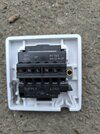
I was goin to plug into a single socket where the hob extractor was. Not using it anymore. But I can swap the socket to this spur instead if is better?
 

Attachments

  • IMG_20250509_205817.jpg
    IMG_20250509_205817.jpg
    259.6 KB · Views: 28
You might want to double check those striplights, the yellow case usually indicates there for a 110v building site supply. Some of the new LED versions are universal (100-240v) but older fluorescent ones will be permanently damaged if connected to the wrong supply voltage.
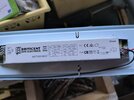
They are from a building site. It was end of the job and they were taking temps out,these lights were on corridors and they out them in the bin. So I salvaged them. They are LEDs and they work on 240. I connected them to an extension lead and they lit up.This is on the back. Are they ok to stay in the garage or shall I change them? Thanks
 

Attachments

  • IMG_20250509_205637.jpg
    IMG_20250509_205637.jpg
    162.3 KB · Views: 39
You're fine with those ones, they're OK on anything from 100 to 277v

If they weren't universal voltage ones, you'd know about it by now if you've already plugged them in! Older style ones probably wouldn't have survived more than a few seconds.
 
Firstly, the cable from the house needs adequate protection. It has to be protected by an RCD somewhere, probably in the house consumer unit. It has to have adequate overcurrent protection at source, either a fused spur at 13 amp or again at the house consumer unit. 2.5 mm could have as high as 20amp protection.
It then has to have suitable mechanical protection or be out of the way of damage on its run to the garage. It could be done in armoured cable, metal or plastic conduit. But you wouldn't be able to simply bury that type of cable, and if it is run along a wall, it needs protection from damage.
In the garage, take the cable to the first socket somewhere near the entrance door. As well as running to the next socket, also come of it to a switched fused spur mounted right next to it. Use the load side of that spur for your lighting circuit, fused down to 5amp in the spur. You could actually use 1mm cable for this.
Again, cables should be protected from damage. Plastic conduit of trunking is good for this and quite cheap.
FYI cable sizes are in square mm and can be calculated by measuring the diameter of the conductor, halving it for its radius. Then using the formula Pi x radius squared, or 3.142 x radius squared.
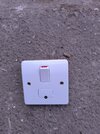
I was going to just plug it into a socket in the kitchen,but I can swap the socket to this spur if is better(see picture).
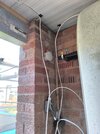
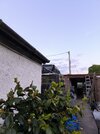
The cable is cable tied to a wire that I put up between kitchen corner and garage(see picture). I can get some flexy conduit and wrap the cable in it if that helps.
I can add another spur with a 5amp fuse right next to the junction box ,and run the light off that.But this is where I'm getting stuck.conecting the load cable , sockets cable and lights cable together.

Thank you very much for your help.

And thank you to everybody for their input. Much appreciated
 

Attachments

  • IMG_20250509_211446.jpg
    IMG_20250509_211446.jpg
    316.1 KB · Views: 41
  • IMG_20250509_205817.jpg
    IMG_20250509_205817.jpg
    259.6 KB · Views: 36
  • IMG_20250509_205856.jpg
    IMG_20250509_205856.jpg
    311.4 KB · Views: 36
If you are going down the junction box route instead of using a socket then WAGO connectors are ideal for 2, 3 or 5 way connecting.
 
Do you mean without an earth?
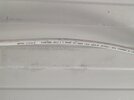
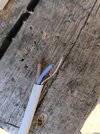
Sorry,it does have a 3rd bare wire,but it's not copper wire,it's silver colour. The other 2 have blue and brown colours . Is it ok to use? Thank you
 

Attachments

  • IMG_20250510_074708.jpg
    IMG_20250510_074708.jpg
    463.2 KB · Views: 42

If you need to find a tradesperson to get your job done, please try our local search below, or if you are doing it yourself you can find suppliers local to you.

Select the supplier or trade you require, enter your location to begin your search.


Are you a trade or supplier? You can create your listing free at DIYnot Local

 
Back
Top