• Looking for a smarter way to manage your heating this winter? We’ve been testing the new Aqara Radiator Thermostat W600 to see how quiet, accurate and easy it is to use around the home. Click here read our review.

Systematic procedure for tracing repeated fuse blowing in domestic 5 amp lighting.

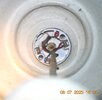
Hard to tell exactly, but does the hall rose have thermal damage?

It's possible that the blue wire has shorted onto the bare reds. Certainly seams to be the worst point. (or even brown to red if reversed LN)

It can't really just be plastic yellowing, as the other side of the terminal block looks fine.

I also find it interesting that there are no screws holding the rose up, and it has shifted a little.

No earth sleeve that I would expect to see with that age cable and CU.

Has someone being trying to replace the hall light?

 
Last edited:
As I keep saying; non contact and led/neon screwdrivers are useful. Like any tool you need to learn how to use them to get the best out of them.

Exactly, which was why I suggested buying one, and having a bit of practise with it, to see how they work.

But first we need more pictures of the roses, to see if they really are looped (as my test method requires), or if there is some hidden junction box.

I've already suggested that, because the that one photo, might not be typical of the rest of the installtion.

Yeah I can see a volt stick being some use. (do they work taped to a wooden pole?), or at the switches.

A volt stick will work on the end of anything, or nothing. You can just rest the volt stick in proximity to a live part, and it will trigger. They will not trigger, if there is any none-live metal-work, between them and the stick, for instance.... They will trigger in proximity to a live plastic 13amp socket, but not with a similar metal faced socket.
 
It can't really just be plastic yellowing, as the other side of the terminal block looks fine.

I also find it interesting that there are no screws holding the rose up, and it has shifted a little.

I would suggest the brown, is due to their being a heavy smoker in the house, at some point in history. The smoky air flow, has been drawn up through the flex hole in the cover, and up through the hole in the ceiling, condensing on the backplate.

The recessed fixing screw sockets, are white, suggesting the screws have recently been removed.
 
Yeah I can see a volt stick being some use. (do they work taped to a wooden pole?), or at the switches.
I once taped a piece of 1mm CPC to the end of the neon screwdriver to reach the ceiling rose terminals as they were too small for the end of my neon screwdriver. It was much simpler than probing around with a multimeter but one should know the limitations of using one and that is a broken neutral.
 
It's possible that the blue wire has shorted onto the bare reds. Certainly seams to be the worst point. (or even brown to red if reversed LN)

It can't really just be plastic yellowing, as the other side of the terminal block looks fine.

I also find it interesting that there are no screws holding the rose up, and it has shifted a little.

No earth sleeve that I would expect to see with that age cable and CU.

Has someone being trying to replace the hall light?

I would suggest the brown, is due to their being a heavy smoker in the house, at some point in history. The smoky air flow, has been drawn up through the flex hole in the cover, and up through the hole in the ceiling, condensing on the backplate.

The recessed fixing screw sockets, are white, suggesting the screws have recently been removed.
Thanks for your thoughts re: smoking - this is good detective work: prior to my purchase of the properties the ground floor flat had been let out to numerous tenants back in the days when 'everybody used to smoke'..
The 'no screws and shifted position' is also correct - the plastic rose cover wouldn't shift until I gave it some chipping away at the layers of plaster and/or paint around the edge - after a while the whole assembly came away from the (lath?) support.

Photos as requested of the hallway next to the fuse-box and the ceiling fitting in the adjacent room. The hall wiring ‘hall rose 01’ has two three-way cables coming from the fuse-box, the red wires seem to be joined in a screw-block, while the black wires go one to each wire in the light cord bayonet, and nowhere else. There seems to be a smudge marking between the two red wires and a smaller red wire going from left red wire up into terminal block. What to make of this I cannot guess. From the average of your remarks the finger of suspicion seems to be pointing at the discoloured old wires from which the hall bayonet is hanging. Would it be instructive to just unscrew and remove the wire and then put a new fuse in and fire up the 5A circuit. Can't hurt and I've got a box full of cartridge fuses.

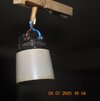
The adjacent ‘rose room 02’ is wired more simply, and appears to be the end of the line, as there are only the three wires from, I assume, the more complex wiring in the ‘hall rose 01’ - just earth, red and black, connected to the dangling bayonet more modern cord coloured blue and brown. This was the socket that was ‘ON’ when the fuse blew. Again, competently wired but no earth sleeving - well, it was the seventies, as if that was ever an excuse for anything.
 

Attachments

  • rose-room-02.JPG
    rose-room-02.JPG
    260.5 KB · Views: 30
  • socket-hanging-02.JPG
    socket-hanging-02.JPG
    176.9 KB · Views: 28
AndyPRK you eagle-eyed spotter!
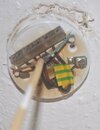
On the hallway ceiling rose 01 you saw where the black wire crossed over the un-sleeved bare earth wire and up close I could see it too - you couldn't get a fag paper between them.
I grabbed a reel of earthing tape and with tweezers managed to slip some tape behind the black wire, thus insulating it from the bare earth. With fuse replaced I switched 'on' the fuse-box - no bang, no nothing. I replaced one of the light bulbs and flicked it 'on' - it worked!
photo of successful temporary fix attached.
Success! - many, many thanks to all contributors, this website certainly lives up to its name.
 

Attachments

  • black-wire-insulated.JPG
    black-wire-insulated.JPG
    164.4 KB · Views: 33

If you need to find a tradesperson to get your job done, please try our local search below, or if you are doing it yourself you can find suppliers local to you.

Select the supplier or trade you require, enter your location to begin your search.


Are you a trade or supplier? You can create your listing free at DIYnot Local

 
Back
Top