• Looking for a smarter way to manage your heating this winter? We’ve been testing the new Aqara Radiator Thermostat W600 to see how quiet, accurate and easy it is to use around the home. Click here read our review.

Water Penetration New Build

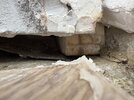
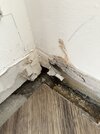
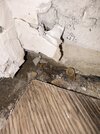
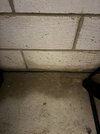
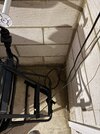
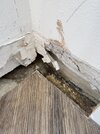
Site manager agreed to cut the damp skirting board off yesterday so we could atleast see if anything was going on and give it a chance to dry out using a dehumidifer.

I said we would leave it for a few weeks and monitor before being comfortable to repair the skirting and plaster board.

PS, what's the polystyrene all about?
 

Attachments

  • IMG_3439.jpeg
    IMG_3439.jpeg
    473.8 KB · Views: 51
  • IMG_3440.jpeg
    IMG_3440.jpeg
    379.4 KB · Views: 49
  • IMG_3441.jpeg
    IMG_3441.jpeg
    240.5 KB · Views: 48
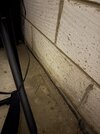
The polystyrene is the upstand insulation. Before pouring the concrete floor they put a slab of insulation under it, and thinner slabs leaning against the walls, level with the floor. Its purpose is to prevent cold-bridging, there would be a cold point between the wall and floor insulation otherwise where they only just meet. I'm surprised it's polystyrene though, it's normally better performing PIR/PUR foam these days.

I can see the black DPM popping up from under the floor at the edge and going into the wall, so all looks OK there.

Wait and see what happens.
 
The polystyrene is the upstand insulation. Before pouring the concrete floor they put a slab of insulation under it, and thinner slabs leaning against the walls, level with the floor. Its purpose is to prevent cold-bridging, there would be a cold point between the wall and floor insulation otherwise where they only just meet. I'm surprised it's polystyrene though, it's normally better performing PIR/PUR foam these days.

I can see the black DPM popping up from under the floor at the edge and going into the wall, so all looks OK there.

Wait and see what happens.
Well that's my knowledge gone up a level. Would never of thought that.

They have probably gone with the cheapest option knowing the new house builder.

Do you think i need to do anything once dried out? does the polystyrene need concrete back over it so it cannot be seen or is how it currently is fine?
 
It needs to be bare, it's fine as-is.

Your concrete floor and all the insulation under it sits within a sealed polythene tray, you can see the edge of it going into the wall. If it's had a few gallons of water poured into it then it will be sitting within the concrete and insulation in this sealed container so may well take a long time to try, as the only way out is evaporation into the room above.
 
Just back from a week away and checked to see if it had dried out any further. Seems not…… we have some little friends appear.
 

Attachments

  • IMG_4066.jpeg
    IMG_4066.jpeg
    352.1 KB · Views: 56
OP,
On my screen the "little friends" seem to be stalk and cup mushrooms - is there a mushroom smell?
Various mushrooms are involved with decaying timber including Dry Rot conditions.
However afaik, nine months is a short time for Dry Rot to flourish?

If you carefully removed the loose debris from the open flooring "channels" then more could be perhaps seen of the DPM &/or DPC?
 
OP,
On my screen the "little friends" seem to be stalk and cup mushrooms - is there a mushroom smell?
Various mushrooms are involved with decaying timber including Dry Rot conditions.
However afaik, nine months is a short time for Dry Rot to flourish?

If you carefully removed the loose debris from the open flooring "channels" then more could be perhaps seen of the DPM &/or DPC?
9 months would be a short time but those mushrooms were not present a week ago before we went away. I do believe we’ve had plenty of rain days so maybe this accelerated the growth.

I’ll let the house builder know and they can do the investigating rather than myself.

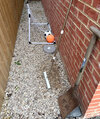
Also just checked outside and it’s either a coincidence or something of nothing but there’s clearly a distinct difference between dry and wet stones here oddly enough.
 

Attachments

  • IMG_4099.jpeg
    IMG_4099.jpeg
    2.3 MB · Views: 38
Last edited:
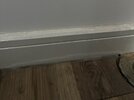
Still waiting for these clowns to sort this out but at the same time, I’ve also noticed the opposite side of the house, particularly in the garage has a damp floor down one side and also some skirting in the downstairs wc.
 

Attachments

  • IMG_4864.jpeg
    IMG_4864.jpeg
    355.1 KB · Views: 29
  • IMG_4865.jpeg
    IMG_4865.jpeg
    427.7 KB · Views: 29
  • IMG_4867.jpeg
    IMG_4867.jpeg
    377.7 KB · Views: 27
  • IMG_4870.jpeg
    IMG_4870.jpeg
    160.4 KB · Views: 29
Damp in a garage is fairly normal, as the floor is lower than the DPC, as it has to be so that potential fuel/oil spills from a car don't trickle into the adjoining house. Sadly this just how it is.
 
Any reason why it wasnt there last winter and has suddenly started appearing now? Do you think the skirting is showing an issue? It's all along the same wall.
 
It'll be the water table rising, the accumulation of lots of recent rain. Many rivers are very high at the moment.
Fair enough, makes sense re the garage theory but I’m not convinced the skirting in the bathroom should be like that so will get that checked
 
Habitable rooms should be bone dry unless the waves are lapping up the walls above the DPC.

Even driving rain saturating the brickwork shouldn't cross the cavity.
 

If you need to find a tradesperson to get your job done, please try our local search below, or if you are doing it yourself you can find suppliers local to you.

Select the supplier or trade you require, enter your location to begin your search.


Are you a trade or supplier? You can create your listing free at DIYnot Local

 
Back
Top