• Looking for a smarter way to manage your heating this winter? We’ve been testing the new Aqara Radiator Thermostat W600 to see how quiet, accurate and easy it is to use around the home. Click here read our review.

Looking for some advice on framing a wall-hung toilet

Joined
2 Feb 2016
Messages
405
Reaction score
5
Country
United Kingdom
I’m installing a wall-hung toilet frame and need to build a boxed-out stud wall for it. The toilet will sit under a bathroom window, so the new stud wall will only be about 125 cm high and will stick out from the existing wall around 20–25 cm.

Because of the window, the studs can’t run all the way up to the ceiling. The base of the frame will be solid because it can be fixed directly into the floor joists, but I’m unsure about how to secure the top of the stud wall so it has no movement.

Right now the studs would come up from the floor but have nothing to tie into at the top. I was thinking of fixing a horizontal timber to the wall just under the window so the tops of the studs can screw up into it but I’m not sure how best to secure that timber to the wall or how to stop the whole thing from moving side-to-side.

What’s the best way to stabilise the top of a half-height stud wall like this? and what sort of size and type timber should I use for this please?

Many thanks
 
You need to connect the horizontal nothings to the wall studs.
I'm not a fan of wall hung toilets, especially on stud walls.
 
You shouldn't be hanging a toilet tank from it! You need a metal L-shaped frame that braces between the wall and floor. If you can buy such a thing then great, if not then I'd suggest going the standard way and just having a normal toilet and tank.

Honestly I don't really agree with this current trend for panelling in toilets, it's a maintenance nightmare. Is a toilet tank really such an embrarassment? Don't be a slave to fashion, they'll probably be uncool in a few years anyway. Modern clean-looking tanks with all the plumbing hidden look fine anyway, they don't have to look like the old days ones with crusty pipes and drips.

With a standard toilet, it sits on the floor. The wall merely steadies it. You could probably get away with just plasterboard fixings for one, I'd assume that's what housebuilders do.

To find the studs, try sliding a neodynium magnet all over the wall and make a pencil mark where it sticks to the screws or nails holding the plasterboard to the studs. Hopefully a pattern will emerge showing where the studs are.
 
To find the studs, try sliding a neodynium magnet all over the wall and make a pencil mark where it sticks to the screws or nails holding the plasterboard to the studs. Hopefully a pattern will emerge showing where the studs are.
Good idea
 
Why not use a proper frame and cistern?


I am not a plumber but when I redid my bathroom I used one by the above company.

If I have problem, I can remove the button faceplate and remove the guts via the face plate. After 15 years a small amount of water started to run into the pan. I had to replace the lower rubber washer. The flush plate had a spare one behind it.
 
I assume that the op has already considered having a proper frame fit for the job.
 
it's a maintenance nightmare
only if the person who built the panelling doesn't care. When I do this both the front panel and/or the top panel are removable according to how the service access on the cistern is configured. I too don't like wall hung- there's a heck of a lot of stress on those fixings when some people sit on them. Just go for a close fitting floor mounted bowl and the problem goes away
 
Oh... We're actually talking about hanging the whole lot, including the seat and a human from a timber-framed wall? And from a bit below the window where someone banged a few bits of 4x2 together with nails around the window?!

Just stop, think, then come up with a plan that won't end in certain disaster!
 
I thought we were just talking about a concealed cistern, which would be tricky enough but OK with the right frame that ultimately rests on the floor. Provided you could brace it to studs either side of the window somehow.

Wall-mounting the whole thing is just crazy.
 
If you fit cement board to the face, it will significantly stiffen the whole timber frame up. And if need be, run some horizontal braces back to the house wall to take out any slight movement.
 
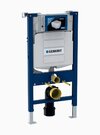
I think maybe there’s been some confusion and maybe I have explained properly apologies for that. I am not having the toilet to the stud wall. I have a gerberit sigma steel metal frame as pictured.

I’ve had these style system in my office for nearly 10 years and seems very robust. The serviceability through the flush plate has been quite good and hence the reason for installing at home.

to accommodate my soil pipe I basically need to space the frame from the wall hence needing to build a stud frame to the place the metal frame inside. So I need that’s what I was asking for advice on. Similar to this video:
 

Attachments

  • IMG_2357.jpeg
    IMG_2357.jpeg
    46.5 KB · Views: 10
It's wall-hung. Yes, the base of the frame is on the floor, but the seat cantilevers out from it. When a 100kg+ lump of human being sits on that thing, their entire weight, plus the ceramic unit, plus water etc will be pulling down, so trying to pull the top of the frame outwards from the wall.

Absolutely fine on a concrete block wall. Also, according to the video, on a floor-to-ceiling timber frame.

You'll need some really good joints between the timbers where the timbers meet to span under the window. Definitely not the usual couple of nails banged in, it needs structural metal brackets.

What's the original wall made from? You should add lots of brackets to brace the stud wall to the original. Overdo it, brace the heck out of it - you don't want any movement, especially not if you're tiling over the joint in the window reveal between the new and old walls - you'll get cracks if there's any flex when a human sits on it.

A photo of the situation would be really useful. Plus a drawing of what you intend to build.
 
Bui
I think maybe there’s been some confusion and maybe I have explained properly apologies for that. I am not having the toilet to the stud wall. I have a gerberit sigma steel metal frame as pictured.

I’ve had these style system in my office for nearly 10 years and seems very robust. The serviceability through the flush plate has been quite good and hence the reason for installing at home.

to accommodate my soil pipe I basically need to space the frame from the wall hence needing to build a stud frame to the place the metal frame inside. So I need that’s what I was asking for advice on. Similar to this video:
Build the wall. Anchor it back to the main wall with galv' straps or solid fixing/noggin arrangement. Sheath it with 18mm ply.
 
It's wall-hung. Yes, the base of the frame is on the floor, but the seat cantilevers out from it. When a 100kg+ lump of human being sits on that thing, their entire weight, plus the ceramic unit, plus water etc will be pulling down, so trying to pull the top of the frame outwards from the wall.

Absolutely fine on a concrete block wall. Also, according to the video, on a floor-to-ceiling timber frame.

You'll need some really good joints between the timbers where the timbers meet to span under the window. Definitely not the usual couple of nails banged in, it needs structural metal brackets.

What's the original wall made from? You should add lots of brackets to brace the stud wall to the original. Overdo it, brace the heck out of it - you don't want any movement, especially not if you're tiling over the joint in the window reveal between the new and old walls - you'll get cracks if there's any flex when a human sits on it.

A photo of the situation would be really useful. Plus a drawing of what you intend to build.

I will try and draw something up and post later on. The original wall that it is attaching to is in this order Dot & Dab > Block > Gap > Bricks
 
I'd suggest taking the original plasterboard off, chiselling off the dabs then bolting the framework directly to the block. Make up with plastic packers where necessary to ensure it's perfectly vertical and utterly solid. Only fix to the edges under the window, not in the middle where it will be prone to lifting/breaking away.
 

If you need to find a tradesperson to get your job done, please try our local search below, or if you are doing it yourself you can find suppliers local to you.

Select the supplier or trade you require, enter your location to begin your search.


Are you a trade or supplier? You can create your listing free at DIYnot Local

 
Back
Top