Plug in solar, what do you think?

total use 14kwh a day @ 27p = £3.78 per day with no investment.(£1397pa)
With solar and battery around £200 pa, so saving around £1100 pa, I can say that as I also use around the same amount of power per day and have 6 kW of solar, a 5 kW inverter and a 6.4 kWh battery, the cost of electric is 8.5p, off-peak, 32p peak, was 15p now 12p export. So my gains will reduce but not that much. But @JohnW2 is correct, I was also looking at maintaining the boiler during a power cut, so there are other factors.

So which is the better option, a third 3.2 kWh battery on the existing solar, or a 2 kWh battery independent which can also be used for a picnic for example?

I could add more panels to roof, or add panels to balcony, so it is better angled for winter sunlight, and will grab the morning sun better. And no installation cost either scaffold or electricians.

To have electric costs around £252 per year, even if you use zero kWh, just the standing charge. To go off grid is not really an option, so as it stands, I over the last 10 months have paid less than the standing charge. But this is not the question, the question is should all be allowed to export power into the grid, using a DIY set-up.
 
... total use 14kwh a day @ 27p = £3.78 per day with no investment.(£1397pa)
... Balcony solar - £2000 investment with £270 savings pa ( assuming average uk sunshine of 5 hours per day) so 7 years to break even.
... 14KW solar install is what 15k installed with a break even of 16 years.....
Quite so (and more!). As I recently wrote, when one is as old as eric and myself, the concept of even "being worse off for the next 7 years", let alone "being worse off for the next 16 years" is not very attractive and, I would personally say, verging on a pretty daft thing to even consdier ;)
 
There is also the question of what do you base your break-even calculations on.

1. Do you use todays electricity prices straight, or do you make some assumptions about how electricity prices will rise in the future?
2. Do you account for "cost of funds"? if so at what rate.
3. How do you account for the risk of failures of the solar equipment?
 
There is also the question of what do you base your break-even calculations on.
1. Do you use todays electricity prices straight, or do you make some assumptions about how electricity prices will rise ine the future?
One obviously ought to make some attempt to anticipate future price changes (rises!), which will somewhat reduce the 'break even' time
2. Do you account for "cost of funds"? if so at what rate.
Again, one might attempt to also take that into account, which would make the break even period even longer. Getting a useful return out of invested cash is not easy these days, so probably not much of an issue if one could be a 'cash buyer' of the kit - but, conersely, if one had to pay for the kit 'with credit', that could markedly increase the break-even ('worse off') time.
3. How do you account for the risk of failures of the solar equipment?
In terms of 'failures prior to break even', I suppose one should aim to only buy if the warranty is at least as long as the likely break-even period. However ....
.... 4. How soon after break-even (and end of warranty) is it likely to be before one has to 'start again' and render oneself 'worse off' for yet another X years, or whatever? (I suspect the answer is likely to be 'not long'!) !!
 
There is also the question of what do you base your break-even calculations on.
1. Do you use todays electricity prices straight, or do you make some assumptions about how electricity prices will rise in the future?
One obviously ought to make some attempt to anticipate future price changes (rises!), which will somewhat reduce the 'break even' time
The drop in payment from 15p to 12p/kWh my not seem much, but it is a warning that in the future we may not be getting the same pay for export, the said due to general price drop in electric, but my peak is still around 32p/kWh

However for plug in, would not expect much export, unless adding to existing. If adding to existing then one will likely have the second MPAN number for export, but one is unlikely to get the second MPAN number for only balcony solar panels.

I have tried to work out what the 800 watt limit means? I would assume it means the unit can feed 800 watt into the socket outlet, so one may be able to run a heat pump drier from a different socket, but most heavy users would need to be plugged into the inverter direct.

I have on my meter tails current transformers which tell my inverter what to do. Also, the iboost+ for the immersion heater. Without those CTs, the inverter would simply not know what to do, in the video he talks about a CT to see results, (Shelly) but not any CT connected to the inverter. I know the iboost+ uses a wireless CT, but the inverter is hardwired.

So not sure how the inverter knows when to import and when to export?
 
So not sure how the inverter knows when to import and when to export?

Perhaps I'm missing something.

I don't have a storage battery.

My inverter produces as much power as it can from the panels.

When my house is using more that the inverter produces, it is all used by the house.

When the inverter is producing more than the house uses, the excess is exported.

It all happens without any switching or decisions. By slight voltage difference.
 
Perhaps I'm missing something. ....
I also sometimes struggle to understand the thinking behind what eric writes about these matters ...
I don't have a storage battery. .... My inverter produces as much power as it can from the panels. ... When my house is using more that the inverter produces, it is all used by the house. ... When the inverter is producing more than the house uses, the excess is exported. .... It all happens without any switching or decisions. By slight voltage difference.
That's what I would have expected, and very probably the way that 'things are' (and have to be) for the vast majority of people with a PV installation.

I get the impression that what eric is talking about is that when there is an excess of generation (in excess of what the house needs to use), there is theoretically a 'choice' between exporting the excess and using it to charge his batteries (for subsequent consumption) - and , because of details of the (import and export) tariffs, one or other of those options might be financially beneficial at a given point in time.

However, I have no idea as to what extent one can exercise that theoretical choice, and even less idea as to whether there is any way it could be done 'automatically' (without constant human involvement).
 
I suppose, if your tariff was time dependent, you could charge you batt with timer control.

I hear it is difficult to do that with an EV as they don't like being switched.

I would charge a battery for choice so I can use it at peak times.
 
I would charge a battery for choice so I can use it at peak times.
Maybe, but the financial arithmetic of that would presumably depend upon how much one could ('alternatively') export the excess electricity for 'in real time' (at the time in question), wouldn't it?
 
Perhaps I'm missing something.
Yes, the storage battery. My system charges 00:30 to 05:30, it will discharge from 05:30 until around 09:00 and slowly the solar takes over, by 15:00 the solar is starting to reduce, depending on time of year so it is around 18:00 to whole evening when the battery finally runs out. Even with no solar, looking at around 15:30 before the battery runs out.

Worst month is December, solar = £4.03, Night rate £24.12, Day rate £32.39, standing charge £21.19, total £73.67 in kWh 389.9 - 26.89 = 363.01 kWh at 27.69p/kWh and 54.57p/day standing charge that's £117.49 so £43.82 saving on the worst month of the year. And £39.79 of that is due to the battery.

As we move to May the best month
1773347635930.png
it is not so easy, as we were getting 15p/kWh now 12p/kWh, and I only moved to Octopus in May so June first full month £15.13, Night rate £20.35, Day rate £32.39, standing charge £20.35, total £37.42 - £77.04 so they owed me £39.62. So
1773348211229.png
was what the solar software showed.

To work out if I need overnight power for next day is impossible to work out, but overnight rate 8.5p/kWh and export rate was 15p/kWh now 12p/kWh so may as well fully charge overnight as export rate is higher.

£117.49 x 12 = approx £1400 per year, my yearly bill around £200, so even with the changes looking at more than £1000 per year saving.

However, this is not the question, what I am looking at is the balcony solar and battery. And the question remains, how does it know how much to add to the grid to maintain net zero without a CT on the meter tails?
 
Balcony is in essence designed to tackle base load - just the stuff that is on all the time, there is an argument that eliminating vampire draws is far more cost effective than sloshing 2k at the problem but as I have a solar install and I am lazy thats still on my to do list.

As for ecoflow you need a shelly and CT to sync it up if you have a separate inverter otherwise its just dumb timer for off peak charge or direct solar connection.
 
As for ecoflow you need a shelly and CT to sync it up if you have a separate inverter otherwise its just dumb timer for off peak charge or direct solar connection.
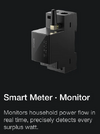
Thank you, I have looked at the portable inverters, some do show 1773480826390.png and 1773480955517.png others seem to have no method to monitor the power flow.
1773482001557.png
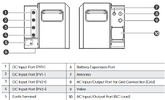
It does seem to have a wireless connection to the supply 1773482088329.png it does seem two outputs.
1773482546306.png
The output to all sockets in the house limited to 800 watt, the output from the devices sockets 1.5 kW, and charging from mains 800 watts, so 5 x 800 = 4 kWh it can take from the grid during the standard 5 hours of off-peak. the manual is here so without solar to charge over 4 kWh is pointless.

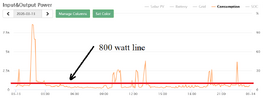
There is also this 800 watt limit. So looking at yesterday this is my usage with a red line at 800 watt.
1773483486622.pngas to how one would integrate two inverters, which would discharge first, I don't know? I look at December as worst month, and in the main existing battery always lasts until 6 pm. So 2 kWh over 6 hours is around 333 watts, so set to discharge at 200 watt from 5 am to half past midnight yes it would integrate with existing. But it does seem pointless, a third 3.2 kWh battery for me would work far better, simple plug and play.

So for those without existing solar, is it worth it? It is the 800 watt limit which means it will cover things like TV, fridge, freezer etc. But to get the battery charged each day, you would need off-peak, so the question is the balance peak to off-peak. So here
1773484732946.png
We see the spikes it would not cover, and I am not convinced that it would cover enough peak load, to ensure one is gaining with an off-peak tariff. If one has an off-peak tariff for some other reason, like storage heaters, then yes it will likely help. But otherwise, one could be jumping from frying pan into the fire.
 

If you need to find a tradesperson to get your job done, please try our local search below, or if you are doing it yourself you can find suppliers local to you.

Select the supplier or trade you require, enter your location to begin your search.


Are you a trade or supplier? You can create your listing free at DIYnot Local

 
Back
Top