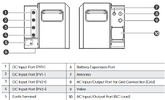
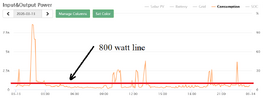
Plug in solar, what do you think?

total use 14kwh a day @ 27p = £3.78 per day with no investment.(£1397pa)
With solar and battery around £200 pa, so saving around £1100 pa, I can say that as I also use around the same amount of power per day and have 6 kW of solar, a 5 kW inverter and a 6.4 kWh battery, the cost of electric is 8.5p, off-peak, 32p peak, was 15p now 12p export. So my gains will reduce but not that much. But @JohnW2 is correct, I was also looking at maintaining the boiler during a power cut, so there are other factors.

So which is the better option, a third 3.2 kWh battery on the existing solar, or a 2 kWh battery independent which can also be used for a picnic for example?

I could add more panels to roof, or add panels to balcony, so it is better angled for winter sunlight, and will grab the morning sun better. And no installation cost either scaffold or electricians.

To have electric costs around £252 per year, even if you use zero kWh, just the standing charge. To go off grid is not really an option, so as it stands, I over the last 10 months have paid less than the standing charge. But this is not the question, the question is should all be allowed to export power into the grid, using a DIY set-up.
 
... total use 14kwh a day @ 27p = £3.78 per day with no investment.(£1397pa)
... Balcony solar - £2000 investment with £270 savings pa ( assuming average uk sunshine of 5 hours per day) so 7 years to break even.
... 14KW solar install is what 15k installed with a break even of 16 years.....
Quite so (and more!). As I recently wrote, when one is as old as eric and myself, the concept of even "being worse off for the next 7 years", let alone "being worse off for the next 16 years" is not very attractive and, I would personally say, verging on a pretty daft thing to even consdier ;)
 
There is also the question of what do you base your break-even calculations on.

1. Do you use todays electricity prices straight, or do you make some assumptions about how electricity prices will rise in the future?
2. Do you account for "cost of funds"? if so at what rate.
3. How do you account for the risk of failures of the solar equipment?
 
There is also the question of what do you base your break-even calculations on.
1. Do you use todays electricity prices straight, or do you make some assumptions about how electricity prices will rise ine the future?
One obviously ought to make some attempt to anticipate future price changes (rises!), which will somewhat reduce the 'break even' time
2. Do you account for "cost of funds"? if so at what rate.
Again, one might attempt to also take that into account, which would make the break even period even longer. Getting a useful return out of invested cash is not easy these days, so probably not much of an issue if one could be a 'cash buyer' of the kit - but, conersely, if one had to pay for the kit 'with credit', that could markedly increase the break-even ('worse off') time.
3. How do you account for the risk of failures of the solar equipment?
In terms of 'failures prior to break even', I suppose one should aim to only buy if the warranty is at least as long as the likely break-even period. However ....
.... 4. How soon after break-even (and end of warranty) is it likely to be before one has to 'start again' and render oneself 'worse off' for yet another X years, or whatever? (I suspect the answer is likely to be 'not long'!) !!
 

If you need to find a tradesperson to get your job done, please try our local search below, or if you are doing it yourself you can find suppliers local to you.

Select the supplier or trade you require, enter your location to begin your search.


Are you a trade or supplier? You can create your listing free at DIYnot Local

 
Back
Top