Joined
13 Mar 2026
Messages
7
Reaction score
0
Country
United Kingdom
Hello everyone,

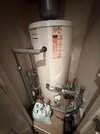
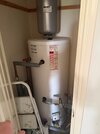
I’m experiencing some problems with my dual-zone central heating. The system has a boiler in the downstairs kitchen and a hot water tank with an expansion tank on top on the first floor. The ground floor is controlled via a thermostat down there, and the first and second floors via a thermostat on the first floor. I have no issues with taps or shower hot water.

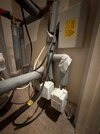
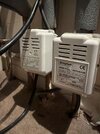
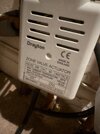
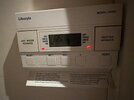
When I change the thermostats either on the ground or first floor, I can see the respective valves by the hot water tank shut and open as expected. However, I have been having issues with the hot water not heating the first and second floor radiators.

I started by bleeding all the radiators, and all were fine, but one at the very top of the house needed a lot of blading. I then refilled the boiler pressure.
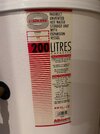
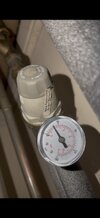
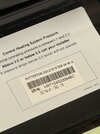
I then checked the pressure of the expansion vessel and found that it was very low. So I topped it up to 3 bars (as found by searching online as I couldn’t find any lanes on the vessel itself) and again topped up the boiler pressure. When I inspected the system, I found that the tundish had a small leak, so I replaced the TPRF. And the leak has now gone. I can’t detect any more issues; however, I still have no radiator heating on the upper two floors. Can anyone advise any solutions or things to check? (The gauge picture is the only gauge near the hot water tank and have no idea what part of the system it measures)
 

Attachments

  • IMG_0967.jpeg
    IMG_0967.jpeg
    804.4 KB · Views: 18
  • IMG_0968.jpeg
    IMG_0968.jpeg
    709 KB · Views: 14
  • IMG_0969.jpeg
    IMG_0969.jpeg
    812.9 KB · Views: 14
  • IMG_0970.jpeg
    IMG_0970.jpeg
    742.6 KB · Views: 14
  • IMG_0971.jpeg
    IMG_0971.jpeg
    749.6 KB · Views: 15
  • IMG_0972.jpeg
    IMG_0972.jpeg
    646 KB · Views: 14
  • IMG_0938.jpeg
    IMG_0938.jpeg
    452.7 KB · Views: 13
  • IMG_0936.jpeg
    IMG_0936.jpeg
    316.7 KB · Views: 13
  • IMG_0977.jpeg
    IMG_0977.jpeg
    271.2 KB · Views: 14
That pressure gauge (looks like it) measures the mains water pressure after the PRV (pressure reducing valve) and is the supply to the unvented HW cylinder, if so, has nothing to do with your problem.
If there is a pressure gauge on the front of the boiler, check its reading, should be 0.7bar/1.0bar with a cold system and boiler off. If no pressure gauge, you have a open vented boiler with a feed and expansion cistern (a small tank) in the attic, check that this is ~ 1/3rd full of water, go back to bed.
 
Thank you for your reply John. The boiler does have a front gauge and it does show the correct pressure. All the water tanks are on the first floor as in the picture with nothing in the attic.
 
Looks and Sounds like the motorised valve for the heating but you’ve worked illegally on an unvented cylinder (TPRV).
 
Last edited:
1773485298542.png
Looking at the manual, circulation pump inside the boiler To be frank, as an electrician, I would not even remove the cover to look at the pump, I don't have a clue as to how it is controlled, for all I know, it may have an inverter drive and vary speed to match boiler output, so I would call in an expert, too easy to make a mistake. It could be a by-pass valve stuck open for all I know.

I have never worked out, why one would fit an on/off valve to a boiler with a variable output, the whole idea is as each TRV gradually opens and closes, the boiler matches its output to suit, everything is an analogue control, OK once all rooms warm, it does need switching off, unless it has something like opentherm, so we do need somewhere some on/off control, I would have expected a hub which connects to all the TRV heads, and once all satisfied then it turns off the boiler. I know that is what my Drayton Wiser does, but a motorised valve as shown only has two states, open or closed, I can see where a boiler supplies multi-homes, as with mine, which can heat the flat or the main house, how motorised valves have a place, but in the main house, rooms get allocated a use, which may change many times in the life of a boiler. Upstairs I have an office, and craft room, and downstairs I have a garden room, these could change to bedrooms and dinning room, so the control needs to be flexible enough to allow a change in the times rooms are heated room by room, doing it floor by floor, in the main is too limiting.

At £15 per programmable head at entry level, there seems no reason why one would fit motorised valves. But I am only an electrician.
 
Last edited:
View attachment 410257 Looking at the manual, circulation pump inside the boiler To be frank, as an electrician, I would not even remove the cover to look at the pump, I don't have a clue as to how it is controlled, for all I know, it may have an inverter drive and vary speed to match boiler output, so I would call in an expert, too easy to make a mistake. It could be a by-pass valve stuck open for all I know.

I have never worked out, why one would fit an on/off valve to a boiler with a variable output, the whole idea is as each TRV gradually opens and closes, the boiler matches its output to suit, everything is an analogue control, OK once all rooms warm, it does need switching off, unless it has something like opentherm, so we do need somewhere some on/off control, I would have expected a hub which connects to all the TRV heads, and once all satisfied then it turns off the boiler. I know that is what my Drayton Wiser does, but a motorised valve as shown only has two states, open or closed, I can see where a boiler supplies multi-homes, as with mine, which can heat the flat or the main house, how motorised valves have a place, but in the main house, rooms get allocated a use, which may change many times in the life of a boiler. Upstairs I have an office, and craft room, and downstairs I have a garden room, these could change to bedrooms and dinning room, so the control needs to be flexible enough to allow a change in the times rooms are heated room by room, doing it floor by floor, in the main is too limiting.

At £15 per programmable head at entry level, there seems no reason why one would fit motorised valves. But I am only an electrician.
 
Thank you for your reply. I wasn’t aware it had a pump and when I looked for a manual I struggled. But because I did not have issues with hot water I didn’t focus on the boiler as I thought that was not the issue. Can you share how you found the manual?
 
I cut and pasted 'potterton gold system 24he' then added 'installation manual' to it with a Google Search.

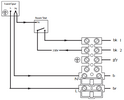
I will often do a work search then for opentherm and ebus, to find out if designed for on/off or up/down thermostat. And a Max and Min on output, it shows 24.7 to 7 kW so clearly a modulating boiler. I look for Corgi or Gas Safe, and IEE or IET which shows how old it is, and how the thermostat is connected 1773487774483.pngas often the thermostat needs supplying from the boiler, so that the boilers fuse or other overload is not by-passed. And also to see what voltage, some boilers have 24 volt control.

I also look to see if it has motorised valves in the layout, as it seems the ability to heat parts of the house independent to other parts was added to the building regulations, but some boilers are clearly not designed to have this function as an on/off device, I would guess the algorithms used by the boiler to modulate the output have changed over the years, and it needs to be plumbed and wired to the standard in use at the time the boiler was made.

I know at work we have a one pipe heating system and the steam from the boiler is simply vented to atmosphere once it had done the heating, the boiler is around 100 years old, it depends on which engine coupled to the train. Today boilers don't it seems boil water, but they have retained the old name.
 
I cut and pasted 'potterton gold system 24he' then added 'installation manual' to it with a Google Search.

I will often do a work search then for opentherm and ebus, to find out if designed for on/off or up/down thermostat. And a Max and Min on output, it shows 24.7 to 7 kW so clearly a modulating boiler. I look for Corgi or Gas Safe, and IEE or IET which shows how old it is, and how the thermostat is connected View attachment 410262as often the thermostat needs supplying from the boiler, so that the boilers fuse or other overload is not by-passed. And also to see what voltage, some boilers have 24 volt control.

I also look to see if it has motorised valves in the layout, as it seems the ability to heat parts of the house independent to other parts was added to the building regulations, but some boilers are clearly not designed to have this function as an on/off device, I would guess the algorithms used by the boiler to modulate the output have changed over the years, and it needs to be plumbed and wired to the standard in use at the time the boiler was made.

I know at work we have a one pipe heating system and the steam from the boiler is simply vented to atmosphere once it had done the heating, the boiler is around 100 years old, it depends on which engine coupled to the train. Today boilers don't it seems boil water, but they have retained the old name.
Thank you so much for the detailed post. I’ll look into this.
 
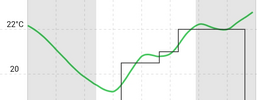
Late mothers house with modulating gas boiler, the radiators seemed to only get warm, where the electronic TRV was doing its job, and maintaining the room temperature, with very little hysteresis, this house on/off boiler, so we do tend to get an over shoot 1773492520134.png the electronic TRV does help, but not as good as they were with a boiler that could modulate (turn down) I am sure if I had Wiser TRV heads in the living room as well as the wall thermostat it would be better, but I look for near enough engineering. Costs too much to be spot on.
 

If you need to find a tradesperson to get your job done, please try our local search below, or if you are doing it yourself you can find suppliers local to you.

Select the supplier or trade you require, enter your location to begin your search.


Are you a trade or supplier? You can create your listing free at DIYnot Local

 
Back
Top