Consumer configuration query

Joined
16 Mar 2012
Messages
91
Reaction score
1
Location
Rutland
Country
United Kingdom
I've recently moved from a self-build barn conversion with workshops into a compact 9-year-old three-bed terrace.

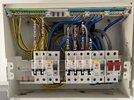
I had a quick look at the consumer unit after a freebie hoover tripped one of the circuits. The breaker layout looks nothing like the consumer units I had in the previous property.

Could someone tell me whether this configuration is standard (please see photo), and perhaps explain what I’m looking at?

Many thanks in advance.

PS. I've binned the hoover
 

Attachments

  • consumer - labelled.jpg
    consumer - labelled.jpg
    462.3 KB · Views: 25
Looks pretty normal, bit of excess copper here and there (hopefully the factory terminated neutrals are in properly)

Usually the upstairs lights and downstairs sockets would be on one side (rcd) and vice versa. Thats what I would have done....incase an rcd trips you still have some power on a floor.
 
Thank you - my previous install had RCBOs in the consumer units, and 3 phase distrubution boards, so this is new to me.
 
Well - first of all let me admit that I have a front end RCD consumer unit - One RCD for the whole installation.
This configuration is now considered "old hat".

The next move was to have dual RCDs - one RCD for some circuits and the other RCD for the other circuits.
Sensibly mixing up and down (or left and right) circuit types should be done to ensure you`d still have some lights or some power (to plug in a table lamp) whichever RCD tripped, in each room or each location.
It was some improvement cos you would only lose about half your circuits rather than all of them in an earth fault.
But that too is considered old hat by many of us too.

Nowadays many of us would consider both of those to be old hat and penny pinching.

Ideally all circuits on RCBOs ( RCD & MCB in one device) thereby any fault would only lose the one circuit.

Smoke detectors could be better considered as fed from a well used local lighting circuit rather than on their own on the basis that loss off the smoke detector circuit would more likely be noticed therefore corrected therefore attended to.

This history has really been driven by RCDs then also RCBOs becoming cheaper therefore more produced therefore becoming cheaper , ad infinitum.

I would always insist on RCBO for each circuit these days.
 
I returned to the UK in the 1990s to find RCDs, RCCDs, ELCB-v, ELCB-c and the list goes on, with many names for basic same devices, it would seem in the main due to plastic water mains meaning the water main could no longer be used as an earth, and also the sixteen edition had been made into BS 7671:1992, and every electrician it seems had been on a course and was quoting what it said.

It was 2008 before RCDs were required for items within the home, before that we were fitting them for sockets likely to be used in the garden, but the rules said things like "(iii) take account of danger that may arise from the failure of a single circuit such as a lighting circuit (iv) reduce the possibility of unwanted tripping of RCDs due to excessive protective conductor currents produced by equipment in normal operation" but this was read by many as allowing us to use just two 30 mA RCDs, and before that with 100 mA RCDs were used for the whole house.

So as @pete01 says, we should arrange it so we are not plunged into darkness, when a fault on the ring final trips the RCD. We used to split the ring finals side to side of the property, so if there was a failure, there was no temptation to run extension leads up or down stairs, but to get away with just two RCDs this changed, to split up/down so it could match the lighting circuits.

So in this house, split side to side, for ring final, and up/down for lights, it would need 3 RCDs, or use RCBOs which is a RCD and MCB combined. But most homes just had two, and reports on this forum tells us many people did not have a problem with that. I did, I would have the RCDs trip maybe 4 times in 2 weeks, no fault found, and then would run for maybe 4 years before it tripped again.

So this house when fuse box was replaced with a consumer unit, I had all RCBOs, and latter also an EPS (like a UPS but slightly slower change over times) to feed my freezers. In 5 years, one RCBO failed, I had 3 of the RCBOs trip, 2 of them good cause, one never did find out why. So I am glad I spent the extra for RCBOs, a bit annoying, hardly been fitted all type AC, when type AC were replaced with type A, I have upgraded 2, but have 12 left in the board.

You also have type AC and rated at 80 amps, as long as incoming DNO fuse 80 amps or less, that's OK, as to being type AC, with a TN supply the RCD is secondary protection so would not worry, but with a TT supply would consider an upgrade. But unlike I would bother.

However, there is nothing wrong with what you have, and I would only consider an upgrade if having problems with the existing setup.

 

If you need to find a tradesperson to get your job done, please try our local search below, or if you are doing it yourself you can find suppliers local to you.

Select the supplier or trade you require, enter your location to begin your search.


Are you a trade or supplier? You can create your listing free at DIYnot Local

 
Back
Top