Just because "not BS1363", I'd agree. But when you look at the size/shape of some of the "safety" covers, it's not hard to see how some of them could damage the socket.As to condemning sockets which had them plugged in as the socket could be strained as a result of fitting a non BS 1363 items, I think that is going too far.

You are using an out of date browser. It may not display this or other websites correctly.
You should upgrade or use an alternative browser.
You should upgrade or use an alternative browser.
Non-bidirectional RCD/RCBO feeding sockets, should they get a code C2 with EICR?
- Thread starter ericmark
- Start date

I test a church with a children's play centre on the side and as I go round I unplug all those plastic things and tell them to throw them away, when I go back they are plugged back inthose plug/socket thingies)


- Joined
- 27 Jan 2008
- Messages
- 29,347
- Reaction score
- 3,608
- Location
- Llanfair Caereinion, Nr Welshpool
- Country

I watched a Jonathan Tracey YouTube called Is Plug-In Solar LEGAL in the UK? He links to Is Plug-In Solar Legal in the UK? The Complete 2026 Guide which says "Quick answer
Yes, plug-in solar is legal in the UK since 24 March 2026."
But then continues "The BSI product standard that certifies kits for DIY self-connection is expected summer 2026. Until then, the fully compliant route is to use a qualified electrician."!
It does seem it is legal, but does not comply with regulations, which seems to be splitting hairs, as that has always been the case, there was no real change to any law on the 24th of March 2026.
If using a FCU it is not plug in solar, simple, can you use plug in solar and comply with the regulations, the answer has to be yes, but not using a BS1363 socket, you would need to use an EV charging socket.
A reference to "The wiring regulations (BS 7671 Amendment 4) are live." seems daft, as it was BS 1363 which did not permit it, so that needs to be re-written before we can use a 13 amp plug.

OK, then why bother writing website?
So What you CANNOT do yet - Skip DNO notification — it's a legal requirement regardless. - Plug a kit into a wall socket yourself and be fully compliant.
So why say "Quick answer Yes, plug-in solar is legal in the UK since 24 March 2026."?
Either you can plug it in and be fully compliant or you can't, so quick answer it seems is No.
So why bother making the video? Every report I see is by someone who already has completed a G99 or G98 and can get paid for export, so for the people that plug in solar is aimed at, the person in rented accommodation who want to be able to move it home to home, the report is useless.
Yes, plug-in solar is legal in the UK since 24 March 2026."
But then continues "The BSI product standard that certifies kits for DIY self-connection is expected summer 2026. Until then, the fully compliant route is to use a qualified electrician."!
It does seem it is legal, but does not comply with regulations, which seems to be splitting hairs, as that has always been the case, there was no real change to any law on the 24th of March 2026.
If using a FCU it is not plug in solar, simple, can you use plug in solar and comply with the regulations, the answer has to be yes, but not using a BS1363 socket, you would need to use an EV charging socket.
A reference to "The wiring regulations (BS 7671 Amendment 4) are live." seems daft, as it was BS 1363 which did not permit it, so that needs to be re-written before we can use a 13 amp plug.
OK, then why bother writing website?
So What you CANNOT do yet - Skip DNO notification — it's a legal requirement regardless. - Plug a kit into a wall socket yourself and be fully compliant.
So why say "Quick answer Yes, plug-in solar is legal in the UK since 24 March 2026."?
Either you can plug it in and be fully compliant or you can't, so quick answer it seems is No.
So why bother making the video? Every report I see is by someone who already has completed a G99 or G98 and can get paid for export, so for the people that plug in solar is aimed at, the person in rented accommodation who want to be able to move it home to home, the report is useless.
Possible ways to change their minds :I test a church with a children's play centre on the side and as I go round I unplug all those plastic things and tell them to throw them away, when I go back they are plugged back in
1) Tell them they are opening themselves up to massive personal liability since it is (or should be) well known that both the NHS and Dept. for Education ban them on safety grounds - it's there at the top of the Fatally Flawed website, didn't realise that both announcements are now around a decade old
 If they then plug them in, having been told that they are dangerous, they open themselves up to claims that their insurance company will walk away from.
2) Next time, fail every socket that has one plugged in. Use a permanent marker or sticker that's going to be really hard to remove. They either spend ages scrubbing the markings off, or have the expense of replacing them.
3) Is this part of the church ? If so, inform the churchwardens (plus safeguarding officer, and incumbent priest if there is one) that the play centre is creating a real safety risk to the children and a fire risk to the building. With my churchwarden hat on, I would be intervening - although if such a centre was part of my church, you would not be finding them in use.
I'm probably going to live to regret this, but reaching for my Devil's Advocate hat (since I've spent most of my life in 'evidence-based' environments, and feel a bit unhappy if/when it seems that others {particularly 'officialdom'} may be abandoning objectivity in favour of theorising'!) ....Possible ways to change their minds :
1) Tell them they are opening themselves up to massive personal liability since it is (or should be) well known that both the NHS and Dept. for Education ban them on safety grounds - it's there at the top of the Fatally Flawed website, didn't realise that both announcements are now around a decade old
The above is very reasonable, but only IF the NHS and Dept. for Education (and anyone else who has done likewise) has done adequate properly ('evidence-based') research and sought adequate advice (what some would call 'due diligence' these days) to satisfy themselves that there is fairly strong evidence that these products really do represent a net 'danger' - rather than just relying on the rather one-sided and seemingly not-very-objective arguments and material presented by such sources as "Fatally Flawed".
We hear a lot here about 'risk assessments', and I hope these are actually the "risk-benefit assessments/analyses" that have been a major part of my professional life for decades (on the basis that there are nearly always 'two sides to any story').
As I recall it, last time I looked Fatally Flawed did not actually report (let alone attempt to quantify the frequency of) any actual incidents of 'harm' related to the use of these products, although they certainly did document a number of what they described as 'near misses'. On the other side of the 'risk-benefit' assessment, I don't think they mention, let alone acknowledge (or attempt to quantify, which would be difficult) the possibility that there may well have been some cases in which use of the products has prevented the occurrence of harm. Without other information/input (which, I admit, would be very hard to find) it's therefore not really possible to be even reasonably sure that the potential downsides actually do outweigh the potential benefits. In fact, at the most basic of levels, I wonder if there have been any well-documented cases of significant harm resulting from use of the products ?
Then there is the question of the design of the products. I rather doubt that the fact that their pins are slightly larger than those of a BS1363 plug) arose by accident (it would have been just as easy/cheap to make them slightly smaller) - so I personally suspect that it was done deliberately, perhaps because they might at least partially fail to achieve their intended purpose if they were too easy to pull out. Whatever, I wonder if there is actually any evidence (rather than a 'theoretical possibility') that use of these products has ever significantly damaged a socket, or that any such damage has ever resulted in anyone coming to any harm ?
If it were to transpire that the NHS/Dept.of Education/Whoever has 'banned' the use of these products without adequate objective/critical research, such they had actually (due to inadequate thought/research/reason) 'banned' the use of something which actually had the potential to do more good than harm, then those organisations/bodies presumably might themselves be (to paraphrase your statement) "opening themselves up to the possibility of massive liability" ? ... and I would imagine that that 'risk' (of liability) will exist unless they have reasonably strong evidence that the products they are banning are likely to do more harm than good?
- Joined
- 27 Jan 2008
- Messages
- 29,347
- Reaction score
- 3,608
- Location
- Llanfair Caereinion, Nr Welshpool
- Country
The NHS did ban the socket protectors in their properties. But I note still used in my doctors' surgery. We are going back around 4 years when they were banned, so no idea as to reason.
Very likely as not complying with BS 1363, so regulations will not allow them to be put into a socket unless they comply with BS 1363, so one could plug in a plug which has not cable going to it, but not the plastic lump simply as lacking the BS 1363 compliance.
I have questioned these
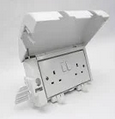 due to ability of being locked, the BS 7671 table 53.2 lists what can be used for isolation, emergency switching and functional switching. The BS 1363 is not permitted for emergency switching, so I would assume no problem with the lockable cover?
Very likely as not complying with BS 1363, so regulations will not allow them to be put into a socket unless they comply with BS 1363, so one could plug in a plug which has not cable going to it, but not the plastic lump simply as lacking the BS 1363 compliance.
I have questioned these

GP practices are not owned or run by the NHS. They are independent organisations working under various contracts to provide NHS funded services to their registered patients.The NHS did ban the socket protectors in their properties. But I note still used in my doctors' surgery. We are going back around 4 years when they were banned, so no idea as to reason

In summary regarding the 'socket protectors' or whatever else they may be called:I'm probably going to live to regret this
In the UK they serve no purpose since every BS1363 socket outlet already includes shutters.
Shoving items into the socket to cover them up will at best, achieve nothing.
Looking for 'evidence' that they might somehow be beneficial is irrelevant, since the product has no purpose and should not exist.
This is exactly why nothing ever gets done in such places.If it were to transpire that the NHS/Dept.of Education/Whoever has 'banned' the use of these products without adequate objective/critical research,
X needs to be done.
Instead of doing that, lets waste billions and decades on spurious research until the money runs out.
That is merely an opinion.In summary regarding the 'socket protectors' or whatever else they may be called: .... In the UK they serve no purpose since every BS1363 socket outlet already includes shutters. ... Shoving items into the socket to cover them up will at best, achieve nothing.
In general, we try to avoid situations in which there is only one level of protection against a potential danger. I presume that you would not approve of people being protected from contact with live parts/conductors only by 'basic insulation' (e.g. 'single-insulated' conductors), even though the situation remains totally safe unless that one level of protection 'fails'?
Don't get me wrong - I know nothing about the extent (if any) of possible beneficial effects. However, I make no apology for preferring practices to be based on evidence, rather than on opinions, theorising and speculation/guesswork (or because of pressure applied by individuals/organisations/whatever).Looking for 'evidence' that they might somehow be beneficial is irrelevant, since the product has no purpose and should not exist.
Well, these places certainly did cause something "to get done" ('banning' the products), whether they spent nothing or billions in ascertaining whether or not it actually 'needed' to be done (or maybe, even, that it "should not" have been done).This is exactly why nothing ever gets done in such places. .... X needs to be done. .... Instead of doing that, lets waste billions and decades on spurious research until the money runs out.
If/when it subsequently transpires that the lack of adequate research/thought/consultation on the part of 'such places' has resulted in decisions/actions (or inactions) that have actually been 'harmful' or detrimental, we are very quick to label the situation as 'a scandal', with calls for 'heads to roll' and talk of massive amounts of 'compensation'. Quite apart from that, as I wrote above:
I wonder what is your opinion (and that of others) is about the requirement for 'non-combustible' CUs?However, I make no apology for preferring practices to be based on evidence, rather than on opinions, theorising and speculation/guesswork (or because of pressure applied by individuals/organisations/whatever).
What 'regulation' do you think prevents members of the public plugging certain things into BS1363 sockets? Without looking, I can't be sure, but BS1363 may well say that only BS1363-compliant plugs should be plugged into them, but that's just a British Standard which has no 'teeth' in dictating what the general public can and cannot do.Very likely as not complying with BS 1363, so regulations will not allow them to be put into a socket unless they comply with BS 1363, so one could plug in a plug which has not cable going to it, but not the plastic lump simply as lacking the BS 1363 compliance.
So is everything.That is merely an opinion.
It's a socket, which by necessity has holes in it for the plug prongs.In general, we try to avoid situations in which there is only one level of protection against a potential danger
The holes are too small for normal fingers to fit into
The shutters are there to prevent other objects being inserted.
To overcome that protection, it's a deliberate act to overcome the shutters by some method and also deliberately shove inappropriate objects into the socket holes.
Entirely unrelated to insulation of a cable, which can be worn through, cracked or otherwise damaged in a single inadvertent act.
No doubt because no one has ever bothered to investigate such things, as the primary function of such devices is to make money by selling items which have no purpose.Don't get me wrong - I know nothing about the extent (if any) of possible beneficial effects
Those that make and sell them couldn't care less about any effects, beneficial or otherwise.
Sometimes common sense prevails, in not allowing a pointless device to be used.these places certainly did cause something "to get done"
Some evidence exists showing that they can be broken off in the socket or shoved in upside down to open the shutters.
Some people might be. Others less so.we are very quick to label the situation as 'a scandal', with calls for 'heads to roll' and talk of massive amounts of 'compensation'.
Such requirements have no place in BS7671, and that particular entry should never have been added to it. Much like most of the other regulations ending in numbers over 200.I wonder what is your opinion (and that of others) is about the requirement for 'non-combustible' CUs?
If consumer units are to be made 'non combustible' whatever that might mean, then that and any other requirements should be put into the standard(s) applicable to the construction of consumer units.
- Joined
- 27 Jan 2008
- Messages
- 29,347
- Reaction score
- 3,608
- Location
- Llanfair Caereinion, Nr Welshpool
- Country
Totally agree, a consumer unit made of a conducting material has more dangers specially with a TT supply than any chance any non-conducting material going on fire.Such requirements have no place in BS7671, and that particular entry should never have been added to it. Much like most of the other regulations ending in numbers over 200.
Fair enough. As an engineer, I too am expected to make evidence based judgements, or present evidence to colleagues who have to make a decision.I'm probably going to live to regret this, but reaching for my Devil's Advocate hat (since I've spent most of my life in 'evidence-based' environments, and feel a bit unhappy if/when it seems that others {particularly 'officialdom'} may be abandoning objectivity in favour of theorising'!) ....
You seem to be applying the same flawed logic that the vendors of these so called safety covers use - that they prevent a risk.As I recall it, last time I looked Fatally Flawed did not actually report (let alone attempt to quantify the frequency of) any actual incidents of 'harm' related to the use of these products, although they certainly did document a number of what they described as 'near misses'. On the other side of the 'risk-benefit' assessment, I don't think they mention, let alone acknowledge (or attempt to quantify, which would be difficult) the possibility that there may well have been some cases in which use of the products has prevented the occurrence of harm.
As flameport beat me to it, the sockets have small holes, they have shutters, so it needs two co-ordinated actions (shove something into the earth pin hole, shove something conductive into the live pin hole) to realise any actual danger. With some sockets (MK IIRC) it's actually quite hard to open the shutter as it needs both L & N pins to go in at the same time, and just shoving a screwdriver in doesn't do it.
So the actual risk is exceedingly small - not zero, but small.
Conversely, these so called safety covers defeat the protection provided by the shutter. Possibly damage the socket. And make it much easier to push something into the live pin hole. Not hard to see that the latter creates significant risks, while preventing ... close to zero.
Incidentally, I have first hand experience of opened up socket contacts. It was a 15A socket rather than 13A, and it had probably had a rough life. But I recall many years ago getting a tingling from a water heater - one of those old free standing tub designs you fill with a bucket or hose and has a tap on the side. When I looked at the socket, the earth pin contacts were splayed out, so I squeezed them together, plugged back in, and there was a bang from underneath - the elements were some sort of film resistor, with mica insulation, and clamped to the bottom of the tub with a plate and two nuts. One plate had come loose, and the element had moved sideways ...
I would imagine that would be heard to come by. The main problem is that the general public aren't likely to report anything, and the authorities are only likely to know if it's serious (e.g. someone is hospitalised.) Also, some of the potential harms would not be related to the previous (possibly years previous) use of these items. E.g. if an oversized pin results in a lower contact pressure, adn that results in a pin burnout, the user is unlikely to be thinking "that'll be because I used socket covers 5 years ago."I wonder if there have been any well-documented cases of significant harm resulting from use of the products ?
I think you are more generous to the manufacturers than I am. If you look at the table with dimensions, it's clear that people have many different ideas about pin sizes - many of them smaller than the standard allows. Add in evidence about how there are so many incorrectly designed "BS1363" plugs around, I can't help thinking someone just picked up a plug, measured it coarsely with a ruler, and made something to those dimensions.Then there is the question of the design of the products. I rather doubt that the fact that their pins are slightly larger than those of a BS1363 plug) arose by accident (it would have been just as easy/cheap to make them slightly smaller) - so I personally suspect that it was done deliberately, perhaps because they might at least partially fail to achieve their intended purpose if they were too easy to pull out.
I am really sceptical that someone looked at the standard and consciously designed something with larger pins.
Also, bear in mind that one of the suggested damage modes is to the shutter - by having short pins, and someone forcing the cover in, there's a real risk of damaging the shutter such that it no longer protects against foreign objects.
AgreedEntirely unrelated to insulation of a cable, which can be worn through, cracked or otherwise damaged in a single inadvertent act.
Also agreedNo doubt because no one has ever bothered to investigate such things, as the primary function of such devices is to make money by selling items which have no purpose.
Those that make and sell them couldn't care less about any effects, beneficial or otherwise.
Oh yes, those failure modes as well.Sometimes common sense prevails, in not allowing a pointless device to be used.
Some evidence exists showing that they can be broken off in the socket or shoved in upside down to open the shutters.
Agreed. Either that, or the requirement should specify what standard it is required to meet - e.g. by referencing an existing standard for flammability.If consumer units are to be made 'non combustible' whatever that might mean, then that and any other requirements should be put into the standard(s) applicable to the construction of consumer units.
Unfortunately, we seem to be getting ignored as there's been no shortage of people (myself included) who have raised this - yet there's been, IIRC, 2 or 3 new versions where they've failed to fix this f'up that brings BS7671 and BSI into disrepute.
It's essentially a semantic issue, but I suppose it's true that everything which is not indisputable 'fact' is, in some senses, an 'opinion'. However, if one is going to say that nearly all statements are 'opinions', one has to remember that there is a whole spectrum - varying from opinions based on very strong evidence to those based on no real evidence at all, and I would suggest that the extent to which we 'take notice' of opinions should depend on where they fall in that spectrum - and I personally don't think it desirable that such opinions be presented as assertions, particularly at the 'lower' end of the evidence spectrum.So is everything.
All true.It's a socket, which by necessity has holes in it for the plug prongs. .... The holes are too small for normal fingers to fit into ... The shutters are there to prevent other objects being inserted.
Even if that were true, it would not be a reason to discount that possibility, particularly where children are concerned. However, in reality there does not necessarily have to be a 'deliberate act to overcome the shutters'. You must surely have come across shutters that were (not 'deliberately') damaged, non-functional or jammed open - I am a mere DIYer, hence with limited experience, but I have certainly seen such things.To overcome that protection, it's a deliberate act to overcome the shutters by some method and also deliberately shove inappropriate objects into the socket holes.
The 'failure' of shutters can be a single inadvertent happening.Entirely unrelated to insulation of a cable, which can be worn through, cracked or otherwise damaged in a single inadvertent act.
Whatever, as I've said, we generally try to avoid situations in which a danger can arise as the result of a single event/act/happening. If the shutter has (for whatever reason) already 'failed' just one further act can invoke the danger.
That obviously is definitely an 'opinion' and I have no information which helps me to know how correct it is - and I imagine the same is probably true of you. It wouldn't surprise me if those who originally conceived the idea sincerely believed that they were useful products which might reduce injuries and deaths.No doubt because no one has ever bothered to investigate such things, as the primary function of such devices is to make money by selling items which have no purpose. Those that make and sell them couldn't care less about any effects, beneficial or otherwise.
Who knows. If it was done for the reason you suggest, they must (should) have had some reason to believe that they are 'pointless devices' - unless you are suggesting that they did it 'blindly' solely as the result of the representations of a pressure group?Sometimes common sense prevails, in not allowing a pointless device to be used.
I haven't seen that evidence but, if it does exist, I would have thought that it would be pretty difficult to break off just the earth 'pin', or just the N and E pins?Some evidence exists showing that they can be broken off in the socket ...
If the socket is such that that can be done with one of these devices, the same could presumably also be achieved using a BS1363-compliant plug, and even the NHS could not 'ban' the use of them!.or shoved in upside down to open the shutters.
We live increasingly in a 'blame culture'. Whenever anything 'goes wrong' there is seemingly an obsession to find people to blame (often with the idea/hope of financial gain), not to mention the lawyers who seek to make money out of the situation.Some people might be. Others less so.
I'm pleased to hear that our opinions are the same about that. The reason we both have that opinion is presumably that neither of us has seen any reasonable evidence that 'non-combustible' CUs would offer a significant benefit (let alone 'necessity'). However, if we were presented with reasonably strong evidence that there is a benefit, then we hopefully would (should) consider changing our opinions,Such requirements have no place in BS7671, and that particular entry should never have been added to it.
That's one thing we haven't discussed - the fact that opinions certainly do evolve/change over time, usually as a result of increasing knowledge (hence 'evidence'), and also that there has been an increasing awareness of the need for 'evidence-based' practices. That has been particularly true in relation to disciplines I have been involved with, in that many of the things I was taught (as 'facts') 50 or so years ago were 'opinions' based on historical traditions, mis-applied 'intuition' and sometime even 'superstitions', with little (if any) fact/evidence base. However, in many cases, subsequent increases in knowledge/evidence have shown that those teachings were just plain 'wrong'. Even at a personal level, I'm sure that, although I have always acted 'in good faith' (in relation to then current knowledge/evidence) I will have 'done harm', probably including contributing towards some deaths, as a result of deficiencies in the then current level of knowledge/evidence.
That's really just an operation/administrative/'bureaucratic' difference. I have yet to see any good evidence that there is a good reason to include such a requirement in any Standard (or any 'regulations').If consumer units are to be made 'non combustible' whatever that might mean, then that and any other requirements should be put into the standard(s) applicable to the construction of consumer units.
No matter what our opinions, it's presumably too late to do anything about the requirement for 'non-combustible' CUs but we are, at least in my opinion, now seeing the same sort of situation arising with SPDs, with AFDs (and goodness knows what other future technologies) not that far behind. However, in these cases I think that your opinion is in support of at least SPDs, isn't it?
- Joined
- 27 Jan 2008
- Messages
- 29,347
- Reaction score
- 3,608
- Location
- Llanfair Caereinion, Nr Welshpool
- Country
I think it was @JohnW2 who pointed out for the RCD/RCBO to fail it needs to test button to be pressed, while the flow is reversed, but from 10 am to 6 pm today flow was reversed, so there is a reasonable chance of the button being pressed at the wrong time.
I looked at data sheets, non seem to say non-reversible, they only say when it can be reversed, and there are type 'A' which show input and output so the plug in solar website which says

is incorrect. I look at

Round fuse holders, were Siemens not Wylex, and not seen any in the UK, Algeria 1980 loads, as working for a Dutch company, darn dangerous things, as fuse was before the switch, so to change a fuse base it had to be done live.
But it would seem they have translated a German website!
I looked at data sheets, non seem to say non-reversible, they only say when it can be reversed, and there are type 'A' which show input and output so the plug in solar website which says
is incorrect. I look at
Round fuse holders, were Siemens not Wylex, and not seen any in the UK, Algeria 1980 loads, as working for a Dutch company, darn dangerous things, as fuse was before the switch, so to change a fuse base it had to be done live.
But it would seem they have translated a German website!

DIYnot Local
Staff member
If you need to find a tradesperson to get your job done, please try our local search below, or if you are doing it yourself you can find suppliers local to you.
Select the supplier or trade you require, enter your location to begin your search.
Please select a service and enter a location to continue...
Are you a trade or supplier? You can create your listing free at DIYnot Local
Similar threads

- Replies
- 36
- Views
- 3K
- Replies
- 24
- Views
- 4K

- Replies
- 48
- Views
- 7K