Plug in balcony solar UK , just a Lidl question

but the whole idea of 'plug-in-solar' would presumably be that it could be plugged into any 'ordinary' BS1363 socket, isn't it?
That was what I assumed, when we started, but when we look at other items, we do have
The IET Wiring Regulations (722.55. 101.0. 201.1i) specify that 13A UK sockets which are installed to charge an EV must comply with BS 1363-2 and be marked 'EV' on the back of the plate.
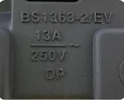
1780384117576.png I think marking were the user can't see the mark, is daft, I look at the cost of a BS 1363 EV socket 1780384289402.png and just wonder at the price. Compared with a normal outdoor socket 1780384405260.pngand wonder at the price OK RCD protected so add cost of RCBO
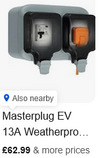

1780384525379.png
and still it seems a completely daft price. I have a BG socket on my shed that my son can use with his EV on a 16 amps bidirectional RCBO, I would not dream on paying £63 for a socket used to charge an EV maybe twice a year, to be whole point in granny chargers is when visiting on the odd time parents or grandparents.

I know in industrial premises it was common to have a red, yellow, blue dot on a socket, and also to have things like DB4-6 which directed to the distribution board 4 and 6th MCB/RCBO but domestic as I found out with my own home, often nothing to show where supplied from. I had assumed utility room was fed from front RCBO with the kitchen, but turned out on rear of house RCBO, the outside socket is plugged into an inside socket, so as actually happened, if any water or bug causes it to trip, it can be easily isolated, the other two outside sockets are fed from dedicated circuits, so no plug and socket on them.

But we look at our own homes, and I know I have two bidirectional RCBOs and the other 12 are unidirectional, and I know 4 sockets fed direct from the inverter, I don't want to consider what would happen back feeding into an EPS supply. Sockets are RCD type and marked EPS, but it would be pointless to plug a solar inverter into them, as already supplied from a solar inverter, but would assume it would cause damage. And very expensive damage at that.

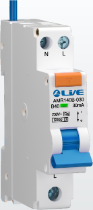
@mikehammer69 the video does show some problems, but the main problem as it stands, is unidirectional devices can't be identified without removing the CU cover. So the user can't tell if bi or unidirectional, same applies with the EV socket, the user can't tell if EV rated or not. This advert shows the problem it clearly says "Live 6A 30mA Double Pole Bidirectional RCBO Mini B Curve AMR106B-030" but picture shows
1780387653985.png
clearly marked as out, so how does an electrician opening a board with one of these, know if bidirectional or not? The data sheet shows it to be bidirectional, and the picture on the data sheet 1780388131925.png does not show in and out, I found the data sheet by entering the AMR1 into google, so it would be so easy to make an error.
 
Last edited:
Isn`t this the same issue?
There appears to be 2 issues with unidirectional rcds is what im saying not just a test button problem

Appears there’s a problem on some compact models when tripping which damages components
 
Last edited:
The other problem is G98 v G99, the parameters required are not the same, I think it is the delay before disconnection? To stop loads of devices disconnecting together, it seems there is a required delay of 500 mS, but this does not line up with the 40 mS found in BS 7671, so this is a problem to be resolved.

And I know the dip switch settings for G98 and G99 are not the same, so if I was to get plug in solar, it would need an alteration to the G99, but if next door without any solar was to get plug in solar, it would require G98 on one side, the other side not sure, as don't know if the EV charged point is V2G or not.

OK likely people will ignore the registration process, but what is not clear, is what the DNO will do if it is found an installation does not comply. Worse case seems to be they could disconnect the supply.
 
likely people will ignore the registration process, but what is not clear, is what the DNO will do if it is found an installation does not comply. Worse case seems to be they could disconnect the supply.
Do you mean with plug in solar? The changes/proposals haven't been made or released yet.
 
Oh I see,
1/ if an RCD trips within the specified time it should be designed not to damage compenents.
2/ one would hope that the manufacturers have ascertained that a trip in excess of that time is most unilkely to damage compents (one might call it a "safe margin of allowance).
3/ An extremely large margin over that time, including up to infinity could often be expected to be likely to cause damage to most or all common designs.

So item 1/ all should survive. Item 2/ some might not and item 3/ most wouldn`t.

If we are happy to include items 1/ & 2/ as reasonable then we would reasonably expect nearly all to survive.
If we do not expect many or nearly all to not survive item 3/ then we might be being reasonable.

If we take steps to avoid the item 3/ possibilty we can be happy to class them as bi directional.

so now we have two classes , right I`m happy with that thought.
 
Tripping time for the same fault can't be less than 40 mS and over 500 mS.

And also a solar panel added to a property which already has a device needing G99 like a EV V2G charger, will need different settings to when there are no, what are classed as generating devices fitted.

It can hardly be considered as plug and play, if there are a host of items needing to be done either before or after you plug it in.

I put a swing seat on my balcony, this sort of design
1780391893456.png
and the wind caused the metal holding the canopy on to fail, and when it was taken down to garden, the wind was high enough to swing it enought for it to shed one of the suspension springs. What do you think a solar panel will do?
 
This video talks about a second issue with newer rcds. It appears to be an issue affecting the electronic components when rcd trips.
Also mentions the test button issue
Interesting.
As has been said, that second issue seems to be pretty close to the 'first' ('test button') one. However, I have to say that I personally find it difficult to understand/'believe' what is being said/suggested ...

• There is clearly no problem with the electronics being permanently powered when in their 'quiescent' state (any residual current being less than trip threshold), since that is a situation which exists continuously for years/decades when the devices are in service - and I presume that must remain the case even if there is usually a residual current close to (but not at/over) the trip threshold.

• Similarly, I presume there is no problem with the electronics being permanently powered after the device has tripped. The trip means that there can't be any 'residual current', so the situation is no different from the normal ('continuously powered') 'quiescent' situation.

• It would therefore seem that an 'issue' could only arise during the period from when the electronics first detected a residual current at least as great as the threshold and when tripping (if it occurred) terminated that residual current.

• The devices will obviously be designed such that no harm will come to the electronics if tripping occurs within the 'required' time (usually 40 mS) after detection of a 'trip-level' residual current, so any potential problem will only exist if the device has 'failed' (evidenced by by not tripping rapidly enough - sort-of analogous to keeping a test button pressed for a 'long' time) - and one would hope that the design would not be so 'borderline' that harm could result if the trip tipe were just slightly 'over spec'.. During that period, the main difference (to the electronics) from the 'quiescent state' will be the trigger current going into the thyristor, and I must say that I would have thought that would be fairly minimal, and probably well within the ratings of the electronic components?

• If that is the perceived potential problem, then (similar to what I wrote last night about the test button), it's hard to see how it could be addressed. If, due to a fault, the device fails to trip (reasonably quickly, or at all) when the electronics are telling it to trip, then the electronics (including the electronics' attempt to initiate a trip) will inevitably remain powered - possibly to its detriment, but it would seem (at least to me) to be impossible to do anything about that? Am I missing something?​

Any thoughts?
 
This advert shows the problem it clearly says "Live 6A 30mA Double Pole Bidirectional RCBO Mini B Curve AMR106B-030" but picture shows <image>clearly marked as out, so how does an electrician opening a board with one of these, know if bidirectional or not?
Quite so. Although some of the documents being waved at us suggest (indeed, state) that the presence of in/out markings mean that a device is not bidirectional, that is clearly not the case - and, as I've observed before, in the case of an RCBO, a neutral'flying lead' also effectively constitutes such a 'marking', even if the device is actually 'bidirectional'.
 
I'm very interested in these new " balcony solar " panels that I hear Lidl are going to be selling from June
By now @Neil Carroll must be wishing never started the thread. We have heard that plug-in solar panels will be legal, and there is clearly a lot of interest, and it seems loads have also jumped the gun, and have fitted them before the official release of any rules and regulations.

The main problem seems to be uni and bidirectional RCD/RCBO and the tripping time which to allow units not to trip with a power dip so will not cause a cascade effect with many units going off-line together, and also must trip time so that pins are not live when unplugged being so different 40 mS to 500 mS.

Also as it stands the G98 and G99 are not the same, so an inverter needs different dip switch setting with G98 and G99, so adding solar where solar already exists will require the inverters to be set to different parameters to those where it is the only inverter.

As to multi-inverters in one premises we are again facing a problem with islanding.

The other problem is people have already worked out setting an inverter to France it can deliver more than setting it to Germany, so it is how to ensure inverters are set to UK, which as it stands they can't be set to UK as there is no UK setting for plug and play.

So any systems bought before made legal will remain illegal as they will not have a UK setting.

And this is before considering if the wind resistance or weight can be safely taken by the balcony they are hung off.

It seems like the question if I poke my finger in the fire, will you? We know there are problems, but since Germany and France say OK, we are it seems also going to say OK even when we have no idea if safe or not.
 
which as it stands they can't be set to UK as there is no UK setting for plug and play.
As it stands as there no plug and play available in the UK.

The new legislation will hopefully clear things up.
 
As it stands as there no plug and play available in the UK. .... The new legislation will hopefully clear things up.
...or not, as the case might be.

Maybe it's just me, but I continue to struggle to see how any legislation or Standards could create a sensible way for these plug-in' solar systems to 'work' in the UK - but I dare say I'm wrong.

Whatever, I certainly agree that we need to wait and see what is actually proposed, let along enacted/introduced, before we can have any sensible discussions about the matter!

Kind Regards, John
 
Last edited:

If you need to find a tradesperson to get your job done, please try our local search below, or if you are doing it yourself you can find suppliers local to you.

Select the supplier or trade you require, enter your location to begin your search.


Are you a trade or supplier? You can create your listing free at DIYnot Local

 
Back
Top
