Ed Miliband's heat pump plans could see home heating rationed.

Joined
27 Jan 2008
Messages
29,045
Reaction score
3,559
Location
Llanfair Caereinion, Nr Welshpool
Country
United Kingdom
OK, further down the MSN news report it does say
Ministers have sought to address concerns by proposing that participation in the scheme would remain voluntary.

Households choosing to enrol would receive discounted energy tariffs in exchange for allowing suppliers to adjust their heating systems remotely during periods of high demand.
It does not seem to matter, electric cars, electric heating and cooling, payment for exporting electric, plug & Play solar, it seems the government keeps changing its mind and making mistakes.

But the reports seem to point to a grid problem, be it control or capacity does not matter, it seems likely we are going to have power cuts.

It happened before, James Callaghan started our winter of discontent, (1978) and the ramifications continue to this day, with people unwilling to rely on electric for heating at least, not much option with cooling.

But as homeowners, how far should we go? Personally as it stands, I have a 300 watt power pack using a 20 AH lead acid battery, and 6.4 kWh of battery on my solar, which will run freezers and central heating, and a couple of old batteries kicking around.

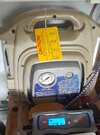
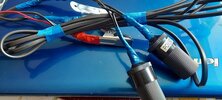
I have looked at the modern version of this Battery pack and charger.jpg 1784543475290.png but I have been waiting to see the results of the plug and play solar, as it may all change. I made a lead in case Emergancy power kit.jpg it has vanished, my wife has a carrier bag fetish, where she hides the identity of things by hiding them in a carrier bag.

But be it an auto switch on with power failure torch, proper emergency lights, returning to smoking, so I carry a lighter everywhere, until the main government also changes, we have already done it in Wales, a bit late I know, stuck with 20 MPH, but we, it seems, have to plan for Winter of Discontent 2.

But will we get plug and play before or after Winter of Discontent 2? And what else can we do to prepare to live without the grid?

Also, what can they do with smart meters? Can they select those without solar panels to switch off? Clearly turning off homes with solar panels will make it worse, we never had this in 1978, also V2G EV connections, power in 1978 was one direction only.

So famous words, what does the team think?
 
Households choosing to enrol would receive discounted energy tariffs in exchange for allowing suppliers to adjust their heating systems remotely during periods of high demand.

Sounds reasonable enough to me.

As the article says, the proposal is such that if one doesn't want that 'discounted tariff', one doesn't have to 'enrol'
 
The real reason for the push out of smart meters, it was never for your convenience.
It's a reason for push out of 'smart' appliances/equipment (although they are not remotely 'smart', merely remotely controllable), but the reare as yet very few of those to 'push out'!
 
More guff, we are all ready being restricted, have you not noticed that the off peak window has shrunk by 1 hour.. why is that as off peak demand has soared. This seem's a pretty good idea to keep off peak rates rather than moving to 24 hour rates. what are you going to tell the 1.7 million UK homes on storage heaters, sorry chaps all those heat pump/battery solar /EV brigade have nicked all the cheap leccy, cold ain't it ? Off peak demand is fast catching up with peak... what would you suggest we do about it eric ?
 
More guff, we are all ready being restricted, have you not noticed that the off peak window has shrunk by 1 hour.. ..
That may be true of some tariffs from some suppliers, but certainly is by no means universal.
why is that as off peak demand has soared. This seem's a pretty good idea to keep off peak rates rather than moving to 24 hour rates.
As you say, demand during the traditional 'off peak' period (nighttime) has been steadily increasing, due primarily to EV charging, and that is going to carry on increasing in probably quite a big way - so the traditional 'off peak' period (off-peak demand) will progressively become less and less 'off-peak', and might eventually even 'flip', such that 'off-peak' comes to be during the day and 'peak' during the night!

For that reason, I feel sure that we are going to see progressive reduction, and perhaps eventual elimination, of financial incentives to use more electricity at night!
 
have you not noticed that the off peak window has shrunk by 1 hour.
No, it was 5 hours some 3 years ago when I first got a smart meter, and it is still 5 hours.

But supplier to supplier and tariff to tariff, we have between 5 and 10 hours of off-peak and the more hours we have of off-peak in general the lower the differential between the two or three rates.

There are also two rates one if we give the supplier control, and one if we retain control.

However, all the tariffs are aimed at one group of users, and once on starts to have multi-reasons to have a split rate tariff, then it gets all muddied up.

So someone with solar panels, batteries, an EV and storage radiators it starts to get complex, which tariff works out best.

Even with gas or oil central heating with the price changes, there is a question as to if central heating Autumn, Winter and Spring is still the best idea, or if Autumn and Spring it would not be better to have an oil filled radiator in the main room only.

In fact, it does not matter if heat pump, gas, oil, or solid fuel, when only a small amount of heating is required, all central heating systems have a sweet point where they run efficiently, and when running at a low output, all central heating units tend not to run as efficiently.

However, can someone remote, really control the homes heating? I have found summer I want rooms cooler than winter. And I had a big problem with cooling times. Each radiator has a lock shield valve which I can adjust heating speed, but no way to control cooling speed.

My boiler is either on or off, but most can modulate, I know commercial freezers modulate the motor speed to adjust cooling required, I don't know if heat pumps use the same method, or are simply on or off? Likely we have both, and so some use one method and some use another.

However, it has been shown that heat pumps do need to be carefully selected to work efficiently, I have wondered if we would also get the same gains if gas powered boilers were also selected carefully for size required?
As you say, demand during the traditional 'off peak' period (nighttime) has been steadily increasing, due primarily to EV charging, and that is going to carry on increasing in probably quite a big way - so the traditional 'off peak' period (off-peak demand) will progressively become less and less 'off-peak', and might eventually even 'flip', such that 'off-peak' comes to be during the day and 'peak' during the night!
Can see that happening, due to the number of solar farms.
 
Can see that happening, due to the number of solar farms.
Solar farms, per se, obviously cannot alter demand. However, during the hours of daylight they will increase the supply-demand difference, thereby reducing or eliminating the need to incentivise people to shift demand to daytime, should daytime ever become the lower-demand period.

At present, it works fairly well, since solar generation occurs at the time of day when there is 'peak' demand. However if the 'peak demand' period ever flips today time, that will become far less ideal unless one has batteries - since solar generation would be happening at the time of day at which one least needed supply!
 
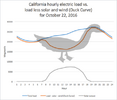
Report refer to a duck curve, 1784645405938.png when we superimpose use and generation it seems we get a curve.

But we have always had periods of peak demand, but the problem is steam or gas powered power-stations take time to come online.

So the main idea is to have a smooth curve, so we have time if required to bring power stations off/online as required.

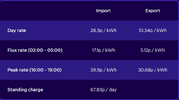
The peak 4 pm to 7 pm, is a problem, and some tariffs offer us massive rates if we export during that time, the reverse is also true where more is charged if we use it.

However, to me the question has to be why so many tariffs? I can understand three tariffs, a fixed 24/7, a variable 24 hours, but fixed as to what the charge is for each hour, and a tariff which requires you to hand over control.

But I am sure, others like me, have no option to hand over control to the supplier, and don't want to sit at our power station control board all day selecting what should run.

We want to simply sit back, and let it do its own thing, maybe wait ½ hour until off-peak starts, or set a timer on washing machine etc, but we don't want to sit there watching the state of charge (SOC) of our batteries to ensure there is enough charge to take us past 7 pm.

But this may help me, but it does not help the supplier, so why offer me a host of different rates?

So if my rate was split into 6, so 11 pm to 1 am, 1 am to 6 am, 6 am to 11 am and 11 am to 4 pm, and 4 pm to 7 pm, and 7 pm to 11 pm, then it was up to me to decide when to charge batteries, run heaters, charge a car, do my washing etc. Then there is no feeling that EV, Solar Panel, storage heater users are being given any preferential treatment.

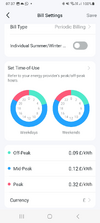
It would likely cause problems, my old smart socket adaptors only have two rates that can be programmed in, the latter ones I know I can program in three rates, 1784646933428.png with my newer versions, and my washer etc, allows delay of complete hours, so control equipment may not line up with new tariffs, but technology would catch up.

It is one thing with a £10 socket adaptor, but a solar panel inverter is an expensive lump, so unlikely to change one in my lifetime.

We also have the smart meter, mine has a single output, but some have dual outputs, as to if there are any with more I don't know. However, with a three-phase isolator, it is easy enough to give the homeowner the option, and he can fit three consumer units, essential, off-peak, and desirable, and he could have a tariff which rewards him for allowing the supplier to select clearly the essential and desirable would be 24-hour tariffs, but in times of high demand the supplier could turn off desirable.

But the problem with a heat pump, is how can a supplier turn it off, but ensure no one left in the cold? My first house was cold within an hour, this house will retain the heat so turning the thermostat down from 22°C to 17°C overnight, means the heating rarely comes on overnight.

So I simply can't see how a one system suits all can be developed.
 
At present, it works fairly well, since solar generation occurs at the time of day when there is 'peak' demand.
Sadly, peak demand in the UK tends to be around teatime when, especially in winter, solar demand is already tailing off.
 
Sadly, peak demand in the UK tends to be around teatime when, especially in winter, solar demand is already tailing off.
Yes, that's actually true, but I was talking about the parts of the day that are 'deemed' to be the peak and off-peak ones for 'tariff purposes'- and the hours of daylight certainly fall within the former.
 

If you need to find a tradesperson to get your job done, please try our local search below, or if you are doing it yourself you can find suppliers local to you.

Select the supplier or trade you require, enter your location to begin your search.


Are you a trade or supplier? You can create your listing free at DIYnot Local

 
Back
Top