I’m too young. But I thought 5A and 15A sockets were fitted/present at the same timeframe.
Therefore a lamp would have a 5A plug
Therefore a lamp would have a 5A plug

probably a bit of 19/0.0076" or about 0.5mm²Dunno.
A size which was OK with a 15A fuse for protection?
oops - my apologies, for some reason (I'll try blaming the heat) I thought the ebee/mikehammer sub-topic was 30/32A circuits.
They wereI’m too young. But I thought 5A and 15A sockets were fitted/present at the same timeframe.
even if the house had no 5A sockets?Therefore a lamp would have a 5A plug


Overload isn't a big issue with appliance cords is itIt matters a great deal - before we had fused plugs circuits were 15A radials with unfused 15A plugs.
The change to 30A ring finals necessitated changing to fused plugs.
With an unfused plug it also protects the power cord.
What size would such cords have to be if their only protection was a 32A MCB or a 30A semi enclosed?
No - you can't have 15A unfused plugs with 30/32A circuits.

The imperial equivalent of 0.5, or 0.75, I would think. The flex would possibly be twisted figure of 8, flat twin or round twin or three core depending on the era and the lamp.so what size flex was supplied on table lights in the days of BS546 15A?
They were
even if the house had no 5A sockets?
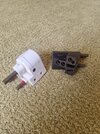
Indeed and not only that, I've also seen 30A adapters with % & 15A unfused socketsView attachment 419851
And not a 5A fuse in sight.
Sometimes but not always.I know radials use more cable, but I prefer them to ring finals.
They're easier to test

I saw a lot more 2A in place of the 5s.

Ive seen one or two electrical installations on the East Cost of OZ, one thing I noticed was they seemed to favour consumer units on the outside of a property (all be it in a "cupboard" ), is this the normal standard?Much discussion here concerning the so called mismatching of the Load (device) to the Supply (availability).
Circuit breakers (and CU fuses) are there to protect the internal wiring of a building from overload,
which may otherwise result in the overheating of in-wall conductors and possible fire - Unseen for a short time.
If a normally "low powered" device is plugged into a MUCH higher supply outlet than the device is normally intended to draw,
nothing untoward will happen - unless the "low powered" device develops a fault,
which causes it to draw significantly more than its rated load.
For such a device to draw significantly more than its rated load, it is probable (virtually certain)
that a short circuit has occurred within the device and it (or part of it) is (or is being) destroyed.
Since the device is now "beyond redemption",
what is necessary is to stop the flow of electricity,
to prevent damage to the internal wiring of the building
and to the external wiring within the premises of the building - if any.
While overheating it,
It is extremely unlikely that
a short circuit causing destruction of a "device"
would "pull" sufficient current (in the short time involved),
via any "Low Capacity" cord which may connect it.
sufficiently to cause other damage to the premises
without operating a (say) 32 A Circuit Breaker.
(In other words, you won't see the cord go up in flames if any Power Supply or Lamp develops a Short-Circuit.
Consider also a direct plug-in Power Supply)
My reasons for pointing this out is to show the "logic" which exists behind the design of "Socket Outlets" in Australia/New Zealand.
(Please view https://commons.wikimedia.org/wiki/...cket_styles_for_different_current_ratings.jpg )
Standard single phase 230 V domestic socket outlets in Australia and New Zealand are rated at 10 A - as are Lighting Circuits.
(The 10 A [and 15 A] Socket-Outlets "exist" on circuits which are rated at 20 A,
much as UK 13 A Socket Outlets may exist on 20 A or 32 A circuits.)
However, for heavier duty applications there are several variants having current ratings of up to 32 A:
From this it may be seen that any "plug" can be inserted into a socket outlet of the same or higher rating but cannot be inserted into a socket outlet of lower rating.
- The 15 A outlet has a wider earth pin than the 10 A outlet.
- The 20 A outlet has a wider earth pin and wider Line and Neutral pins.
- The 25 A outlet has an inverted L-shaped earth pin and wider Line and Neutral pins.
- The 32 A outlet has a sideways U-shaped earth pin and wider Line and Neutral pins.
Hence, a 10 A plug will fit into all of the five types of socket outlets, a 15 A plug will fit into all except a 10 A (and so on) while a 32 A plug will fit only into a 32 A socket outlet.
In general, only 10 A and 15 A socket outlets are likely to be encountered in domestic or commercial installations.
Higher rated socket outlets, used for the connection of electric ovens in domestic kitchens, are usually hidden behind ovens and never seen by the Customer.

If you need to find a tradesperson to get your job done, please try our local search below, or if you are doing it yourself you can find suppliers local to you.
Select the supplier or trade you require, enter your location to begin your search.
Are you a trade or supplier? You can create your listing free at DIYnot Local


