Electric boiler?

Does anyone know about the relative cost of gas and electricity in Germany (or, come to that, the rest of mainland Europe)?

Fischer appear to be a large, 'serious' and fairly reputable company, so if they are finding significant markets, they presumably must be in countries where the gas/electricity price comparison is very different from what it is in the UK? Mind you, their marketing people seem to be a bit lacking, since they surely must know about UK prices and I doubt that a significant number of even half-informed or half-advised people in UK would go with the all-electric option, so I wonder why they're bothering to try to sell in UK?
 
so we are then presumably simply back to the relative cost of the fuesl?
No, this is my point, fill a bath, and looking at fuel cost, but if you need 1 pint of hot water, and to get it you need to run off 4 pints first, add the inefficiency of the boiler, and your gas or oil needs to be 1/6 of the price of electric.

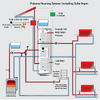
The idea to store energy has been considered, this Torrent pipe example.PNG is super expensive due to the heat stores needing to be up-stairs for safety with solid fuel, so the fire can cool with thermo syphon, but without solid fuel the tanks could be on the ground floor, but unless some energy storage, electric heating is just not going to work.
 
No, this is my point, fill a bath, and looking at fuel cost, but if you need 1 pint of hot water, and to get it you need to run off 4 pints first ...
Even that can presumably be largely addressed.

In my youngest years (and maybe the same for you), the only source of hot water we had was a gas-powered 'Ascot' instantaneous heater, with a 'swing arm' just a few inches from basin and bath. I honestly can't remember what happened in the kitchen - maybe there was another such heater?
 
Mind you, their marketing people seem to be a bit lacking, since they surely must know about UK prices and I doubt that a significant number of even half-informed or half-advised people in UK would go with the all-electric option, so I wonder why they're bothering to try to sell in UK?

Because some people are daft enough, to believe the hype? Often, they are installed in HMO's, where the tenant pay the energy costs.
 
It is, but for a system which is going to be used for the next several years, what has the fact that "now is Winter" (hence "the most expensive time of year for electricity") got to do with anything?

Did you not understand 'My own cost varies, with each day, dependent on demand, wind, and solar.' In winter, the cost rises dramatically, in winter, is also when there is a large demand.
 
Even that can presumably be largely addressed.

In my youngest years (and maybe the same for you), the only source of hot water we had was a gas-powered 'Ascot' instantaneous heater, with a 'swing arm' just a few inches from basin and bath. I honestly can't remember what happened in the kitchen - maybe there was another such heater?
1769716842801.png
Yes, I remember them, can you get an oil fired version? I suppose there is a calor gas version? I have upper bathroom, lower bathroom, front kitchen, back kitchen, and shower room, so it would need 5 units, so for me non-starter. The loses boiler to cylinder are however therefore on all outlets, so it is that lose I think about.
 
Fischer products
are grossly overpriced and make no sense for anyone ever.

electric combi or an electric heating-only boiler
makes no sense for anyone ever.

is there ever a situation in which it would make sense to even consider an all-electric approach to space/water heating?
There are, but there are far more situations where it doesn't.

In any event, electric hot water should be a storage system, such as an immersion heater in a hot water cylinder.
Any attempts to provide instant hot water via electricity in a normal dwelling will fail.
Electric combis are the equivalent of filling a bath with an electric shower, and far worse than that if you want actual hot water for kitchen purposes.
An electric boiler to heat radiators just adds massive cost and complexity, the same end result is obtained with wall mounted panel heaters.

Heat pumps are useful in some situations, mainly those where the entire system is being replaced anyway. Pricing currently is massively inflated due to the government grant distorting the market and encouraging bandwagon companies to supply the demand.
They are also usually set up for heating the property all the time even with radiators, and with UFH that's pretty much the only option, which is not particularly useful for people who go out during the day.

For smaller properties with decent insulation, the large upfront costs of a heat pump and installation may not make sense, as a small number of electric panel heaters would be vastly cheaper to install even if the running costs were higher.

The overlooked heat pump option is what has previously been sold as air conditioning - an outdoor unit with 4 or more indoor units, which can provide instant heating or cooling when required, far more suitable for properties which are unoccupied for large parts of the day or night. They are a fraction of the cost to install compared to wet heat pumps used with radiators or UFH.
 
. I honestly can't remember what happened in the kitchen - maybe there was another such heater?
It was a pipe from the bathroom heater, so when the kitchen tap was used the bathroom heater turned on automatically, and when the open flue was blocked with a birds nest it billowed toxic fumes into the upstairs of the house without anyone realising until it was too late.
 
The overlooked heat pump option is what has previously been sold as air conditioning - an outdoor unit with 4 or more indoor units, which can provide instant heating or cooling when required, far more suitable for properties which are unoccupied for large parts of the day or night. They are a fraction of the cost to install compared to wet heat pumps used with radiators or UFH.
The problem is the green lobby have convinced the government that the heat pump grants and planning exemptions should only apply to heat-only systems.

I think this is very short-sighted, but it's the reality we currently have to deal with :(
 
Did you not understand 'My own cost varies, with each day, dependent on demand, wind, and solar.' In winter, the cost rises dramatically, in winter, is also when there is a large demand.
Yes, of course I understood the first time you wrote it - and do again now that you have repeated it.

What I did not (and still do not) understand is why it's relevant that it is currently Winter. It could just as easily have been mid-Summer when I posted my message and my point would have been exactly the same - although I doubt that Why Not Indeed would then have written "...this is the least expensive time of the year for electricity ...", even if that had been true.

Don't forget that your involvement in this exchange started when you responded to my response to Why Not Indeed having written "... this is the most expensive time of the year for electricity ..."
 
are grossly overpriced and make no sense for anyone ever.
makes no sense for anyone ever.
I don't think that anyone has suggested otherwise.
There are, but there are far more situations where it doesn't.
Fair enough, but judging by what you go on to say, I presume that you feel that the few situations in which 'all-electric' might make sense are not 'wet' ones?
In any event, electric hot water should be a storage system, such as an immersion heater in a hot water cylinder. .... Any attempts to provide instant hot water via electricity in a normal dwelling will fail. .... Electric combis are the equivalent of filling a bath with an electric shower,...
Indeed, and it has always been my personal belief that the taking of baths is probably the major problem. It is that alone which creates the need for storage of relatively large amounts of hot water - so, other than when, very occasionally, there is some legitimate ('medical') reason, the taking of baths would seem to be an unnecessary waste of both water and energy (and the costs of both) ... not to mention the fact that taking baths can be argued to be questionable in terms of 'hygiene'.

If one takes baths out of the equation, then I think the arguments for hot water storage and the arguments against instantaneous water heating become significantly weaker.
 
It was a pipe from the bathroom heater, so when the kitchen tap was used the bathroom heater turned on automatically ....
You may well be right. As I said, I can't remember - I was only 6 years old when we moved from that house to one with a 'better' hot water system (a DHW cylinder, 'directly' heated by a 'back boiler' in a coal fire) - and that was a very very long time ago :-)
... and when the open flue was blocked with a birds nest it billowed toxic fumes into the upstairs of the house without anyone realising until it was too late.
That's a very 'dramatised' statement! For very many decades, all gas-burning appliances had to be satisfied with an 'open flue', if any flue at all!

My current boiler and Aga both have 'open flues'.
 
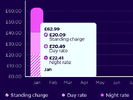
My problem is when people are coned. It is very easy to say any electric heater is 100% efficient. But what is more to the point, is what it costs, and with my own electric supply I have three prices for electric, overnight 8.5p/kWh, export pays 15p/kWh and peak is 31.94p/kWh and what electric costs is very dependent on if the battery has lasted until 00:30, and also if I have exported any electric that day.

If nothing exported, then whenever I use electric it will likely result in it costing 31.94p, but even if I have only exported 0.1 kWh, that means electric used up to that point is only costing 15p.

Adding an extra battery or two, would mean less likely to run out of low-cost electric, but this is not the problem, the problem is working out what electric costs. Or, more to the point, what it will cost in the future. This month to date, ⁣ but this does not help, as it does not show what I will be changed for that 359.6 kWh. The smart meter helps 1769741080027.png it does show me how much is off-peak and how much peak, £4.79 I got for whole month export, but to work out what an electric heater will cost, in real terms, the only way is to suck it and see. There is no real way to work out costs, I did sit back before deciding which tariff to go for, and worked out likely costs, looking at three years
1769740751237.png
1769741629968.png
1769741688176.png
having all three together, showing 2026, 2025, 2024 the 2024 I only had one battery, but it is in the main guess work, as to what will work out best, summer very different, but only using heating in the winter.

I am sure electric heating will cost me more than oil, I pay 55p/litre and just over 10 kWh per litre, so around 5.5p/kWh for oil, with a heat pump 400% efficient that means electric needs to cost less than 22p/kWh, and it needs to be as controllable as oil central heating. I pay no standing charge to have oil, unlike gas, and I can and do select what rooms to heat and when, doing this with electric would likely mean exceeding the 60 amp supply.
 

If you need to find a tradesperson to get your job done, please try our local search below, or if you are doing it yourself you can find suppliers local to you.

Select the supplier or trade you require, enter your location to begin your search.


Are you a trade or supplier? You can create your listing free at DIYnot Local

 
Back
Top