
Roof to wall Connection

Joined
22 Oct 2020
Messages
5
Reaction score
0
Country
United Kingdom
Hi all,
We are working on an extension project. We are in the process of hiring a structural engineer, but we do not wish to hire an architect and are doing the plans and the build ourselves. We already have planning permission in place.

I am no pro, but I have fully stripped out and renovated the house over the last 5 years.
I'm a fast learner with a logical mind, but also not naive to the momentous task ahead.

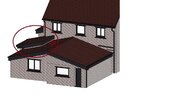
Could someone point me in the right direction for learning about how to make watertight when a roof ends at an external wall?
Also would that wall have to be a full cavity wall even though there is only about 20/30cm actually external?

Just looking for some starting points so i can conduct the research.

Tried a good old google search and I'm not getting any key words or correct terminology to help me progress.

Thanks guys!
 

Attachments
  • Roof Advice 1.jpg
    Roof Advice 1.jpg
    98.4 KB · Views: 32
Last edited:
It's a very basic detail, Google roof flashing. The type will depend on what tiles you use.

Also Google cavity trays, as you'll need them.

Be mindful of minium roof pitches.

Also if that's your design, the fascia and barge boards are massively deep, and the eaves look way too low

Good design means keeping door and window heads at the same level if possible, and that left hand window looks like it's up in the ceiling.
 
As a DIYer that's done a few 'bigger' jobs myself, please take this advice as someone that's been in your position rather than someone trying to criticise.

Please do spend the money and get someone to draw you some proper plans. You don't need an architect, but you do need someone that can do some technical drawings.

If you don't know what a flashing is, and you don't know why you're going to need a double skinned wall, then the plans are really going to help you a lot. I guarantee you will save money overall by playing for some plans, and then building everything right first time, than you will save by not having plans and making mistakes along the way.

Best of luck with the build.
 
Hi all,
We are working on an extension project. We are in the process of hiring a structural engineer, but we do not wish to hire an architect and are doing the plans and the build ourselves. We already have planning permission in place.

I am no pro, but I have fully stripped out and renovated the house over the last 5 years.
I'm a fast learner with a logical mind, but also not naive to the momentous task ahead.

Could someone point me in the right direction for learning about how to make watertight when a roof ends at an external wall?
Also would that wall have to be a full cavity wall even though there is only about 20/30cm actually external?

Just looking for some starting points so i can conduct the research.

Tried a good old google search and I'm not getting any key words or correct terminology to help me progress.

Thanks guys!
The raking abutment will be a standard step flashing. The adjacent horizontal abutment will be a sloping valley, whereby the bottom one or two tiles will be removed and a sloping plywood tray built at the bottom.
 
Dare one suggest that a flat roof would be a safer bet for a DIY job: easier to construct and easier to seal up

I also tend to think that very flat tiled roofs, even allowing for the use of the correct tiles, just don't look right.

On the basis of learning though, why not go old school and get yourself a proper paper and ink book on building construction? Basic principles don't alter though things like insulation thickness do evolve and you can always consult building regs (available on line AI free) for up to date details if yoy get an older one. Roy Chudley's books were always the gold standard and you should be able to find on Amazon easily enough

Do make sure you submit your plans for approval before you start and use the LA rather than be tempted by private suppliers of the service.

You will need a site plan drawn at 1;200 ideally which shows all trees within 30m but other than that sufficient drawings to show what you're doing. Do you have any public sewers to deal with?
 
It's a very basic detail, Google roof flashing. The type will depend on what tiles you use.

Also Google cavity trays, as you'll need them.

Be mindful of minium roof pitches.

Also if that's your design, the fascia and barge boards are massively deep, and the eaves look way too low

Good design means keeping door and window heads at the same level if possible, and that left hand window looks like it's up in the ceiling.
Thanks Woody, I understand it will need flashing, my question was more to do with the specific flashing that will be needed here, along with how the whole construction design works when a roof Eave meets a wall. I know it's not an easy thing to explain, but when searching online for specifics, I can't find anything.

I'm also aware of cavity trays, thank you, and how and where to use them, that learning curve wasn't so bad!

Roof pitch is 15 degrees!
Can get a wide selection of tiles for that shallow pitch .

Facias and barge look deep, but on the software I used they cover the tiles, so imagine that is the tiles thickness too.

The eaves are a little lower than what is 'normal' but that is to allow the pitch, and they are vaulted ceilings to hight inside is not a factor. From memory they measure 2200mm stood inside at lowest point.

Left window way too high....wife noticed that the other day! Thank you. That will be dropped to the same hight.
 
As a DIYer that's done a few 'bigger' jobs myself, please take this advice as someone that's been in your position rather than someone trying to criticise.

Please do spend the money and get someone to draw you some proper plans. You don't need an architect, but you do need someone that can do some technical drawings.

If you don't know what a flashing is, and you don't know why you're going to need a double skinned wall, then the plans are really going to help you a lot. I guarantee you will save money overall by playing for some plans, and then building everything right first time, than you will save by not having plans and making mistakes along the way.

Best of luck with the build.
Hi Kingandy2nd,

Cheers for replying.

I know basics like, flashing and when a double skinned wall is needed. It was more specifically what type of flashing or some technical terms for that type of construction where an eave meets a wall I was after.
As for the double skinned wall, as it's just the top section that is 'external' I was after some advice/reassurance I suppose that the wall would be constructed like any other external wall and then flashed and cavity trays used in the standard way like the rest of the roof at the main house.

Sound advice about having someone do some drawings.
I have done all the plans, and things like the u-value calculations. Foundation needs, build over as we have a sewer running through. So I have done a good amount when the planning permission went in.
We are getting full plans approved before we start, so the structural engineers drawing will obviously be a huge asset there.

You say we don't necessarily need an architect, what other kind of professional did you have in mind for someone to draw up drawing for the construction methods etc?


Again really appreciate the input.

Cheers
 

If you need to find a tradesperson to get your job done, please try our local search below, or if you are doing it yourself you can find suppliers local to you.

Select the supplier or trade you require, enter your location to begin your search.


Are you a trade or supplier? You can create your listing free at DIYnot Local

 
Back
Top