2 pole (mini) RCBOs

If the new regs want all these rcd's then
With a TT supply how would you avoid having a 30 ma after the 100ma one

Same way you do now - a board with separate sections, not the conventional split-load design which is really only suitable if the incomer is just a switch...
 
It is not very common, and I connot think of any reasonable reason why you would want to use a true Double Pole to monitor the neutral in a single phase situation.
Not only unreasonable, but pointless in an RCBO, because the neutral current and the phase current had better be within 30mA of each other - you can't overload just one...

A Single Pole Switched Neutral simple switches the phase at the same time as the live, but only the live pole will operate due to overcurrent.
Hmm - well ignoring the mixup of "phase", "live" & "neutral" terms ( :wink: ), what would be the point of that?
 
You wouldn't have RCD's before other RCD's if designed correctly.

Agreed not two 30 ma ones

If the new regs want all these rcd's then
With a TT supply how would you avoid having a 30 ma after the 100ma one

Altho back on with touring caravans - the site sockets need to be protected with a 30mA RCD, the caravan itself should also have a 30mA RCD too.
 
Same way you do now - a board with separate sections, not the conventional split-load design which is really only suitable if the incomer is just a switch...


Sorry not with you
I do not know how you do it now
can you enlighten me please
I do not do domestic but would like to know
The few that I have seen are old instalations and have had no rcd protection at all on any circuits.
Obviously this will have to change
I have not got 17th book yet, but understand 30ma protection required for bathroom lights etc.
Although I may be wrong.

Maybe I said it wrong
With a house in the country with a 100 ma trip on the supply,How can you design that correctly and not have an rcd before another rcd.
ie 100ma before a 30 ma
Thanks[/quote]
 
house in the country with TT supply

the "main" RCD is 100mA with a 100mSecond delay, so it will not trip if there is another RCD protecting the faulty socket circuit (because that one will usually be 30mA, and is not time-delayed, so the fault will be cleared before the delay expires)

however, it would trip if here was a fault on a circuit which did not have a non-delayed RCD on it
 
The non-delayed 30mA will also in this instance need to disconnect the neutral.
 
house in the country with TT supply

the "main" RCD is 100mA with a 100mSecond delay, so it will not trip if there is another RCD protecting the faulty socket circuit (because that one will usually be 30mA, and is not time-delayed, so the fault will be cleared before the delay expires)

however, it would trip if here was a fault on a circuit which did not have a non-delayed RCD on it

Thank you
So if that is designed right then that IS an rcd before an rcd.

If that socket circuit rcd was s/pole and tripped with a neutral to eath fault,
Then that 100ma will most likely go out also after the delay
 
true

I was thinking of the common Split-Load setup, not the superior RCBO approach
 
With a house in the country with a 100 ma trip on the supply,How can you design that correctly and not have an rcd before another rcd.
ie 100ma before a 30 ma
Thanks
You remove the 100mA from the supply, and put it into the CU.

The CU has a normal switch incomer, and then 2 or more completely separate sections - one for all the circuits that need 30mA protection, and one for the remainder which get 100mA (no longer needs to be time delayed).

Visualise it as 3 discrete units:

1) An isolator supplying 2 basic, non split-load CUs.

2) One CU with a 100mA RCD incomer.

3) The other CU with a 30mA incomer.

The conventional split-load CU has the RCD protected section downstream of the incomer, naturally, but when you make that incomer an RCD, that's when the problems start.

By making the two sections completely separate you avoid those problems. Hager have made such boards for years - I expect that more manufacturers will do so now, in order to allow more fine-grained control over which circuits are lost in the event of a fault in one. I don't think it's so much because of the new bathroom requirements, more because virtually all circuits will now need 30mA RCD protection because of the new regs on buried cables, so unless you want 1 RCD for your entire installation you're going to need either a CU with multiple separate sections, or RCBOs.

Which, BTW, do not need to be DP, or SPSN ones if there is no RCD upstream, so bigger boards are not needed. In fact, you'd free up 2 modules by having just a basic non-split board, with a switch incomer, and a bunch of SP RCBOs for all the circuits. Needs the price of RCBOs to come down though...
 
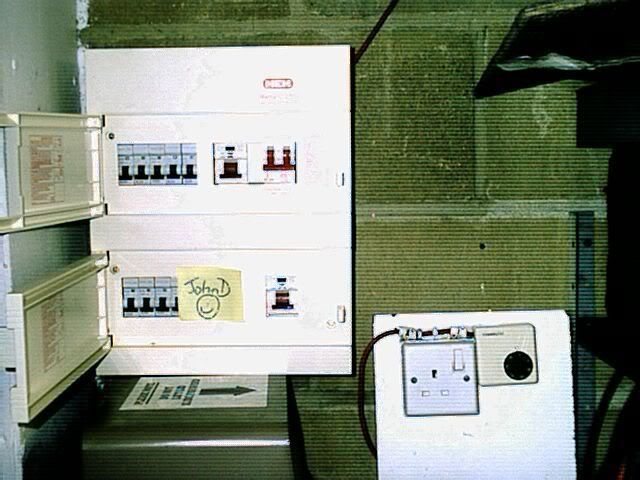
something like this?

POL_0125.jpg


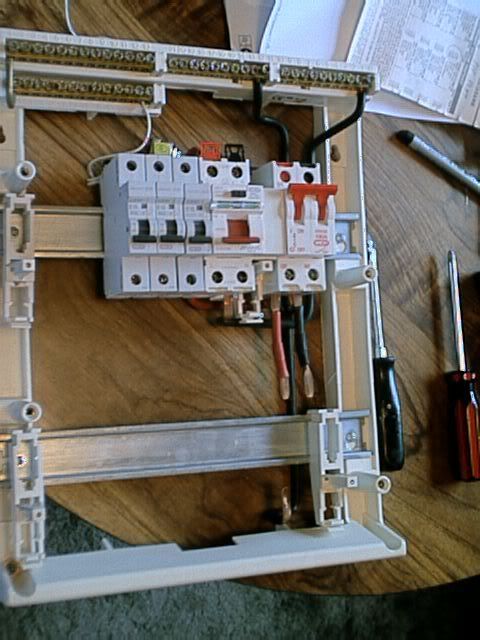
main switch feeds an RCD on the upper rail, and another on the lower rail

POL_0113.jpg
 

If you need to find a tradesperson to get your job done, please try our local search below, or if you are doing it yourself you can find suppliers local to you.

Select the supplier or trade you require, enter your location to begin your search.


Are you a trade or supplier? You can create your listing free at DIYnot Local

 
Back
Top