
You are using an out of date browser. It may not display this or other websites correctly.
You should upgrade or use an alternative browser.
You should upgrade or use an alternative browser.
Cable Tracker with Tone Generator
- Thread starter honestworker
- Start date
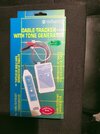

Ok for a an example….you had a cat 5 cables in your house 1 point per room …x10 that all ran to a common point that hadn’t been labelled up …you clip on the tone generator at room 1 , go to the set of 10 cables , run the probe done each of the ten cables one of these should give you a tone …
That’s how it works
That’s how it works


What is this used for (polite replies only, please)?
It depends upon the type. Some have to make actual contact with the cable, others, have adjustable sensitivity, and just need to be close to the cable being traced.

There’s something that does the same that comes in a cat5 cable installation kit and that can test every wire in each cable and tgat it’s connected properly. Plug one end of the cable from the room into one piece of ot and then plug the tester in the other end.

These testers clip onto a cable and basically turn it into an aerial. You can pick up an audible signal when you get the receiver to within 50 mm or so of the cable. Great for tracing unknown cables in walls. This one looks like my Testboy 26 in a different case. It’s great but it does have one downside. The sender needs to be connected to two wires which mustn‘t be shorted nor earthed. So if the wires you‘re trying to trace are shorted together in an unknown or inaccessible place you‘re out of luck. It’s also supposed to be able to withstand up to 400 V for tracing mains circuits without disconnecting but there’s plenty of reports on blown-up units on the internet so I‘m not going to risk mine.
Network testers in those kits are completely different, they just run current through the cable to light up LEDs, one LED per conductor. If an LED doesn’t light, the wire is open, if two light up at the same time you‘ve got a short. The LEDs flash in sequence so if they go in the wrong order you swapped wires. I recently had a truly weird experience with one of them. There were two patch cables, each 20-25 m long and sort of fixed (run through a ceiling). I wanted to connect them together so I shortened both, crimped on new plugs and set out to test each cable. Nothing. Nada. Zero. Not a single LED lit up. Used the tester on a short patch lead, worked fine. Crimped new plugs. No lights. Tested the tester with two 25 m patch leads. Worked fine. In sheer desperation I connected the two fixed cables together with a coupler and tested both together - worked perfectly fine. To this day I have absolutely no clue how this is even possible.
Network testers in those kits are completely different, they just run current through the cable to light up LEDs, one LED per conductor. If an LED doesn’t light, the wire is open, if two light up at the same time you‘ve got a short. The LEDs flash in sequence so if they go in the wrong order you swapped wires. I recently had a truly weird experience with one of them. There were two patch cables, each 20-25 m long and sort of fixed (run through a ceiling). I wanted to connect them together so I shortened both, crimped on new plugs and set out to test each cable. Nothing. Nada. Zero. Not a single LED lit up. Used the tester on a short patch lead, worked fine. Crimped new plugs. No lights. Tested the tester with two 25 m patch leads. Worked fine. In sheer desperation I connected the two fixed cables together with a coupler and tested both together - worked perfectly fine. To this day I have absolutely no clue how this is even possible.
There’s something that does the same that comes in a cat5 cable installation kit
I have one of those too, they check continuity, that there are no crossed connections, or shorts, work quite well, but you need to make sure the light sequence is the same, at both ends.
Once connected and switched on, it runs through in sequence 1, 2, 3, 4 etc at one end that sends out the signal at that end and you check that it sequences 1, 2, 3, 4 etc at the other end. If it flashes out of sequence or misses a number, you know you have a fault - either wires in wrong pins or a faulty connection/broken wire.I have one of those too, they check continuity, that there are no crossed connections, or shorts, work quite well, but you need to make sure the light sequence is the same, at both ends.

- Joined
- 27 Apr 2008
- Messages
- 10,181
- Reaction score
- 1,166
- Country

I want one of these, would be very handy at work when I have to find where the other end of a cable goes in the building.I have been given a "Cable Tracker with Tone Generator" which is brand new and still in the box (BNIB).
What is this used for (polite replies only, please)?
And a Very Merry Christmas to all!
I might get one eventually.
I want one of these, would be very handy at work when I have to find where the other end of a cable goes in the building.
I might get one eventually.
They can save you an awful lot of time, following cables.
- Joined
- 27 Apr 2008
- Messages
- 10,181
- Reaction score
- 1,166
- Country
No what you linked to does NOT do the same.There’s something that does the same that comes in a cat5 cable installation kit and that can test every wire in each cable and tgat it’s connected properly. Plug one end of the cable from the room into one piece of ot and then plug the tester in the other end.
What you have linked is to test the cable is correctly wired once it has been identified.
The op's device is so that you can find that cable amongst others in the first place.
Have a merry Christmas Day Mottie.

- Joined
- 27 Apr 2008
- Messages
- 10,181
- Reaction score
- 1,166
- Country
That's why I want one, they are about £25 on Amazon so imo worth it, I may even get work to pay for it.They can save you an awful lot of time, following cables.
Well, I would if it was not for the fact that I have already done it all manually.
That's why I want one, they are about £25 on Amazon so imo worth it, I may even get work to pay for it.
Well, I would if it was not for the fact that I have already done it all manually.
I have an ex-BT version, it's very sensitive, anywhere within a couple of feet (adjustable), and it will pickup the tone. Only thing is, the transmitter, is only safe connected upto 150v live cable, but why would you connect to a live cable?
- Joined
- 27 Apr 2008
- Messages
- 10,181
- Reaction score
- 1,166
- Country
You wouldn't - there are some specifically made for that.
These cheaper ones specifically say not to.
I have just checked amazon and found one with loads of adapters (not just 2x crocodile clip leads) so it can be plugged into RJ11and RJ45/BNC sockets etc.
These cheaper ones specifically say not to.
I have just checked amazon and found one with loads of adapters (not just 2x crocodile clip leads) so it can be plugged into RJ11and RJ45/BNC sockets etc.
Usually because you want to identify a circuit without turning anything off (connect the sender to a socket and run the receiver along the MCBs in the DB).I have an ex-BT version, it's very sensitive, anywhere within a couple of feet (adjustable), and it will pickup the tone. Only thing is, the transmitter, is only safe connected upto 150v live cable, but why would you connect to a live cable?

DIYnot Local
Staff member
If you need to find a tradesperson to get your job done, please try our local search below, or if you are doing it yourself you can find suppliers local to you.
Select the supplier or trade you require, enter your location to begin your search.
Please select a service and enter a location to continue...
Are you a trade or supplier? You can create your listing free at DIYnot Local


