Cabling for motorised valves

Joined
25 Nov 2006
Messages
781
Reaction score
16
Location
London
Country
United Kingdom
Hello

Hopefully this is not one for the plumbing forum.

In the future I may add an indirect hot water cylinder and zones to my central heating using motorised valves so want to be sure the cabling is in place.

Given the layout of the pipework the valves would be at the branches and not the boiler. (I know they need to be accessible for maintenance or replacement.)

Should the cable that powers them just run separately back to a position near the boiler? To avoid any channeling up the walls I plan to have wireless thermostats in the zones..

Would be grateful for a steer on what cable to run and where! Thanks .
 
I have motorised valves in all rooms, all wireless, they are often called TRV's, but with electronic heads, they are motorised valves.

With gas boilers they modulate, i.e. turn up and down, not on and off, so the controls also need to turn up/down, not on/off, so an old fashion hard-wired motorised valve only turns on/off, so are not a good idea with a modern gas boiler.

If there is a large area of the home, as in my case a flat under the main house, which is often not used then maybe there is a case for the old fashion control, but in the main, things like S Plan are very last century.

I have put my tin hat on, waiting for the flack, as I am sure many don't agree with me.
 
Thanks ericmark. I wasn’t thinking of ‘smart’ TRVs on the rads themselves but a type of gate valve that sits on a branch pipe of the CH flow. So say the back of the house is cold, it would allow CH flow to that branch but be closed to the branch to the warm front of the house until the thermostat called for it.

Just looking online and I’m thinking 5 core heat resistant cable should run between the valves and a central point by the boiler that feeds directly into it?

Won’t be doing any of this myself but may as well run the cable while floorboards are up. Or as you say, that’s old fashioned and it can all be done wirelessly?
 
Today can all be done wireless. The likes of Drayton Wiser the TRV on each radiator is programmed, the idea is every room is independent.

The whole idea hinges around modern boilers gaining the latent heat from the flue gasses, to do this the return water needs to be cold enough, so the boiler is able to modulate, (turn down) if the return water is too warm. But this takes time, so all control needs to be analogue to give time for the boiler to adjust the output.

The boiler will reach a point when it can't turn down any move, at this point it will start a mark/space ratio, turning on and off, but as soon as the boiler switches off, using a programmer or on/off thermostat, it has to start again from scratch.

There are analogue thermostats, using protocols like OpenTherm, which can turn the boiler up/down, but not all boilers use the same protocol, so often it would need some form of converter.

But if only turning off/on maybe 4 times a day, not really a problem, so with say 9 TRV heads all sending signals to the control hub, the chance of none of them demanding heat is slim, so the boiler rarely turns off, just goes up/down in output.

The boiler starts at flat out output, as each TRV starts to close, the pressure raises, until the by-pass valves lifts, and hot water returns to the boiler. So reducing boiler output.

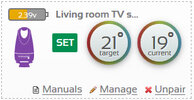
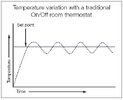
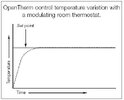
But for it to work, the lock shield valves need to be carefully set, as I said speed is important, Flat Battery TRV.jpg the electronic TRV gives one target and current temperatures, if the current exceeds the target then the lock shield valve is open too much. Using on/off control, we get a hysteresis Temp_variation_on_off.jpg using analogue control we get a smooth graph Temp_variation_OpenTherm.jpg it is easy enough to realise we don't want valves which simply turn on/off.
 
Last edited:
on what cable to run and where!
5 core flex for each valve, from the valve location to wherever the rest of the system will be located.
Wireless thermostat receivers (or wired thermostats) will also need to be connected, as will a thermostat for the hot water cylinder. 5 core flex can be used for those as well, although they probably won't need 5 cores it makes sense to use the same type as then you don't need to buy multiple types of flex, and it allows for other alterations in future.

Normally all of the items have their own flex/cable going to a central point, as does the boiler itself.
 
What setup do you currently have?
Thanks. Currently a 35kw combi boiler only but there’ll be 3 showers. I got a G3 plumber out to talk about adding an indirect cylinder, he thought the boiler would be up to it. I’m not so sure so I thought I’d lay the groundwork anyway.

I’ve extended the CH pipes and cold water inlet to where a cylinder would go (airing cupboard). There’s already a radial circuit back to the CU (nothing else on it).

… as will a thermostat for the hot water cylinder.
Thanks. Can that be wireless? The cylinder would be upstairs, the boiler downstairs. Currently the flow/return tees off to the airing cupboard before it runs to the upstairs rads. Where would the CH/HW valve be positioned? And is 0.75mm 5 core okay?

Ericmark - thanks for the detailed explanation but it’s way over my head! Bottom line is I’ve not seen any motorised trvs that complement traditional rads so am thinking old school. I’ve used them previously on a Vaillant system and they were so noisy - especially annoying when I was trying to get to sleep and they were whirring away! There are three floors and a lot of rads so I think it would be very costly.
 
he thought the boiler would be up to it
It will be, it's already grossly oversized as it's been sized for instant hot water delivery.

Can that be wireless? The cylinder would be upstairs,
Wireless cylinder thermostats do exist, but unvented cylinders require a hard wired hi-limit thermostat, so the whole lot might as well be wired as a cable will be needed even if the temperature sensing part of it is wireless.
 

If you need to find a tradesperson to get your job done, please try our local search below, or if you are doing it yourself you can find suppliers local to you.

Select the supplier or trade you require, enter your location to begin your search.


Are you a trade or supplier? You can create your listing free at DIYnot Local

 
Back
Top