Compression fitting problem

Joined
8 Jan 2026
Messages
5
Reaction score
0
Country
United Kingdom
Hi all!

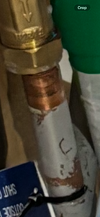
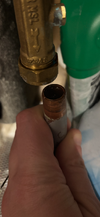
We recently purchased a new build and in the two weeks we’ve been in and not drained down the external tap (yes, bad us) - a pipe has popped out and caused a small flood. Before I put it down to us not doing the draining - I am looking for some advice on this fitting… to me it looks like the olive hasn’t clamped down enough to seal and so even though the freezing weather was the trigger, an incorrectly fitted pipe may be the cause? It looks more like discolouration than a clamping. My limited understanding would say that a correctly fitted pipe wouldn’t have ‘popped’ out like that due to freezing weather and the pipe would have burst or cracked somewhere instead?

Any help would be greatly appreciated to help me with conversations with the builders.

Thanks
 

Attachments

  • IMG_0910.png
    IMG_0910.png
    1.8 MB · Views: 41
  • IMG_0911.png
    IMG_0911.png
    1.6 MB · Views: 40
Thanks both. Guess this is more of a question of liability with the builder/plumber - they want to push it to be my fault for not draining down (which is 100% the trigger) but my argument will be that the part that failed wasn’t installed correctly as wasn’t tight enough, so was going to come loose at some point… the weather was just the trigger.
 
Freezing water in a pipe creates immense pressure as the water expands ,easily enough to pull apart a compression fitting.
I have seen 8 inch diameter cast iron pipes in sprinkler systems split when frozen ,a little olive on a compression fitting is miniscule in comparison.
 
Thanks Terry, do you think the fitting was correctly installed based on pictures?

Completely agree about the pressure etc, no dispute on the trigger. Just whether the fitting was sealed well enough.
 
On any compression fitting on a copper pipe ,including one that is " correctly fitted",the olive can be pulled off the pipe with an olive puller ,and can usually be removed by tapping the nut against the olive with a spanner , leaving the pipe itself with no visible damage ,and able to be re used.
The water pressure in your domestic plumbing would typically be 3 or 4 bar ,and often less, the pressure exerted by freezing water is immensely higher than that.
As you have unfortunately experienced a flood in your new home ,I really feel for you bud , hopefully there wasn't too much damage.
 
As suggested, the forces applied on fittings when ice expands is very significant, it can split copper, crack cast iron, split rock etc. Also as suggested, a compression fitting that has been fitted correctly can hold fine under the pressure of the mains water but the olive can still be twisted off the copper pipe using grips, so expanding ice would have no problem squeezing the pipe out.

If the tap has been fine till now (no leaks) then unfortunately there's no issue around its install but if it didn't have the ability to be isolated and drained down (nor fitted with a double check valve) then that would be a different issue.

As mentioned though, it's never good when something like that happens and there is damage but I wouldn't look to a bad install as the reason, given the info.
 
Thanks both - appreciate the feedback. My limited knowledge suggested that there should be indentations on the pipe, of which there isn't. Not from over-tightening, but by correctly installing with a slight decompression to leave witness marks and create the seal.

There was a slight leak when we first moved in but it hadn't leaked since, or the external tap used in that time. Fitted with a non-return valve and able to be isolated.
 
Did the initial leak magically resolve itself? Did you have any evidence of this?

Pipework isn't designed or installed with the notion that it should be allowed to freeze up.
 
It was such a small leak and was only on the first day I moved in (a month ago). Almost as if weeping from the joint but the pipework was obviously installed significantly prior. Since then, tissue under the pipe and no leak.
 
At the end of the day, a frozen pipe is a frozen pipe. Winter is to blame.
 

If you need to find a tradesperson to get your job done, please try our local search below, or if you are doing it yourself you can find suppliers local to you.

Select the supplier or trade you require, enter your location to begin your search.


Are you a trade or supplier? You can create your listing free at DIYnot Local

 
Back
Top