Yes, agreed - but, other than for the higher initial cost of a 'higher kW rating' combi, I'm not convinced that makes much difference, does it? Maybe a slightly larger exchanger to heat up but, beyond that, no other issues come immediately to mind.One of the problems with combi-boilers, the other being that a combi, to be able to satisfy the demand for the hot water to be instantly heated, it needs to be much higher Kw rating, than it would be to just serve CH, plus heating a cylinder.

You are using an out of date browser. It may not display this or other websites correctly.
You should upgrade or use an alternative browser.
You should upgrade or use an alternative browser.
Electric boiler?
- Thread starter JohnW2
- Start date

Yes, I think we're all agreed about that. For what it's worth, my personal experience of 'average' homes with stored hot water is that there are usually quite significant delays before hot water appears at taps and showers - delays which do not feel (to me) to be any less than those I experience in (generally fairly small) homes with combis.
Then the layout is poor, or the building itself limits the pipe runs. My taps are all reasonably close to the source, the cylinder, and so little delay. The one exception, is the utility room, where we rarely need small quantities of hot water.

- Joined
- 27 Jan 2008
- Messages
- 29,557
- Reaction score
- 3,638
- Location
- Llanfair Caereinion, Nr Welshpool
- Country

I had a Main 7 instant hot water boiler in the last house, it only did DHW, there was another boiler for central heating, seem to remember 18 kW, which was ample for the DHW supply, and we draw DHW for such a short time, turning off central heating when we want DHW is not really a problem.One of the problems with combi-boilers, the other being that a combi, to be able to satisfy the demand for the hot water to be instantly heated, it needs to be much higher Kw rating, than it would be to just serve CH, plus heating a cylinder.
So yes, when you need a 12 kW boiler for central heating, you may fit a 20 kW combi boiler. But that is the point where it stops, there is no point fitting a 35 kW boiler if not required for the central heating.
I will admit I have looked at 25 kW v 35 kW and both could modulate down to 6 kW, which still seems high for central heating, 95% of the time, I only need one room heating, and this room in the main needs no more than 3 kW. So we look at the graphs, on/off
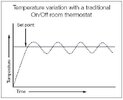 and analogue
 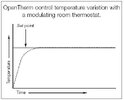 the analogue can only be archived if the boiler does not turn on/off. It does not matter if OpenTherm or some other analogue control, it needs to be able to turn down low enough.
The electric boiler can be wave form chopping controlled, so like the gas, it modulates, but we are talking about time between switching, using solid state switching 5 minutes is short enough between switching to produce a reasonably smooth graph, but using contacts, they would not last very long, and would be looking at more like half an hour between on times.
Setting my Nest Gen 3, it asks what type of boiler, and one assumes a longer time with oil, to gas? But, since I have 3 independent thermostats, 4 in all, and anyone can call for heat, the minium off time simply does not work.
If I had a modulating boiler, Autumn and Spring it must reach a point where it still needs to revert to a mark/space ratio.

ll true, but, if we are "massively exposed to gas prices", and a net importer of it, why is it that gas is so much cheaper than electricity in the UK?
Electricity is grossly overpriced most of the time, as gas is what provides the peak demand, and due to an outdated market system, all electricity is sold at the same price, so a tiny amount of expensive gas generation sets a high price for everything else regardless of where or how it is generated.
Then there is the absurd situation where mainly due to to distribution constraints, wind generators in the North are paid to not generate anything because there is insufficient capacity to get the electricity to where the demand is, while at the same time gas plants further South are paid immense sums as a peak top up.
These and other outdated arrangements add £billions to the cost of electricity every year, and are also where most of the 'rip off' type charges mentioned in the usual rag publications are going.
Plenty of people have lobbied to get rid of this outdated system and have electricity priced regionally, so those closer to available generation pay less. That doesn't mean that those further away would pay more either, as it gets rid of the one price for everything everywhere.
However big generating companies both gas and wind powered do not want this as it would mean they would get paid less. They would still be paid and make a profit, but not as much as the gross excesses that they do now.
There is a pile of other complexity with electricity markets, but that is the general concept of how everyone in Britain is paying way more for electricity than they should, which includes commercial and industrial users, and those high energy prices are passed on into everything else that's made or sold.
I had a Main 7 instant hot water boiler in the last house,
That's the same one I had.
There's obviously a lot more scope for 'optimal design' in the case of a new build, but with an existing home,the locations of kitchen, bathroom(s) and DHW cylinder are usually 'set in stone' (unless one has very deep pockets!).Then the layout is poor, or the building itself limits the pipe runs. My taps are all reasonably close to the source, the cylinder, and so little delay. The one exception, is the utility room, where we rarely need small quantities of hot water.
I've just done an experiment. My kitchen taps are about 5 metres horizontally and BOUT 2.5m vertically from the top of the DHW cylinder (which I doubt is 'excessive' or 'very unusual) and the pipework takes more-or-less the shortest possible route. The hot tap has not been used significantly for quite a while. On opening the kitchen hot tap almost completely, it takes about 25 seconds before the the temp of the water shows any perceptible rise (presumably left-over from when hot water was last drawn) and about 65 seconds before the water emerging from the tap is at its 'full temperature'. I don't regard that as particularly 'quick', do you?
That's clearly the case, the question obviously being "why?". In that regard, you go on to say ...Electricity is grossly overpriced most of the time
If gas is 'so cheap' why is gas-generated electricity so expensive? Are 'renewable' and nuclear sources of electricity really all that cheap (a lot cheaper than gas generation) when the capital expenditure of the required kit is taken into account?.... as gas is what provides the peak demand, and due to an outdated market system, all electricity is sold at the same price, so a tiny amount of expensive gas generation sets a high price for everything else regardless of where or how it is generated.
No 'point' I agree (if one only wants the boiler for CH) but, as I asked, is there actually an appreciable downside (other than initial cost) of installing a boiler big enough to provide instant hot water?.... So yes, when you need a 12 kW boiler for central heating, you may fit a 20 kW combi boiler. But that is the point where it stops, there is no point fitting a 35 kW boiler if not required for the central heating.
I don't regard that as particularly 'quick', do you?
No, that is much slower than here, and will waste a lot of energy, and water. Mine is much quicker.
If gas is 'so cheap' why is gas-generated electricity so expensive? Are 'renewable' and nuclear sources of electricity really all that cheap (a lot cheaper than gas generation) when the capital expenditure of the required kit is taken into account?
Because the gas generation equipment, has to be kept, wastefully, ticking over, ready to use. We are paying three times over - for the wind generation, to switch the wind generation off, when we cannot use it, because it's being generated in the wrong place, then again for the gas they use to make up for what wind is not generating. It is absolutely crazy!
I will admit I have looked at 25 kW v 35 kW and both could modulate down to 6 kW, which still seems high for central heating, 95% of the time, I only need one room heating, and this room in the main needs no more than 3 kW.
I wonder if, a small heatstore would help, with reducing the on/off? Something like a cross between a normal wet rariator, and a storage heater?
The price of the gas as a fuel has very little to do with the price charged by gas powered generators.If gas is 'so cheap' why is gas-generated electricity so expensive?
If demand is high and supply weak, they will charge astronomical prices to cover that demand, because they can. Every day 4pm - 8pm being the usual gouging period.
Nuclear is expensive all the time.Are 'renewable' and nuclear sources of electricity really all that cheap
Gas is expensive some of the time, but when it is expensive, it's the most expensive of all.
Renewables should be the cheapest, but paying them £billions to not generate makes them more expensive than they should be.
Whatever is expensive at a particular moment sets the price for all electricity at that time regardless of where it is generated.
As I said, "horses for courses" - although I don't think that the sort of lengths of pipe run I have here are necessarily all that atypical.No, that is much slower than here, and will waste a lot of energy, and water. Mine is much quicker.
However, and 'whatever', I presume that, in my case, it would probably be 'better' (cheaper to run and less 'delays' to endure), at least in my kitchen (and probably the bathroom immediately above it) if I had a combi in the kitchen?
Seemingly so - but again, "why?". You go on to write ...The price of the gas as a fuel has very little to do with the price charged by gas powered generators.
Why does Ofgem allow that?If demand is high and supply weak, they will charge astronomical prices to cover that demand, because they can.
Fair enough - but none of that makes a lot of sense. Again, why do Ofgem not have something to say about it all?Nuclear is expensive all the time. ... Gas is expensive some of the time, but when it is expensive, it's the most expensive of all. ... Renewables should be the cheapest, but paying them £billions to not generate makes them more expensive than they should be. .... Whatever is expensive at a particular moment sets the price for all electricity at that time regardless of where it is generated.
- Joined
- 27 Jan 2008
- Messages
- 29,557
- Reaction score
- 3,638
- Location
- Llanfair Caereinion, Nr Welshpool
- Country
Since when has politics made sense? The big problem is lack of rotating mass. With an alternator connected to a large steam turbine, a sudden load will be taken up by the weight of the rotating mass, but with wind farms, solar and wave power, there is an inverter between the rotating mass if any, and the grid, so an over load will trip out the generator, and the supply fails like the domino effect.but none of that makes a lot of sense.
So we need both the fast reacting hydropower, and the plodding nuclear and other steam powered generators, and the trick is to strike a balance. But the people who build the systems want paying, so even if the form of generation is not ideal, we have to buy the power, I, for one, would be rather unset if told now I have installed solar panels, I am not going to be paid for export.
Not so bad with my installation as my battery acts as a buffer, charging and discharging as clouds expose and mask my panels, but many have been installed without batteries, so mine do not start exporting until around 11 am even in the height of summer, and I don't need to watch the solar like a Hawk to know when to do my washing. Yes, need to watch battery level, but that changes a lot slower.
What it needs is for the smart meters, car EV chargers, and solar inverters to be linked to a central electricity generating board, able to switch off not essential services while retaining essential services, years ago we had this, where lights, and power were on different meters, and latter the Economy 7 with teleswitches so the CEGB could shed load, but my smart meter does not have two independent supplies, so the CEGB could only switch all or nothing, they can't just turn off non-essential load even if they want to.
The EV charging does allow the CEGB to switch off chargers, and by permitting them that option, they reduce the off-peak charge rate to 6p rather than 8.5p, but only the EV charger does that, not also the smart meter, so people have been cheating using both timed cheap rate, and load based cheap rate.
This cheating started with solar panels, it was estimated what the export would be, and the installers would get paid even if the export was not going on, so we got devices like the iboost+ designed to use solar to heat domestic hot water, and UFH when there was excess solar, the loopholes are being slowly closed, but in the meantime, everyone else is paying for it.
Most of those running OFGEM previously worked in the very same industry.Why does Ofgem allow that?
Like most of these 'regulators' they have zero interest in doing anything that doesn't maintain the existing systems.

DIYnot Local
Staff member
If you need to find a tradesperson to get your job done, please try our local search below, or if you are doing it yourself you can find suppliers local to you.
Select the supplier or trade you require, enter your location to begin your search.
Please select a service and enter a location to continue...
Are you a trade or supplier? You can create your listing free at DIYnot Local

