Job description:
To demonstrate Mottie is wrong, inexperienced, and wrong some more about tyre fitting.
Job personnel:
First time fitter.
Job schedule:
3.5 hours.
Job materials:
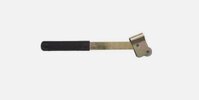
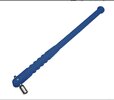
22 year old tyre, 26 year old rim, new china aluminum-alloy tubed valve stem, tyre paste, tyre sealant, soapy water, 2x 24 inch tyre iron, 2x 300mm f-clamps, 3d printed wedging tool.
Job methodology:
Prying, praying, head scratching, losing hope and accepting defeat, elation.
Tyre is locked in place to prevent it "walking" while prying elsewhere. One clamp for the part of tyre above the wheel face, and one clamp for the part of tyre below the wheel face.
3D printed wedging wheels to depress the tyre side to enable the entire tyre side to go into the wheel groove up to the apex of the protective rubber rim flange. These wheels must be removed once the tyre side starts to enter the groove or the entry will be obstructed by the wheels. The tyre side will enter the groove as a result of tensioning from prying. These wheels are printed using petg with a 10% fill.
Deep insertion of the tyre iron allows a hand to be freed. This may or may not be useful.
The wedging wheels protecting the valve stem base and enabling the tyre side to slide under it.
The tyre iron takes a couple of bites out of the thin edge of the tyre bead, oooooouuuuuch!!!
Mission accomplished and later tested with no leaks.
Observations:
1. Paint will be damaged from prying. The wheel metal will be fine. In particular, the paint on the rim edge and the bead seat will be battle scared.
2. There is very little clearance for the tyre edge. The tyre side for the entire tyre must be made to go into the wheel groove as soon as possible to produce a tiny slack.
3. Prying requires alternating between folding the tyre edge below the rim face and pulling the tyre edge away from the rim horizontally. Sometimes, reversing the folding slightly can help positioning the tyre edge. Also the tip of the tyre iron requires constant switching, and the orientation of the tip requires constant changing.
4. To help seating the beads, pick up the wheel, raise it as high as possible, then drop it and catch it like a basketball a good number of times. My beads sat on the first pump. I did give the bead seat as well the tyre rubber plenty of tyre paste. I also ensured the paste go as deep as possible. The valve stem base did keep a gap open with the tyre. But, it did not noticeably affect the inflation. The valve core was removed to increase air flow.