Failed EICR - is this a C1?

Joined
21 Jul 2004
Messages
385
Reaction score
3
Country
United Kingdom
Howdy chaps,

Had an eicr carried out today which failed on the following:

Observation 1 — C1
Protection against mechanical damage where cables enter consumer unit/distribution board (522.8.1; 522.8.5; 522.8.11)

Observation 3 — C3
Coordination between conductors and overload protective devices (433.1; 533.2.1) light circuit in 16 A mcb

Also mentioned the exposed tails for remedial action, but did not give a code for this.

Been quoted £510 to carry out the following remedial works:

EICR Remedial Works Required: 1. Replace 2 x rcd 2. Fi on upstairs cpc discontinuity 3. FI on cpc continuity on upstairs lights , if no cpc present replace switch to plastic 4. Install grommets 5. Move light circuit to 6 A mcb 6. Terminate the incoming meter tail with no copper exposed

Pricing


Labour £300
Materials (EICR remedial materials) £180
Recalibration £20
Sourcing Fee £10
Total £510

Is this classified correctly and reasonable cost to remedy the problems?

Thanks
 

Attachments

  • eicr2.jpg
    eicr2.jpg
    86.4 KB · Views: 22
  • eicr1.jpg
    eicr1.jpg
    69.8 KB · Views: 20
Anything with an FI can not be given a firm price as it could take 30 mins or 3 hours to sort out.

1. is NOT a C1 possibly a C3
2. OK
3. OK
4. is NOT a C1
5. Is a C2
6. Is not really a code as its within the CU. I would have "fixed" that when doing the EICR

Observation 1. is a C2

Observation 3 is a C2

Very poor report IMHO

Is this a rental?
 
In essence, I agree with @Murdochcat it is clearly up to the inspector, unlike an MOT there is no hard and fast coding, most follow electrical safety first, but nothing says you must.

"5. Move light circuit to 6 A mcb" I can't see why the old regulations said "559.6.1.6 Lighting circuits incorporating B15. B22. E14. E27 or E40 lampholders shall be protected by an overcurrent protective device of maximum rating 16A." so I would have thought 16 amp was OK.

"6. Terminate the incoming meter tail with no copper exposed" the electrician can't touch that, and it has nothing to do with a report for rental properties.

FI as @Murdochcat says means not inspected/tested, so no price can be fixed on that. I wonder why FI, why was it not investigated at the time of the first inspection.

"1. Replace 2 x rcd" Why? Did they fail to work? I note only 63 amp rating, but that would only matter with the left-hand one, if the DNO fuse is more than 60 amps.

"Observation 1 — C1" With any C1 something needs to be done before leaving the premises, be it turn off all the power, lock a door, draw a fuse, one can't walk away if there is a real C1. It would seem to be related to "4. Install grommets"

What I feel, is if is clear fault reported does not warrant the code awarded, it puts the whole of the report under the "don't trust it" label.

With a rental property all that is required when an EICR has items which fail, is to have a report from someone qualified to say it has been fixed, be it a recite, minor works certificate, or other paperwork. However, if one can't find a problem, one can't fix it. So a report saying replace 2 x RCDs if when testing they don't comply then easy, but if the trip within the required time and current, then one is left wondering if the inspector has seen something the electrician doing the work has missed.
 
: 1. Replace 2 x rcd
The existing ones are Type AC, presumably this means replace with Type A.
Valid if it has been decided to update to the latest 18th edition (as for a rental property), however as there are only 5 circuits, buying 5x RCBOs would be a far better option and cost about the same.
If it's not a rental then no requirement to update to the latest anything unless it was wanted, or there are other works planned such as extending circuits.

2. Fi on upstairs cpc discontinuity 3. FI on cpc continuity on upstairs lights , if no cpc present replace switch to plastic
No CPC is bad - however what do they mean 'if no CPC present' ? Surely they looked to see if it had one?
Or is this another one where EICR means do a few tests and inspect nothing?

4. Install grommets
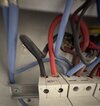
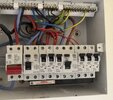
At the back of the consumer unit where there are none?

5. Move light circuit to 6 A mcb 6.
Could have already been done in 30 seconds.

6. Terminate the incoming meter tail with no copper exposed
Yes, but as it's within the consumer unit and no one will be poking at it unless they have removed the lid, it's hardly the end of the world as we know it.
Another couple of minutes to fix, could have been done already.
Those 'tails' look to be from a piece of flat T&E which will have an undersized CPC, and then there are questions about how it is installed in the walls, and whether additional protection would be required.

None of these items are C1 - that would only apply if something was dangerous right now and could injure or kill someone.
No CPC might be C2 if there are metal class I light fittings / switches.
The missing grommet at the back of the consumer unit could be C2 if there is a real risk of damage to the wiring, however if those cables are embedded in the wall, they won't be moving so in reality the risk of damage is effectively zero. C3 at best unless they are already damaged.

There appear to be 2x CPCs at the back of the consumer unit which are not connected to anything. Perhaps the 'missing' ones for the lighting circuits?

unterminated.jpg
 
Thanks @Murdochcat , @ericmark & @flameport - Good spot on the 2 cpc's that dont appear connected to anything.

Very insightful comments, appreciate your responses.

Yes this was for a rental, a 2 bed flat. He was in and out in less than 20 mins. Dont believe he opening any switches or sockets.

Here are the test results of the board testing.

1786473611421.png

1786474767098.png

 
Last edited:
He was in and out in less than 20 mins.
Impossible for any meaningful inspection or testing to be done in that time.
3 or 4 hours would be a more realistic time for an installation of that size.

Of those results, circuit 2 appears to have an open r2 (reading given as 1999 which is the max display on some devices)
and circuit 3 has an r2 which is ridiculously high compared to the r1 and rn values.
 

If you need to find a tradesperson to get your job done, please try our local search below, or if you are doing it yourself you can find suppliers local to you.

Select the supplier or trade you require, enter your location to begin your search.


Are you a trade or supplier? You can create your listing free at DIYnot Local

 
Back
Top