All true, but 'disposable' (aka 'throw away'), a concept which I find somewhat offensiveMaybe consider flat panels , can be suspended from ceiling or fixed to it and give a good spread of light and cheap.


All true, but 'disposable' (aka 'throw away'), a concept which I find somewhat offensiveMaybe consider flat panels , can be suspended from ceiling or fixed to it and give a good spread of light and cheap.

To a very large extent I agree with you. There are times when newer is better, i.e. when it is less polluting, less wasteful on the planet's resources, etc. But I still stick by the old adage "if it aint broke then don't fix it"All true, but 'disposable' (aka 'throw away'), a concept which I find somewhat offensive
Yes, ther obviously can be cases when that is true, but I would think fairly rarely.To a very large extent I agree with you. There are times when newer is better, i.e. when it is less polluting, less wasteful on the planet's resources, etc.
Same here, but we're talk about a slight variant on that, namely "if just a bit is broke, don't replace the whole thing". Imagine the situation if car tyres or batteries were irremovable and not replaceableBut I still stick by the old adage "if it aint broke then don't fix it"


All true, but 'disposable' (aka 'throw away'), a concept which I find somewhat offensive
As a generalisation, I would totally agree with that.Most of the cost, and value, is in the parts of the module which fail, so little point in making those separately replaceable, or manufacturing parts for them. Of course, nowt to stop you buying replacement components, to fix them, as I sometimes do.
However, in the case of things like 'LED tube' light fittings, where the (only) parts which can really 'fail' are the LED elements and the 'driving electronics', it surely would make sense to include all those in a replaceable tube, which can be easily replaced in just a few seconds, without causing any disruption, just as with a fluoro tube, wouldn't?
And the time and effort to get the tools out, strip the fitting to get to the screws, remove it then redecorate the damaged paintwork or the replacement is a different shape /size as opposed to replacing a tube?Not really, you listed above, most of the parts and cost, in such a LED fitting. The only thing left, is the casing.
Yes, I agree with that because it is what I have to do. My problem is that my age is against me and balancing on ladders isn't as easy as it used to be.And the time and effort to get the tools out, strip the fitting to get to the screws, remove it then redecorate the damaged paintwork or the replacement is a different shape /size as opposed to replacing a tube?


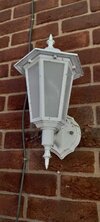
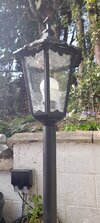 similar, first integral, second uses a bulb, in spite of making a reflector above the bulb, the first one with the LED's built into the top, so all shining down, lights below it far better to the one on the pole. However, don't know rating of the wall lamp, must measure it sometime.
I have a similar problem, but I feel obliged to find solutionsYes, I agree with that because it is what I have to do. My problem is that my age is against me and balancing on ladders isn't as easy as it used to be.
Indeed, but it's replacing the casing that takes much more time/effort (than simply replacing a tube or lamp/bulb), and which is quite likely to result in the need for some 'making good' and decoration.Not really, you listed above, most of the parts and cost, in such a LED fitting. The only thing left, is the casing.
Indeed, but it's replacing the casing that takes much more time/effort (than simply replacing a tube or lamp/bulb), and which is quite likely to result in the need for some 'making good' and decoration.
With some items (particularly when there are multiple 'matching' ones, I do do that at the time of the initial purchase - but (a) many things are not quite as easy to replace as in the example you cite and (b) particularly if the items are reasonably expensive, I am not happy with the negative effect this has on my 'cashflow' and, even worse, the fact that the 'just in case' items I've bought may actually never be needed (i.e. 'wasted money').Then you think ahead, and buy spares. For the lights in my kitchen, I have spares. The mount on a plug in base, it takes just a second to slide a failed one out, and slot a replacement in. Actually quicker/`easier, than changing a fluorescent tube.
).
On the other hand, I never had any problem buying fluorescent tubes or lambs/bulbs for fittings I had, at the time I needed them, even decades later, and it very rarely took more than 'a few seconds' to replace them (give or take the occasion nightmare when the lampholder fell apart
Do you really believe that 'throwaway' light fittings etc. are a good idea?

If you need to find a tradesperson to get your job done, please try our local search below, or if you are doing it yourself you can find suppliers local to you.
Select the supplier or trade you require, enter your location to begin your search.
Are you a trade or supplier? You can create your listing free at DIYnot Local


