• Looking for a smarter way to manage your heating this winter? We’ve been testing the new Aqara Radiator Thermostat W600 to see how quiet, accurate and easy it is to use around the home. Click here read our review.

Halogen Bulbs to LEDs (Tranformer)

Joined
9 Sep 2005
Messages
99
Reaction score
2
Country
United Kingdom
I want to change a set of Halogen bulbs in my bathroom to LEDs. I've simply replaced the bulbs but the last one flickers (all of the others are fine).
Been told I need an LED transformer.

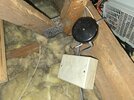
I have these 2 boxes (one black, one white) in the loft where the lighting cable goes into, then out of and services a set of 16 halogen downlights across 2 bathrooms.

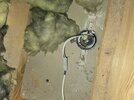
Then this is what the connection to each downlight looks like.

Where do I put the transformer? Is it replacing the 2 boxes or do I need one transformer per bulb and put the transformer just above the bulb cable?
 

Attachments

  • 20250403_152218.jpg
    20250403_152218.jpg
    380.7 KB · Views: 75
  • 20250403_152240.jpg
    20250403_152240.jpg
    374.7 KB · Views: 73
if you have replaced mains halogens with mains led then unless the last light is transformer fed it could just be a faulty bulb or loose connection. try swapping a non flickering bulb with the flickering one
 
There are a number of power supplies one can have, the toroidal transformer outputs a percentage of the supply voltage, it does no regulation, and it does not matter if the load is 1 watt or 200 watt as long as not more than the transformer can provide. And if 50 Hz in, then it was 50 Hz out. They were expensive, heavy lumps, and there was a move to switch mode power supplies, (often called electronic transformers) these have improved over the years, but they regulated the output, so if the input varied 207 to 253 volts, the output stayed at 11.9 volts, often the frequency changed so output in the MHz range, early version had a minium and well as maximum power output often given as VA which is nearly the same as watts, so typically 60 to 120 VA, so changing to LED can under load the unit and cause it to switch off, latter versions do go zero to maximum but still MHz range so limited how much wire can be used on the extra low voltage side.

There is also the driver, these could be AC or DC output, but current regulated rather than voltage, I first came across them for airport runway lamps, designed, so all lamps had same output, however the lighting industry love to call new after the name used for the old, as seen with the toroidal and electronic transformer, so today drivers are normally DC, and can be either current or voltage regulated, so one has to read the label carefully, but because they are DC the length of the extra low voltage cables is not a problem.

In the main 12 volts, LED down lights are AC, but just as happy with DC, there are some specials mainly designed for boats and caravans which are DC only and very economical to run, AC can be transmitted with capacitor or inductive linking, so a little power has to go through a resistor to stop lights flashing or staying on dim, this is not a problem with DC, so the specials for boats and the like produce more lumens per watt, tend to be low wattage, and can work with 10 to 30 volts, which is a huge range. Often over 100 lumens per watt.

The type, for AC use, vary 75 to around 90 lumens per watt. But there it also loses with the voltage dropped as well. But most of the advantages of using extra low voltage are lost with LED, so we tend to move to low voltage (50–1000 volts is low voltage with AC) but to fit 230 volt lamps, one needs an earth to comply with regulations, note not always required to be safe, but only pendent lamps can be fitted without an earth terminated even when not really required, it is an old rule from 1966 when we started to use more fluorescent lamps, but it still applies today.

So often the wiring for extra low voltage does not have an earth, so technically you should not use the old wiring, although it will work.

Moving to low voltage means you can get smart bulbs, so you can dim, colour change, or turn sections off. So there is an advantage to moving to low voltage (Note in the USA they call extra low voltage, low voltage, so need to read the volts in case of grey imports).

So one find out what you have, and two decide on the route you want to take.

 
It’s not a faulty bulb, I’ve swapped it over for another one and same happens.
There’s 9 bulbs in total, 3 rows of 3. If I put 8 bulbs in and leave the last one as halogen then it’s all fine. As soon as I swap that last one for LED then it starts to flicker.

Just tried to swap the last one again for an LED and all of the last row of 3 started to flicker, very strange. I don’t think there are transformers on any of them (as in they all look like the 2nd picture below)
 
It’s not a faulty bulb, I’ve swapped it over for another one and same happens.
There’s 9 bulbs in total, 3 rows of 3. If I put 8 bulbs in and leave the last one as halogen then it’s all fine. As soon as I swap that last one for LED then it starts to flicker.

Just tried to swap the last one again for an LED and all of the last row of 3 started to flicker, very strange. I don’t think there are transformers on any of them (as in they all look like the 2nd picture below)
No pictures.

Do they flicker if the halogen bulb is elsewhere in the group of 9?
 
It’s not a faulty bulb, I’ve swapped it over for another one and same happens.
There’s 9 bulbs in total, 3 rows of 3. If I put 8 bulbs in and leave the last one as halogen then it’s all fine. As soon as I swap that last one for LED then it starts to flicker.
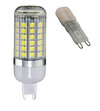
I had the same with low voltage (230 volts) switched with a smart switch without a neutral. Five lamps, four LED and one halogen OK, but five LED flickers and would not turn fully off. My wife found some bulbs on the internet G9-comp.jpgthe larger bulbs worked OK, well one failed, so I took it apart to see how it worked, the smoothing capacitor in the large bulb which stops the flicker, was nearly as big as the whole of the smaller bulb.

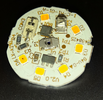
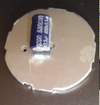
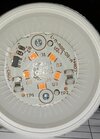
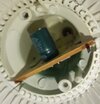
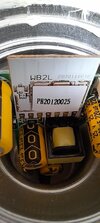
This is repeated with many bulbs bulb inner1.pngbulb inner2.png shows a smoothing capacitor under the printed circuit for the LED chips, and again GU10-inside-1.jpgGU10-inside-2.jpg this one a GU10. As to smart bulbs 20220603_113820.jpg even more capacitors crammed into the small space in a GU10 type MR16 compatible bulb. One does not get many true MR16 LED bulbs, as most LED bulbs don't have a multifaceted reflector, which is what the MR stands for.

Yes, I am showing 230 volt bulbs, not 12 volts, but my point is even with 230 volts, loading of a control device (smart switch) can cause flicker. Except for some bathrooms, there is no point today of using extra low voltage. But it seems likely the problem in your case is the voltage dropping device.
1743755701987.png
is written on this power supply
1743755742271.png
but this one
1743755775934.png
it shows
1743755832422.png
so first one would cause problems with LED lamps, second one would work OK, yet they are both really the same devices, and both still sold. Second one found here, if you want to read all the spec I would move to low voltage (230 volts) but up to you, either change the power supply, or go to 230 volts.
 
Wot e sed.

I'm changing my Mum's over to GU10 LEDs but by bit.

It will save a fortune and will exclude those pesky transformers.
 
Now I’m more confused. Just fitted an LED transformer to that last bulb and now it doesn’t work at all. Do all of the bulbs in the circuit need to have a transformer fitted?
 
Now I’m more confused. Just fitted an LED transformer to that last bulb and now it doesn’t work at all. Do all of the bulbs in the circuit need to have a transformer fitted?
Supplied from what? No good supplying a transformer from another transformer, needs to be supplied from the mains.
LV lights have 3 points of failure…
OK, point one no supply, point two the bulb has failed, what are you considering as the third? There will of course be an extra one with ELV lights, as the electronic transformer could also fail, but can't see reason for the statement?

Returning to @ferkh10 we can have groups of lights from an electronic transformer, in the main distance transformer to lamp is the problem, since they work in the kHz range, the wires can transmit, so often a limit of around 3 meters total cable to an electronic transformer, a toroidal transformer works on 50 Hz, so there is no limit to cable length.

So to keep extra low voltage cables short, often we have only around 3 lamps per electronic transformer, but using DC or toroidal transformer there is no limit, my transformer I think is 200 watt, so it could do the whole room with LED, with 50 watt tungsten however just 4 lamps.

In the main, non-contact voltage testers
1743786085674.png
will not work on extra low voltage, or DC, so easy to test if 230 volt AC in a cable. But what do you have to test with? I assume inside this
1743786231915.png
there is a transformer, but as yet not seen one.
 
Last edited:
The 3rd point is the cable from the tranny to the bulb - really unreliable in my experience
 
The 3rd point is the cable from the tranny to the bulb - really unreliable in my experience
No tranny with LV lights. Low voltage AC = 50–1000 volts, @ferkh10 is using ELV lamps or extra low voltage, so below 50 volts AC or 75 volts DC, this is UK not USA, only USA calls 12 volt low voltage, everywhere else it is extra low voltage.
 

If you need to find a tradesperson to get your job done, please try our local search below, or if you are doing it yourself you can find suppliers local to you.

Select the supplier or trade you require, enter your location to begin your search.


Are you a trade or supplier? You can create your listing free at DIYnot Local

 
Back
Top