As said, I have never had an OpenTherm enabled boiler, in fact my boiler is a simple on/off oil boiler, it does not even modulate.
The whole idea is hinged around gaining the latent heat from the flue gases, to do this, the return water needs to be cool enough, so to keep it cool enough the boiler needs to modulate (turn down output) and something needs to tell it when to turn down output, there are two methods, one is an electric signal, the other is the return water temperature.
So the big change is the use of a by-pass valve, in the old days, one radiator would not have a thermostatic radiator valve, (TRV) so some water always circulating, but the by-pass valve means that is not required.
But also, the TRV takes time to open and close, so we need to slow the heating of the radiator with a lock shield valve, so the TRV has the time it needs to close. The lock shield also ensures water flows through all radiators. This adjustment is called balancing, and the heating engineer will use a differential thermometer to set the valves, so there is around 15°C difference between inlet and outlet of each radiator.
However, I have lost my sensor for my differential thermometer, so I need to use another method, so to start with at the radiator which will likely heat first, I turn off the lock shield valve allow the pipes to cool, then slowly ¼ turn at a time turn it back on, until one pipe gets hot, then move to next.
This is only a rough setting, the next is to use what the TRV head tells you,
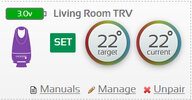
in my case using Energenie heads, but most electronic TRV heads show current and target, not all, the eQ-3 heads only show target, but my Kasa and Wiser heads also show current and target, and if the current exceeds the target while the room is heating up, the lock-shield valve needs closing a bit.
The other change is the TRV can actually call for heat, I think it's called a demand for heat with Hive, and cause the boiler to fire up, the question is if electronic TRV heads are fitted and the lock shield valves set spot on, does it still need OpenTherm? It is very easy to compare a poorly set up home with an old on/off boiler with a home set up A1 with a condensing boiler, but not seen a study where a system which was spot on to start with, is compared with same system plus OpenTherm. We are shown the graphs.
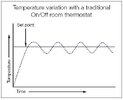
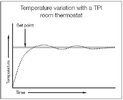
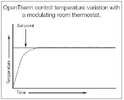
which claim to show how OpenTherm removes the hysteresis, but I set up mother's house using just electronic TRV heads, and except when the sun in the bay window caused the temperature to rise, setting the TRV to 22°C and the room stayed at 22°C, +/- 0.5°C I think that's close enough?
As to measuring how much latent heat gained, with a smart gas meter only updating every ½ hour, not sure one can actually work that out? However, we know we don't want the boiler to switch off/on too often, we want the boiler to modulate, but we also know for a wireless device to send a continuous signal as to if more or less heat is required, the batteries would not last long, I have no idea how often the TRV communicates with the base, but likely with say 10 TRV heads, at any one time, at least one is calling for heat, so the boiler will be running most of the time, even if with a very low output.
So we can be looking at a boiler with 6 - 36 kW output, and very little to show us how much is required to heat the home, however I remember the old days before thermostats, with solid fuel fires, and electric fires, the latter is what the 13 amp socket was designed for, and a 4 bar electric fire, with 750 watt per bar, the windows single glazed, no loft insulation, no cavity wall insulation, and once room was warm we would alternate between 1 and 2 bars, never needed 3 bars, so reasonably safe to say we need less than 1.5 kW per room. So to use 6 kW would need us to be using 5 rooms at the same time, the whole point of a programmable TRV head is we can maintain rooms which are not in use at a lower temperature, so questionable if we can actually use 6 kW of heating, so the boiler will still need to run using a mark/space ratio (switching off and on) so not convinced that OpenTherm can help that much if the home set up correctly to start with?
The whole idea of a wall thermostat is questionable, where the radiator is on an outside wall, the wall can cool the TRV to a lower temperature to the room, so there is a case for the TRV to be controlled by a wall thermostat, I know Drayton Wiser can do this, and also Kasa, but if the radiator is on an internal wall, then no case for fitting a wall thermostat.
So if all the TRV heads and lock shield valves are set up correct, the question is why is a connection between boiler and thermostats required? Answer it stops the boiler cycling when we have warm weather, and turns the boiler on again as the weather cools, and we could likely do that job with a simple on/off switch for the boiler and manually turn it on and off.
This
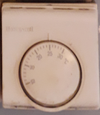
old switch would do that, placed in a room kept cool, so it would not fire the central heating on a day which will likely be a warm day latter, on the ground floor as heat rises, with no doors to outside, and no alternative heating, could put a TRV on the radiator set to allow fast heat up, which will slow down before the wall thermostat turns off the heating. Specially if room selected does have an outside door. There is one problem with it, if the room cools too slowly it may not turn the heating on in time.
So the likes of Drayton Wiser, does allow us more control, selecting when rooms are heated as well as to what level, but still not sold on the idea of OpenTherm being that much better if home set up correctly to start with.
OK putting my hard hat on now. I am sure there will be some flack.