• Looking for a smarter way to manage your heating this winter? We’ve been testing the new Aqara Radiator Thermostat W600 to see how quiet, accurate and easy it is to use around the home. Click here read our review.

Insulating a single skin brick wall

The latest government guidance on insulating solid walls, no longer recommends vapour closed methods, instead, vapour open with a minimum of a 25mm cavity on the cold side. Apart from condensation issues, the other problem with excessive insulation is cold external walls, cold walls that don't dry out in winer and then freeze and damage brickwork.

Isn't the issue, not insulating solid walls but insulating them to these super low U-values ? I'm looking around now at the more natural breathable insulation types, these aren't comparable with PIR but seem to be a lot safer. Lets face it, Britain is a moderate climate, its not siberia.
 
the other problem with excessive insulation is cold external walls, cold walls that don't dry out in winer and then freeze and damage brickwork.

He says that he has at most 5-6 cm including the plasterboard. That’s not going to be “excessive” whatever insulation he uses (except maybe vacuum boards!).
 
Just returning to this job now.

Having inspected the wall, there are some salty deposits coming through and I *think* there are some slightly damp patches - water coming through the brick from outside. But very, very small amounts. Never any water on the stairs below.

I’d really appreciate a final bit of advice.

I’m wondering again about using an internal brick sealer / tanking slurry onto that small area of outside brick, just to make sure to stop any ingress from outside in.

So brick sealer - stud wall (roofing battens) - infill with rockwool / celotex - DPM - plasterboard.
This obviously has no air gap.
I cannot get to the outside wall to seal it from there - it’s a 2nd story, pitched roof.

Would this work? I can’t tell if the brick sealer is a good or dumb idea. I just want to avoid it going mouldy back there.

Thanks so much
T
 

Attachments

  • IMG_4931.jpeg
    IMG_4931.jpeg
    474 KB · Views: 35
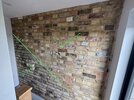
Ard you sure that's a half brick wall? The brick pattern suggests otherwise - or there'll be a load of rough snapped bricks on the other side.

The waterproofing is a good idea, but you'd be better foaming PIR bonded plasterboard on rather than stud walls.
 
Ard you sure that's a half brick wall? The brick pattern suggests otherwise - or there'll be a load of rough snapped bricks on the other side.

The waterproofing is a good idea, but you'd be better foaming PIR bonded plasterboard on rather than stud walls.
I’m pretty sure that is the case yes. I’ve attached a photo of the opposite side which is identical - so yes I think there are a bunch of snapped bricks in there. That part of the wall isn’t visible from the outside.

Glad you think internal waterproofing is a good idea. Any recommendations for a product?

And why foaming on insulated plasterboard instead of a stud wall?

Thanks very much for the reply.
 

Attachments

  • IMG_2082.jpeg
    IMG_2082.jpeg
    484.7 KB · Views: 27
A few coats of the Thompson's stuff. Foamed PIR is an effective vapour barrier, the foam doesn't allow moisture to cross and you'll get a lot more insulation with the limited space you have available (current regs would demand around 100mm). You still have the potential issue I highlighted earlier of water travelling down through the brickwork, which is why you should have a dpc somewhere around where your green line is, to direct it outside.

This is a typical detail, where the DPC is formed using cavity trays in conjunction with the roof flashing - water soaks/penetrates the outer skin, runs down the inside and back out. Obviously you don't have the inner skin!

Screenshot_20250901-074621.png
 
A few coats of the Thompson's stuff. Foamed PIR is an effective vapour barrier, the foam doesn't allow moisture to cross and you'll get a lot more insulation with the limited space you have available (current regs would demand around 100mm). You still have the potential issue I highlighted earlier of water travelling down through the brickwork, which is why you should have a dpc somewhere around where your green line is, to direct it outside.

This is a typical detail, where the DPC is formed using cavity trays in conjunction with the roof flashing - water soaks/penetrates the outer skin, runs down the inside and back out. Obviously you don't have the inner skin!

View attachment 391373
Haha if only I could achieve that!

Think I’ll go with your suggestion of sealing the bricks and injecting DPC cream along the roof line. That’s probably the best I can do! And also quite belt and braces.

Any favourites for foam adhesive?
 
Quick question. The Thompson’s brick sealer says in big letters ‘Exterior use only’

Should I be looking at damp proof paint rather than brick sealer?
 
For anyone interested… I actually went a different route with this.

I paid a guy to get up on the roof and treat the wall with Stormdry masonry cream on the exterior side. Hopefully should give it some water resistance - at least more than it has now.

I’ve then gone ahead with lime mortar / 30mm expanded cork insulation / lime skim coat on the interior side.

Not as good insulation as celotex plasterboard would have been, but better than it was as a single skin brick wall and (hopefully) breathable still.

Just hope it works!
 

If you need to find a tradesperson to get your job done, please try our local search below, or if you are doing it yourself you can find suppliers local to you.

Select the supplier or trade you require, enter your location to begin your search.


Are you a trade or supplier? You can create your listing free at DIYnot Local

 
Back
Top