
• Looking for a smarter way to manage your heating this winter? We’ve been testing the new Aqara Radiator Thermostat W600 to see how quiet, accurate and easy it is to use around the home. Click here read our review.

Junction boxes

Joined
13 Feb 2025
Messages
109
Reaction score
2
Country
United Kingdom
I am planning to cut and reroute 2 core and earth cables 50mm lower through precut holes in noggins. Specifically three x 2.5mm2 cable and one x (either 6mm2 or 10mm2, I can't tell which) cable. The noggins were added to better support the floor above. All three cables should fit through the precut 18mm diameter hole

The problem is that, according to the circuits, each 2.5mm2 could be part of a B32 ring main and the 6mm2 or 10mm2 is part of either a B32 or B40. B32 is 32A and B40 is 40A so larger than the 30A provided by the Essentials junction box.

On the screwfix site it says that the 'Essentials 30A junction box' can do 6mm2 x 2, but it implies 30amps maximum not 32A (B32). Also different sites describe this Essentials box as being 4mm2 x 4 maximum. Website is: https://www.screwfix.com/p/essentials-30a-3-terminal-heavy-duty-junction-box-black/7552d

Or I could massively over do it and use 100A x 4 (one for each 2.5mm2 and one for the 6mm2 or the 10mm2 cable), screwfix website link:
https://www.screwfix.com/p/british-general-100a-heavy-duty-junction-box-97-x-42-x-55mm-brown/661xg

Pics below:
wiring (1).jpg
wiring (2).jpg


Any suggestions of what junction boxes I should use for the 2.5mm2? I don't know what junction box to use. Can a '30A junction box' be used with a 2.5mm2 32A (B32) ring main?

Maybe I should be extra careful and use 100A for each that way I can't go wrong!
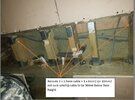
 

Attachments

  • wiring (3).jpg
    wiring (3).jpg
    50.2 KB · Views: 30
The ratings on those brown circular junction boxes is mostly irrelevant, what matters is whether the wires fit into them properly.
However those boxes cannot be used in concealed locations, so are totally unsuitable for this application.

What was the reason for moving the cables anyway, and where did this 50mm come from?
 
The ratings on those brown circular junction boxes is mostly irrelevant, what matters is whether the wires fit into them properly.
However those boxes cannot be used in concealed locations, so are totally unsuitable for this application.

What was the reason for moving the cables anyway, and where did this 50mm come from?
Don't all electric cables that are installed under floorboards in joists have to be 50mm or lower under the floorboard? To prevent someone puncturing the cable accidentally with a screw. This screwfix community forum weblink describes the same issue https://community.screwfix.com/thre...ists-meet-regs-not-notched-or-drilled.140883/.

"17th 2008 Edition. Does say The cable should be run so that it is not liable from damage due to fixings from either the floor above or ceiling below and that it should be installed 50mm from top or bottom of a joist - Or mechanical protection to be installed."
 
Maybe use wago connectors inside an enclosure. What enclosures should I use with wagos?
 
On the screwfix site it says that the 'Essentials 30A junction box' can do 6mm2 x 2, but it implies 30amps maximum not 32A (B32). Also different sites describe this Essentials box as being 4mm2 x 4 maximum. Website is: https://www.screwfix.com/p/essentials-30a-3-terminal-heavy-duty-junction-box-black/7552d

The current rating of terminals and joint boxes is a guide figure only, rather than a fixed limitation. All that really matters is - can you get the conductors into the terminal, without a struggle, and correctly tighten the terminal screws. For through terminals, where the conductors can go in from both sides of the terminals, choc blocks, I aim to get the conductors, to each overlap the other, so both screws bear onto both conductors, so the connector body takes a minimum of the current flow.
 
The current rating of terminals and joint boxes is a guide figure only, rather than a fixed limitation. All that really matters is - can you get the conductors into the terminal, without a struggle, and correctly tighten the terminal screws. For through terminals, where the conductors can go in from both sides of the terminals, choc blocks, I aim to get the conductors, to each overlap the other, so both screws bear onto both conductors, so the connector body takes a minimum of the current flow.
What about wago connectors 50mm below the floorboards with the associated junction boxes?
 
Just leave them where they are. You need to weigh the chances of someone drilling into the floor against the chances of your junction box terminals failing.

You do have a couple of other options: disconnect the cables at one end and re-run them, or add protection (i.e. metal plates) above them.
 
Just leave them where they are. You need to weigh the chances of someone drilling into the floor against the chances of your junction box terminals failing.

You do have a couple of other options: disconnect the cables at one end and re-run them, or add protection (i.e. metal plates) above them.
If I leave the 2.5mm2 x3 and 6mm2 x 1 where they are I would mark out on the floorboard above 'warning cable'.
It's too much work to disconnect the cables and reroute as these cables go through partition walls, it would take weeks to reroute them
I could add a thin 2-3mm metal plate and push this above the cables to prevent accidentally drilling through them, I could indeed to this end to end as long as this long thin metal plate was the right size.
These cables run underneath a partition wall under floorboards - very unlikely to drill through them

I can't find an in line wago junction box for the 6mm2 cable - the only wago junction box being sold is for 1.5mm2 cable. Maybe I can shove the bigger 6mm2 wagos into the smaller wago enclosure?

There is a 10mm2 cable nearly (has gone through the joists and is ready to be pulled up into the kitchen) for the kitchen electric cooker (above the floorboard). There is no 10mm2 wago. I can only find this IP20 rated 100A junction box from Screwfix: https://www.screwfix.com/p/british-general-100a-heavy-duty-junction-box-97-x-42-x-55mm-brown/661xg.

There are several of these 30A Essential 3 way junction boxes (https://www.screwfix.com/p/essentials-30a-3-terminal-heavy-duty-junction-box-black/7552d) already in the loft and they are under about 70cm of fibre glass for 20 years and have not failed. There are mice/rats in the property.

There are 30ma RCBOs on every ring main, and its unlikely that anyone will drill through the floor board from above.
 
The ratings on those brown circular junction boxes is mostly irrelevant, what matters is whether the wires fit into them properly.
However those boxes cannot be used in concealed locations, so are totally unsuitable for this application.

What was the reason for moving the cables anyway, and where did this 50mm come from?
The ratings on those brown circular junction boxes is mostly irrelevant, what matters is whether the wires fit into them properly.
However those boxes cannot be used in concealed locations, so are totally unsuitable for this application.

What was the reason for moving the cables anyway, and where did this 50mm come from?
I rechecked and there is a 3"x2" CLS timber (which forms a horizontal part of a partition wall) above the 18mm floor. So, technically, the electric cables are 18mm (chipboard) + 50mm (timber) from the surface so 68mm. Does the horizontal timber count as height?

If not I can install safe plates (https://www.screwfix.com/p/sabrefix...ck/30038#product_additional_details_container) between the top of the cables and the bottom of the chipboard (install from underneath)
Just leave them where they are. You need to weigh the chances of someone drilling into the floor against the chances of your junction box terminals failing.

You do have a couple of other options: disconnect the cables at one end and re-run them, or add protection (i.e. metal plates) above them.
 
I rechecked and there is a 3"x2" CLS timber (which forms a horizontal part of a partition wall) above the 18mm floor. So, technically, the electric cables are 18mm (chipboard) + 50mm (timber) from the surface so 68mm. Does the horizontal timber count as height?

If not I can install safe plates (https://www.screwfix.com/p/sabrefix...ck/30038#product_additional_details_container) between the top of the cables and the bottom of the chipboard (install from underneath)
I rechecked and there is a 3"x2" CLS timber (which forms a horizontal part of a partition wall) above the 18mm floor. So, technically, the electric cables are 18mm (chipboard) + 50mm (timber) from the surface so 68mm. Does the horizontal timber count as height?

If not I can install safe plates (https://www.screwfix.com/p/sabrefix...ck/30038#product_additional_details_container) between the top of the cables and the bottom of the chipboard (install from underneath)
I rechecked and there is a 3"x2" CLS timber (which forms a horizontal part of a partition wall) above the 18mm floor. So, technically, the electric cables are 18mm (chipboard) + 50mm (timber) from the surface so 68mm. Does the horizontal timber count as height?

If not I can install safe plates (https://www.screwfix.com/p/sabrefix...ck/30038#product_additional_details_container) between the top of the cables and the bottom of the chipboard (install from underneath)
These metal plates: https://www.screwfix.com/p/sabrefix.../30038#product_additional_details_container)?
 

If you need to find a tradesperson to get your job done, please try our local search below, or if you are doing it yourself you can find suppliers local to you.

Select the supplier or trade you require, enter your location to begin your search.


Are you a trade or supplier? You can create your listing free at DIYnot Local

 
Back
Top