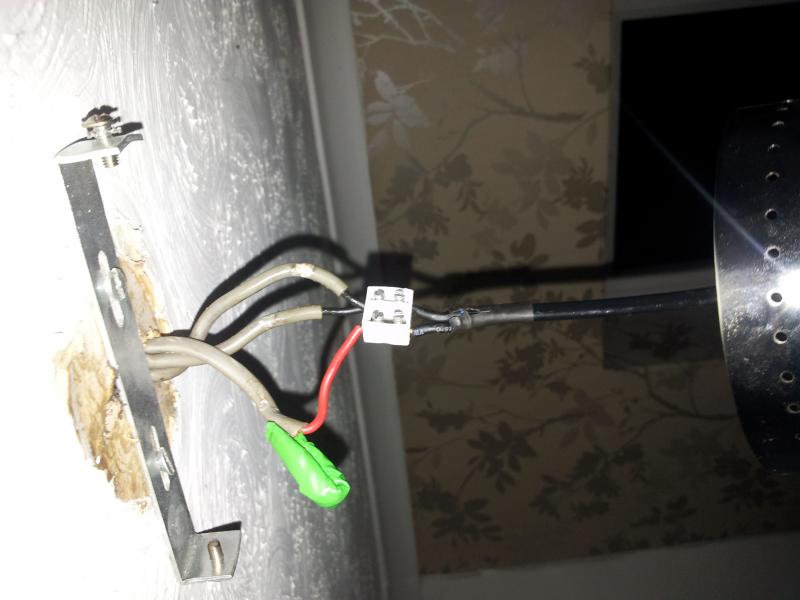
Light switch trips main breaker

I have put each of the wires in some terminal block with the light disconnected and tried. All of the light stay on.
Do you mean that with the wires in a terminal block, rather than connected to the light, you can operate the switches without the RCD tripping? If so, that would obviously seem to point a finger at the light itself.

Kind Regards, John
 
Yes with the wire in the terminal block I can operate the switches without the breaker tripping. If I put my multimeter across the live input and output of the transformer on resistance will I be able to check continuity of the circuitry that way?
 
Yes with the wire in the terminal block I can operate the switches without the breaker tripping. If I put my multimeter across the live input and output of the transformer on resistance will I be able to check continuity of the circuitry that way?
It's all a bit odd. For an RCD to trip, there would have to be a fault connecting the live or neutral to earth in the light - but the light does not have an earth going to it. A possible alternative would be for the connection to earth being through the metal body of the light to the fixing bracket on the wall, but that doesn't seem to be connected to earth, either!

Anyway, for the sake of doing it, I suggest that what you do in the first instance is, with the light totally disconnected, use your meter to test for any continuity between (separately) each of the the two (live and neutral) feed wires to the light (the ones which were connected to the block) and the metal (I assume it's metal!) body of the light which attaches to the wall bracket.

P.S. are you absolutely certain that the earth wire (which was taped up) was not touching anything when you had the problem?

Kind Regards, John
 
So it only trips when a known good fitting is connected.

Just a thought but If the neutral was really CPC (earth) then that would explain the symptoms, but there are 2 blacks going to the fitting and the other light on the circuit are OK.

It's got me puzzled.
 
So it only trips when a known good fitting is connected. ... Just a thought but If the neutral was really CPC (earth) then that would explain the symptoms, but there are 2 blacks going to the fitting and the other light on the circuit are OK. ... It's got me puzzled.
Indeed. As I said, it's very odd - hence the P.S. I added to my last post!

Kind Regards, John
 
I tested continuity between all of the wires and the metal bracket and they were also open circuit. I then stripped off the electrical tape and put more on and its definitely covered. I then snipped back the wires so that none of the copper was showing and tried again, but no luck it still trips.

If it's got you lot stumped then there's definitely no hope for me!

 
So it only trips when a known good fitting is connected.
Just a thought but If the neutral was really CPC (earth) then that would explain the symptoms, but there are 2 blacks going to the fitting and the other light on the circuit are OK.

It's got me puzzled.
Firstly it is the OP who has connected the black/black and red at the ceiling light - the RCD tripped after he did this. So it is quite possible that the assumed black/neutral and red/switch live are totally wrong.
I told him to separate out the four cables into individual connector blocks and now the RCD does not now trip.
So the assumed 'neutrals' do not seem to form part of the loop necessary for the circuit to function properly.
 
So it only trips when a known good fitting is connected.
Just a thought but If the neutral was really CPC (earth) then that would explain the symptoms, but there are 2 blacks going to the fitting and the other light on the circuit are OK.

It's got me puzzled.
Firstly it is the OP who has connected the black/black and red at the ceiling light - the RCD tripped after he did this. So it is quite possible that the assumed black/neutral and red/switch live are totally wrong.
I told him to separate out the four cables into individual connector blocks and now the RCD does not now trip.
So the assumed 'neutrals' do not seem to form part of the loop necessary for the circuit to function properly.

Thanks Riveralt, I assumed (I should know better) that only the fitting had been removed from the 'bottom' of the connector and the 'blacks' were still connected.
 
I tried taking the link out at the switch, all that happened was that the other light on the switch didn't work. The switch still tripped the breaker.

Not sure if this is worth mentioning but it sounds like it might relate to what you are discussing between yourselves. When I disconnected the light I put the 4 wires in separate terminal strip and could operate the switch and nothing tripped but none of the other lights on the same circuit worked. I then linked the 2 blacks in the same terminal strip with the red and earth separate and I could operate the switch and still nothing tripped but all of the other lights on the same circuit worked.

If anyone has any more suggestions please say but if not and I call a professional in I'll certainly let you know what he finds.
 
I tried taking the link out at the switch, all that happened was that the other light on the switch didn't work. The switch still tripped the breaker.
Ah, I think we may possibly be getting somewhere. That light operated by 'the other switch' (which stopped working when you removed the link), is that on a different circuit (i.e. different breaker at CU) from the one we're playing with?

Kind Regards, John
 
Yes there's 2 breakers one that does downstairs and one that does upstairs. Both breakers have to be off to isolate this particular light though.
 
Yes there's 2 breakers one that does downstairs and one that does upstairs. Both breakers have to be off to isolate this particular light though.
I think that may well be problem, perhaps a left-over of wiring from before the present CU (with some RCD-protected, and some not protected, circuits) was installed. Do I takle it that one of these breakers is on the right-hand side and the other on the left-hand side of the CU. If so, you probably do need an electrician, because the two circuits are going to have to be 'separated' better than they are now, probably involving some new wiring.

Kind REgards, John
 

If you need to find a tradesperson to get your job done, please try our local search below, or if you are doing it yourself you can find suppliers local to you.

Select the supplier or trade you require, enter your location to begin your search.


Are you a trade or supplier? You can create your listing free at DIYnot Local

 
Back
Top