• Looking for a smarter way to manage your heating this winter? We’ve been testing the new Aqara Radiator Thermostat W600 to see how quiet, accurate and easy it is to use around the home. Click here read our review.

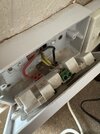
MK Logic Plus Rapid Fix Sockets (built in "Wagos")

The big question is if 1.5 mm² will it make good contact? With 6 mm² not a problem, if it will not fit you can't use it.

We clearly should give the wire a tug, but when working to the clock so easy to make an error.

I remember getting about 7 boxes of sockets, 6 of which the line was one side, but one odd one line other side, no problem as when doing the testing it showed up, fitting one socket mistake would not be made, fitting 35 sockets it is so easy.

However so is not tightening terminal at all. I was called to a new build with a problem with the cordless phone, it was just to show willing, however it seems the supplier had popped the MCB's into the consumer unit, and the electrician had not checked tightness of screws clamping bus bar, yes there is a note to say installer should test all terminals, but if you don't fit it, one does not automatic test for torque.
 
The big question is if 1.5 mm² will it make good contact? With 6 mm² not a problem, if it will not fit you can't use it.
Yes, I think that's one of the greatest weaknesses/'dangers' with any sort of 'sprung' terminal. There will always be a conductor size below which contact will not be satisfactory, and the user will not necessarily know (or think about) what that minimum might be.
... the electrician had not checked tightness of screws clamping bus bar, yes there is a note to say installer should test all terminals, but if you don't fit it, one does not automatic test for torque.
Indeed. Mind you, as for 'testing for torque', as I have often observed, if I tighten terminal screws on 'protective devices' to the manufacturer's torque, I often find that they feel frighteningly loose to me (can often easily get at least 'half a turn more' manually). However, maybe that's just me!

Kind Regards, John
 
Yes, I think that's one of the greatest weaknesses/'dangers' with any sort of 'sprung' terminal. There will always be a conductor size below which contact will not be satisfactory, and the user will not necessarily know (or think about) what that minimum might be.
The contact surfaces on a Wago* lever terminal are flat so they can operate over a wide range of sizes. Wago specify the 221-4 series down to 0.2mm² and the 222 series down to 0.08mm². I've put 30AWG (about 0.05mm²) into a Wago 222 before and it seemed to grip it fine.

While the data I can find for the MK rapid fix socket doesn't mention sizes smaller than 2.5mm² I would be very surprised if there were any problems with any cable used for mains wiring in the UK (as long as you stick to one conductor per terminal).

IME undersized wires are far more of an issue with screw terminals than with lever clamp terminals.

* I belive the MK socket was designed in conjuction with Wago, they certainly use a Registered Wago trademark to describe the terminal type.
 
The contact surfaces on a Wago* lever terminal are flat so they can operate over a wide range of sizes. Wago specify the 221-4 series down to 0.2mm² and the 222 series down to 0.08mm². I've put 30AWG (about 0.05mm²) into a Wago 222 before and it seemed to grip it fine.
Agreed.
While the data I can find for the MK rapid fix socket doesn't mention sizes smaller than 2.5mm² I would be very surprised if there were any problems with any cable used for mains wiring in the UK (as long as you stick to one conductor per terminal).
Again, I agree. Their lack of mention of 1.5 mm² conductors (the smallest that one theoretically use for a socket) may well just be down to 'habit', since, as I said, they don't mention 1.5 mm² in relation to their standard screw-terminal sockets (even though it must be quite common for people to do that).
IME undersized wires are far more of an issue with screw terminals than with lever clamp terminals.
Yes, probably true, at least unless one 'doubles over' the conductor - which I almost certainly would do with a conductor <2.5 mm² going into a socket's screwed terminal.

Kind Regards, John
 
Apart from the not too common requirement for four wires (two spurs off ne point), there's a fairly common requirement for four earth wires (spur plus flylead to backbox). I know there's an argument that they aren't needed, but some of us just don't feel comfortable not fitting it :whistle:
 
Apart from the not too common requirement for four wires (two spurs off ne point), there's a fairly common requirement for four earth wires (spur plus flylead to backbox). I know there's an argument that they aren't needed, but some of us just don't feel comfortable not fitting it :whistle:
All true. However, given that with any size of T+E 'allowed' for wiring a 'sockets circuit', and certainly any size of T+E likely to be used for wiring a socket, the CPC will be of smaller CSA than the live conductors, so there should rarely, if ever, be a problem if the number/size of live conductors is within the stated 'terminal capacity' of a socket.

Kind Regards, John
 
I think you missed the point that these (the spring-clamp version) have one terminal per wire - hence no more than three CPCs regardless of their size of purpose.
Which I have to admit, probably wasn't clear from the context of where my reply sits in amongst other posts :oops:
 
I think you missed the point that these (the spring-clamp version) have one terminal per wire - hence no more than three CPCs regardless of their size of purpose. Which I have to admit, probably wasn't clear from the context of where my reply sits in amongst other posts :oops:
Fair enough. Yes, I 'missed that point' and (for the reason you mention) thought that you were talking about terminal capacity of screwed terminals.

Back to the 'spring-clamp versions', as you say (well, reversing what you say!) they are designed to have one wire per terminal. I wonder if it would be satisfactory and acceptable for that 'one wire' to actually be a 'doubled over' one? If so, in the situation you have described, one could have the CPC of one of the cables going to the terminal on the socket and then ('continuously') on to the back box, with a 'doubled over' bit in the middle going into the connector.

Kind Regards, John
 
Yes, that would be OK as long as it fitted in the terminal. There being the tiny little detail of remembering to leave enough length to do that.

I had started writing that it won't work with the subset who consider any length of cable longer than is needed to get the screwdriver down a narrow gap between socket and wall to be "waste" - but I guess they aren't the sort that would be adding fly-leads to the back-box anyway.
 
Interesting.

I'm no real fan of 'screwless terminals', so would not be very impressed by that (it takes only a few seconds to tighten a terminal screw), but I've always been in favour of the idea of 'one conductor per terminal', so might be interested in them for that reason. Donkeys' years ago, one could get ones like this (and I still have a couple on my shelf), but (although maybe I haven't looked hard enough1) I haven't seen anything like this for very many years (and sets of 3, rather than just 2, terminals would be even better, in case one wants to run a spur from the socket) ....

View attachment 256626

Kind Regards, John

Funnily enough I was looking for images of this socket type as I removed one yesterday as I wondered how old it was?

I replaced it with one of those MK Logic Plus Rapid Fix sockets, I won’t be using them again, the Logic Plus range varies and some versions of the MK sockets are made in the UK and others in Malaysia, I will stick to Hager Sollysta or Scolmore Click Mode.
 

Attachments

  • IMG_4583.jpeg
    IMG_4583.jpeg
    217.7 KB · Views: 44
Do you know where the two brands you favour are 'made'?
I believe Hager are made in the UK and also have a similar pin shutter design similar to MK Logic Plus.

Scolmore I think manufacture at various overseas facilities.
 
Fair enough.

... but not Malaysia ?
Not sure, Hager has been my go to but there are more brass parts in Click Mode ones inc the screws and all terminal blocks are brass inc the earth.

There’s quite a few negative reviews and failures of the MK Logic Plus sockets on Amazon with pictures, mostly cracks and, rusty screws.

How old was that old socket you added a picture of?
 
How old was that old socket you added a picture of?
No idea ... but it's been 'on my shelf' for many years, although I can't recall where it came from or why I happen to have it. However, as you've seen, the L and N connector blocks are coloured red and black, which probably means that it is pre-harmonisation - hence at least 20 years old..

Hang on ... I'll see if it is still there :-) ....
... yep, it is :-) It looks totally unused, but bears very few markings - certainly no indication of the manufacturer. Other than L, N & E markings it has just "Made in England", "PROV PAT" (which I guess probably means "provisional patent"?) and, interestingly for a double socket "13A".
 

If you need to find a tradesperson to get your job done, please try our local search below, or if you are doing it yourself you can find suppliers local to you.

Select the supplier or trade you require, enter your location to begin your search.


Are you a trade or supplier? You can create your listing free at DIYnot Local

 
Back
Top