• Looking for a smarter way to manage your heating this winter? We’ve been testing the new Aqara Radiator Thermostat W600 to see how quiet, accurate and easy it is to use around the home. Click here read our review.

Mould in bedroom

Seems like I need to change a few habits. Do you dry all your washing outside?

As much as possible, yes, but when outside is not possible, we use the utility room, as described in #11 above. The utility room, is separated from the main house, by two doors, and so not much chance of any humidity, escaping from it into the main house.
 
Do you dry all your washing outside?

Washing machine has a 1600 rpm spin, so it starts drier than from an average machine. Then start drying outside, but hang in bathroom if it’s not fully dry at the end of the day. There’s a huge difference between hanging things straight from the machine in the bathroom, vs. hanging things where 75% of the moisture has already been removed. Bathroom has an extractor (not used continuously) and a humidity meter.
 
Most condensation is lifestyle related. Occupants cause it in different ways by various means, and you should review any of the online guidance (from reputable sources) on how it is produced and dealt with and see what if anything you are doing wrong.

In a small number of instances, it is the property that cannot deal with the condensation produced by the occupant and in those cases, more involved action/work may be required.

A generic "open the windows and turn the heating up" is not the answer. Neither is using a using a damp/humidity/temperature meter - you will be taking readings with no context at all and wont be able to interpret them and it will be a complete waste of time.
 
Neither is using a using a damp/humidity/temperature meter - you will be taking readings with no context at all and wont be able to interpret them

I think it would be useful for us to know if their typical bedroom humidity is 50 or 70 or 90%.

I recall going into a neighbour’s flat once and was immediately hit by a wall of hot humid air that felt like a botanical hot house - but to them, that was entirely normal. If you asked them, “is your flat humid?”, they would say no.
 
I think it would be useful for us to know if their typical bedroom humidity is 50 or 70 or 90%.

I recall going into a neighbour’s flat once and was immediately hit by a wall of hot humid air that felt like a botanical hot house - but to them, that was entirely normal. If you asked them, “is your flat humid?”, they would say no.
I don't think it would.

It does not have relevance to dealing with any condensation issue because no-one knows what %RH and at what °C is safe for that property. Many factors are involved.

There is no way someone posting "My room is at 70%RH" and then someone else being able to say "Yeah that's condensation mate".

My heart sinks and I have to stop my eyes rolling when occupants show me their humidity and damp meter readings, and more recently thermal camera images and tell me they have a problem because the device they brought says so.
 
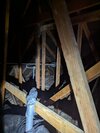
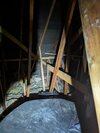
Thanks for all the help. I have lived in the house for 2 months and there was no mould before this and the couple before that lived in the house over 30 years didn't appear to have this issue which to me points to lifestyle. I have checked on the loft but couldn't get in far enough of that helps show if I need more insulation or not?

I will look to not dry clothes indoors now, put kids on the saucepans at all times and look to get a PIR/humidity extractor fan installed. Do you think it could still be loft insulation?
 

Attachments

  • PXL_20251120_104145196.jpg
    PXL_20251120_104145196.jpg
    242.5 KB · Views: 21
  • PXL_20251120_104143163.jpg
    PXL_20251120_104143163.jpg
    244.7 KB · Views: 21
Do you think it could still be loft insulation?

Mould, needs moisture, condensing on surfaces to grow, and so good insulation of those surfaces is one factor. The insulation you have, appears to be quite deep, in your photos, so should be effective. What about the walls, are the cavity, are they insulated?
 
A generic "open the windows and turn the heating up" is not the answer.
Standard idiotic response from Rigsby landlords,
Neither is using a using a damp/humidity/temperature meter - you will be taking readings with no context at all and wont be able to interpret them and it will be a complete waste of time.
Agree. A house will fill with moisture (with varying levels) upon occupancy. A modern well insulated home is mould free for a reason.
 
Buy some humidity meters and scatter them about.
And do what with the results?

I can tell the OP right now that his home (if occupied) will have varying degrees of moisture with in it. And that moisture will be more problematic in the winter when it is very cold outside.
 
That is not true! I have our utility room, set up with over-head washing lines, a fan, and a dehumidifier, to dry clothes after they have been spun in the washer. We set it up, to dry things over-night, which it does very effectively. Over-night, simply so it minimises disruption. I power both the fan, and the dehumidifier, via one of those plug-in Kwh monitors, and find it to be a very economical way to dry clothes.

That system, is one of three methods we can make use of - we have a very long, drying line in the garden, but last year, I added a series of lines, as an alternative, across the open veranda area of the summerhouse - out in the breeze, but sheltered from rain.

Absolutely true, a modern tumble dryer would cost much less to run. Mostly as it would take a lot less time. We have one, the smart meter barely notices it running.

I suspect you're used to the running costs of the old-fashioned heat tumble dryers, which basically boil the water out of the clothes. They were a very expensive way to ruin your clothes.

Heat pump dryers are utterly different, most people don't understand how, despite looking the same, they're nothing like the old ones. They're basically your drying room inside a box, with the clothes being chucked in the air in the middle of the room. The heat pump in a dryer is acting as a dehumidifer, not just a heater. The air gets recirculated - it gets cooled to dehumidify it, then heated (just as in a dehumidifier), then it gets blown through the tumbling clothes, then back round the circuit again.

So it contains everything in your drying room, in a smaller better insulated box. Plus the moisture is sealed in and won't get through the gaps in the door into the rest of the building as it inevitably will with an interior door.
 
Bin them. Spend your money on insulation next time.
We had excessive humidity at a previous house. Turned out it was groundwater getting under the suspended floor. I wouldn't have known without the meters, it was around 80% in the room above where it was gathering.

Obviously you need to credit people with intelligence. You get random variation, and high readings when the weather's damp. But you look at the overall trend. If you have a few you can see if it's worse in some rooms (if the temperature's similar).

You need to approach the problem scientifically with an open mind, it's not always just trapped air and poor insulation.
 
that moisture will be more problematic in the winter when it is very cold outside.
Humidity is often lower in the winter, cold outside air holds much less water. Today it's 51% in my office here - just natural air with no dehumidifier.

But it's also more of an issue in the winter, as it won't condense onto cold surfaces in the summer.
 

If you need to find a tradesperson to get your job done, please try our local search below, or if you are doing it yourself you can find suppliers local to you.

Select the supplier or trade you require, enter your location to begin your search.


Are you a trade or supplier? You can create your listing free at DIYnot Local

 
Back
Top