Newbie basic electrical wiring question

Joined
3 Oct 2026
Messages
1
Reaction score
0
Country
United Kingdom
Hi all,
My first post on DIYNot forums.
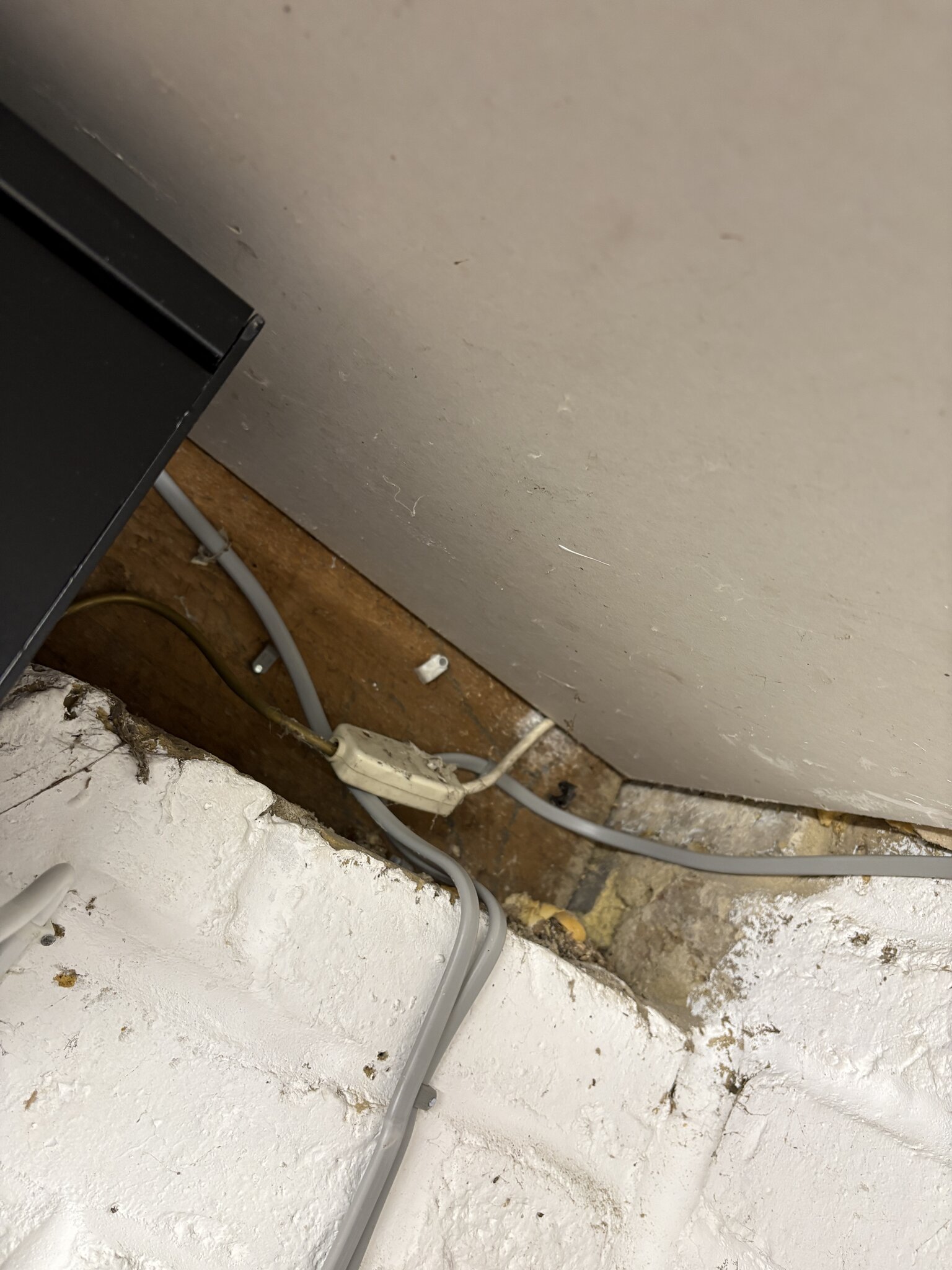
I'm looking to replace the outside flood light on my garage with a Ring flood light current/old light shown in pic). The light is hardwired and connects via this white junction box (second pic).
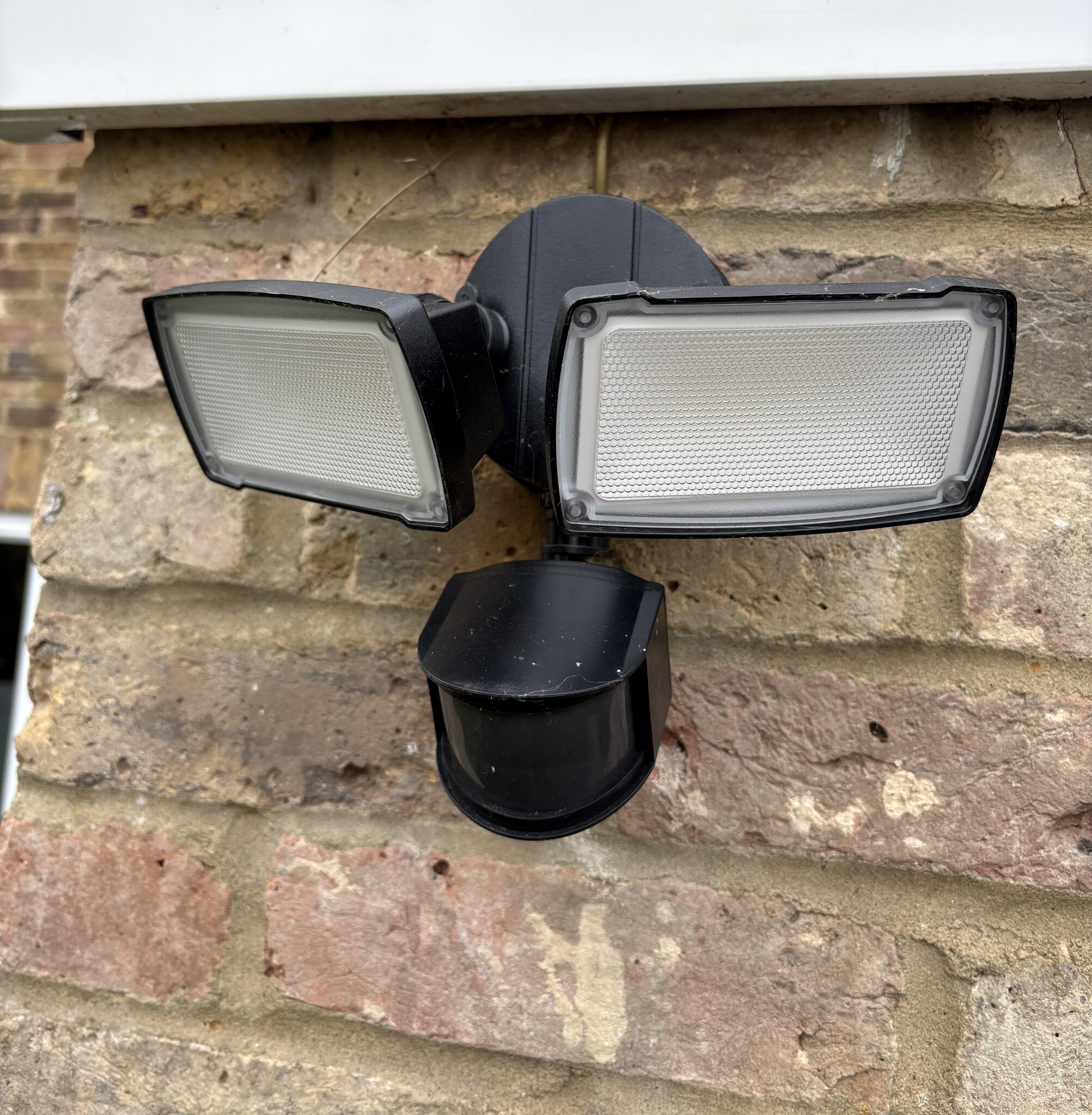
IMG_3756.jpeg
IMG_3755.jpeg

The brown cable from the white junction runs down between the facia and wall into the light.
Unfortunately the earth in the brown cable has been cut short and is to short to reach the earth connection on the Ring light so I need to replace it.
Is this brown cable just 3 core flex 1.5 - or how do I tell? Does it need to be externally rated?

Although this flex cable from Wickes is not external rated, can it be used or would someone share what type of cable I should be using for this please?
It feels silly to call out an electrician for what seems to be a simple job, although I'm happy to if needed.

Thanks all
 
Have a look at the cable along it’s length where possible, there’s usually some writing on it, possibly the same colour as the cable.
 
Can't see too welĺ, but can you confirm that the grey cables are separate from the junction box & it has only brown and white cables involved with the light fitting?
If so, is there not enough spare in the white cable to move the box
towards the brown cable then shorten it?
However the box needs to be fixed securely in any case.
Is it sitting on the wood in an external place?
If the brown wire has to be replaced, would it be easy to follow the white cable back and replace the entire supply w with one decent well clipped length of external cable.?
 
That white box looks like a flex connector and the brown flex looks like the sort of brassy coloured flex used for table lamps.

I might be wrong. But if it is, the flex connector may only have two terminals, hence why the CPC (earth) is cut off.

Am I correct in thinking the white flex goes to the supply and the brassy one to the outside light?

Is the supply cable plugged in somewhere?
 
Definitely looks like gold H03VV-F 3G0.75 (the size is a guess because I‘ve never seen larger flex in this colour).
 
I'm not doubting it for a moment, just never aware of it.

Years ago I used to make up cables for the mobile disco scene and regularly used 4 colours of 0.5mm², at the time it tended to be black, white, orange and gold as they were the easiest to source.
 
0.5 seems very scrawny - 3A - what were they used for?

Even for speakers, it can only carry, what, 50W over a short distance?
 
0.5 seems very scrawny - 3A - what were they used for
3A is 690W at 230 V.

Table lights were often only supplied with 7/0.2mm (0.22mm²) rated at 1A or 230W, although I haven't noticed any of that recently despite LED requirements being only 5W or 22mA. If anything I feel 0.75mm² is more likely now.

I'm finding some 'chandeliers' and other internally wired fittings are now very thin and transparent, if we're lucky may have a transparent coloured stripe to denote the earth wire. I imagine maybe 3/0.02mm (0.09mm²) so I'd hazard a guess at only 300mA rated.
Even for speakers, it can only carry, what, 50W over a short distance?
at 8Ω, 3A is 72W, in reality in a domestic situation one would be hard pushed to detect any issue with an unlikely 20m length of cable (~1.5Ω loop resistance) unless severe a-b comparisons are being made - Some 50 years ago a colleague purchased hand made oxygen free speaker cables, something like 500 strands, and extolled their virtue ad-nauseam, what he didn't know was I replaced them with telephone jumper wire (0.5mm diameter or 0.2mm² tinned copper) and he had no idea for several months until I revealed it to him.

Incidently I use 7/0.2 or 16/0.2mm (0.22 or 0.5mm²) for hundreds of meters for public address loudspeakers but using high impedance loudspeakers
 
3A is 690W at 230 V.

Table lights were often only supplied with 7/0.2mm (0.22mm²) rated at 1A or 230W, although I haven't noticed any of that recently despite LED requirements being only 5W or 22mA. If anything I feel 0.75mm² is more likely now.

I'm finding some 'chandeliers' and other internally wired fittings are now very thin and transparent, if we're lucky may have a transparent coloured stripe to denote the earth wire. I imagine maybe 3/0.02mm (0.09mm²) so I'd hazard a guess at only 300mA rated.

at 8Ω, 3A is 72W, in reality in a domestic situation one would be hard pushed to detect any issue with an unlikely 20m length of cable (~1.5Ω loop resistance) unless severe a-b comparisons are being made - Some 50 years ago a colleague purchased hand made oxygen free speaker cables, something like 500 strands, and extolled their virtue ad-nauseam, what he didn't know was I replaced them with telephone jumper wire (0.5mm diameter or 0.2mm² tinned copper) and he had no idea for several months until I revealed it to him.

Incidently I use 7/0.2 or 16/0.2mm (0.22 or 0.5mm²) for hundreds of meters for public address loudspeakers but using high impedance loudspeakers
Sorry missed out the point of your question.
Mobile disco's typically had multiple 30W pinspots on sequencers, lighting effects were often a 100W projector bulb etc. Generally each effect/channel was nowhere near ½kW so well within capabilities.
One of the very popular things I made/supplied was an ABS box containing one or two Bulgin 8pin connectors
1791143414267.png

and 4 tails terminating with 4 C13 sockets
1791143621347.png

as a breakout from a multicore cable.
 
Some 50 years ago a colleague purchased hand made oxygen free speaker cables, something like 500 strands, and extolled their virtue ad-nauseam, what he didn't know was I replaced them with telephone jumper wire (0.5mm diameter or 0.2mm² tinned copper) and he had no idea for several months until I revealed it to him.
:ROFLMAO: A Russ Andrews customer!

Incidently I use 7/0.2 or 16/0.2mm (0.22 or 0.5mm²) for hundreds of meters for public address loudspeakers but using high impedance loudspeakers
Cool!
 

If you need to find a tradesperson to get your job done, please try our local search below, or if you are doing it yourself you can find suppliers local to you.

Select the supplier or trade you require, enter your location to begin your search.


Are you a trade or supplier? You can create your listing free at DIYnot Local

 
Back
Top