Sure, but the "30 mA" spec is merely a semi-arbitrary 'compromise' (between safety and convenience), in the face of something which 'varies'. One could argue that one which did not trip until, say, 32 mA, might not 'save a life' which would have been saved by one which tripped at 30 mA - but that will to some extent be 'balanced'/'cancelled' by the fact that one which (as is common) trips at 25 mA might 'save a life' which might not have been saved if it has not tripped until the (required by spec) 30 mA!
I would be more worried about the 40 mS trip time. I know my RCDs did trip at less than 40 mS as I did have a tester, but when I found a horizontal wired going around 4 right-angle bends, so not in a permitted zone, with a pair of hacksaw blades that I was using to cut a channel for a water pipe the hard way, it knocked me out.
I would have thought my falling to the ground likely disconnected me in less than 40 mS anyway. In other words having a RCD did not help.
Also, it would not have mattered if 30 mA or 300 mA it would have still tripped.
In the main we hope the 30 mA will cause it to trip before we touch anything, so water leakage for example will cause a trip before anyone touches a live item.
When I came to work on my fathers house, I found no sign of any earth other than for the GPO party line, there must have been one, when I was a boy I ruptured a 13 amp fuse when I made an error and shorted line to earth, but 40 years latter could not find a sign of it ever existing.
However, the attempts to fit a 30 mA RCD failed, could not stop it tripping, due to rubber insulated wire degrading, so there must have been enough of an earth to cause the imbalance large enough to trip the RCD.
The test button on a RCD can be between line and neutral and not involve an earth, so it does not prove it will trip with an earth fault. But the socket tester
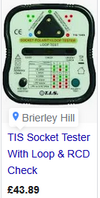
both tests RCD to earth so shows it will work, and does a loop test so gives a reasonable indication as to how good the earth rod is. It has three lights, better than 1.8Ω better than 92Ω and over 92Ω not as many options as the Martindale tester, but as already said in the main 92Ω is good enough for an earth rod. To test the RCD there are cheaper testers
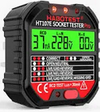
but they don't test time or loop impedance, but at £15 what do you expect? The Kewtech Loopcheck 107 13A Advanced Socket Tester 230V AC is better than 1.8Ω and better than 93Ω or worst than 93Ω so nearly the same as the TIS one.
In both cases the paperwork tells you to check if over 1.8Ω with this from Kewtech
Flashing amber LED with warble tone indicates the incoming mains should be checked to see if the system is using an earth rod for protection. Safety earth path is between 1.80Ω and 92Ω. If the system is protected by an earth rod then
an RCD should be present.
Yes better with a loop testing giving a reading in ohms, but all three Plug in units Kewtech, TIS, and Martindale will all show if the earth rod is good enough to work the RCD.



