• Looking for a smarter way to manage your heating this winter? We’ve been testing the new Aqara Radiator Thermostat W600 to see how quiet, accurate and easy it is to use around the home. Click here read our review.

Shower tray on T&G

Joined
17 Jan 2023
Messages
110
Reaction score
10
Country
United Kingdom
sorry asked this I think but a check on the shower tray lay, bathroom floor is heavy thick 25mm T&T boards, solid stuff, going to add some PVA bond then CT1 the tray down, part of the area is ply now as I had to get to the waste, I am going to lay like this, will this be ok?.

also tricky to get to waste will use a flexi pipe to make easier McAlpine.
 
Last edited:
What size spacing and condition are the joists underneath the T&G?
 
Don't lay a shower tray directly onto P5 chipboard (terrible stuff in a bathroom) or T&G wood. Ideally cut the P5 out and replace it. If it's T&G floorboards, add extra screws and check it for bowing. if it can't be cut out then always cover it with a top of either Ply or OSB3, screwed @ 150mm spacing and then tank the whole space.
 
Just followed your link, yep, that's a tanking membrane, 2-3 coats at least.
So ok to go ahead and tank the chipbiard direct and tape joints. I do have lots of ply 18mm l think but if l lay that on top the tray which is low profile 25mm will go up. Think its normal ply that was in shed cupboards strong stuff or could remove tray area chipboard and use the ply then tank?
 
Last edited:
could remove tray area chipboard and use the ply then tank?
Personally, if it's possible, remove the chipboard or at least the section where the tray will sit. Do you know if the chipboard is 18mm or 22mm? If 22mm then get a piece of 3.6mm ply and then use that to pack the joists before laying the 18mm, that will raise it to almost level. Is the 18mm ply hardwood WBP ply or softwood?

Measure out where the tray will sit on the board and ensure there are supports between/alongside the joists (dwangs/sister) under where the edges of the tray will sit. That will minimise deflection. Then tank the entire wet space.
 
Personally, if it's possible, remove the chipboard or at least the section where the tray will sit. Do you know if the chipboard is 18mm or 22mm? If 22mm then get a piece of 3.6mm ply and then use that to pack the joists before laying the 18mm, that will raise it to almost level. Is the 18mm ply hardwood WBP ply or softwood?

Measure out where the tray will sit on the board and ensure there are supports between/alongside the joists (dwangs/sister) under where the edges of the tray will sit. That will minimise deflection. Then tank the entire wet space.
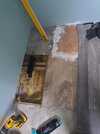
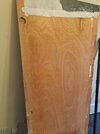
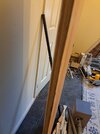
Hi Rob, thanks for advice. Here are the pics, chipboards is 22mm, ply is 18mm not sure what type attached pic. Happy to remove chipboard and replace with the ply got loads if thats best option and use battens to support then tank all, added new plasterboards to which are moisture resistant as old stuff was normal and rotten. I await your guidance, thanks
 

Attachments

  • 20250409_085610.jpg
    20250409_085610.jpg
    217.2 KB · Views: 27
  • 20250409_085425.jpg
    20250409_085425.jpg
    292.2 KB · Views: 30
  • 20250409_085439.jpg
    20250409_085439.jpg
    275.1 KB · Views: 32
Hard to tell which ply it is from a pic though the colour does suggest it's hardwood, softwood tends to be lighter. No matter, as long as it's tanked well and properly supported.

Looking at that space, I presume the shower will be sitting against the left and top walls therefore best to fit the dwangs along where all the outside edges of the tray will sit, then lay the 18mm screw tight to the joists/batons then use some silicone to 'glue' the 3.6mm on top and screw that down onto the board @ 150mm spacing with 25mm screws and that will increase the whole board thickness to 21.6mm. Then tape all the corners/joins (primer the space, then a coating of membrane in the corners/joins and stick the edging tape to that then paint over it to seal) and at least 2 coats of the membrane - let one dry properly first.

Again, as far as the plasterboard is concerned it doesn't really matter if it's moisture resistant, TBH there isn't really such a thing but again just tank it well.

 
Hard to tell which ply it is from a pic though the colour does suggest it's hardwood, softwood tends to be lighter. No matter, as long as it's tanked well and properly supported.

Looking at that space, I presume the shower will be sitting against the left and top walls therefore best to fit the dwangs along where all the outside edges of the tray will sit, then lay the 18mm screw tight to the joists/batons then use some silicone to 'glue' the 3.6mm on top and screw that down onto the board @ 150mm spacing with 25mm screws and that will increase the whole board thickness to 21.6mm. Then tape all the corners/joins (primer the space, then a coating of membrane in the corners/joins and stick the edging tape to that then paint over it to seal) and at least 2 coats of the membrane - let one dry properly first.

Again, as far as the plasterboard is concerned it doesn't really matter if it's moisture resistant, TBH there isn't really such a thing but again just tank it well.
Thanks Rob, sounds like a plan. I can cut the 600mm width ply I have as the tray is 800mm into 2 pieces 600mm x 800mm for the 800mm x 1200mm tray and tape that up then add the thinner layer of ply and repeat...all a bit more work but want to do it right, the pipe waste not easy to get to going to use a Macalpine flexi pipe from the shower waste to the pipe underneath...thanks again mate.
 

If you need to find a tradesperson to get your job done, please try our local search below, or if you are doing it yourself you can find suppliers local to you.

Select the supplier or trade you require, enter your location to begin your search.


Are you a trade or supplier? You can create your listing free at DIYnot Local

 
Back
Top