Type/Age of Wiring?

Yeah I was just being picky/cautious with regards to when the regulations came into affect :D but yeah they are probably older than I am (and in better condition).
It's not so much a matter of regs, but of when stranded conductors (for the smaller sizes of cables) ceased to be used - and that was long before introduction of harmonised colours etc. I'm not sure whether there were stranded conductors in any of the earliest of metric-size cables, but I doubt it - so that wiring probably pore-dates metrication.
I still call snickers Marathons and starbust opal fruits.
Same here (and I still call light bulbs light bulbs!) - but I suspect I'm a lot older than you.
But yeah PIR>EICRs is probably something I should refer to correctly.
Indeed. I wasn't 'getting at you' but wanted to make sure that the OP didn't get confused.

Kind Regards, John
 
Wiring of that age can sometimes suffer from leeching of plasticiser which looks like green jelly. Those wires pictured look like they've got away with it so far!

You can google "twin and earth green goo" to read all about the issues you can sometimes get.
 
Wiring of that age can sometimes suffer from leeching of plasticiser which looks like green jelly. Those wires pictured look like they've got away with it so far!

You can google "twin and earth green goo" to read all about the issues you can sometimes get.

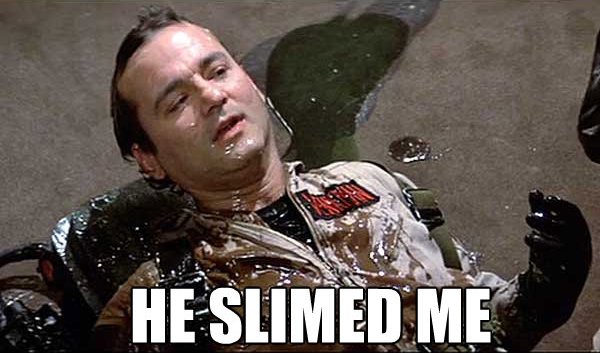
My friend! if I see green goo leaking from my sockets, I will not only call an electrician - I will call a doctor!
HE-SLIMED-ME.jpg
 
I have a 1964 house which I bought 20 years ago. Similar wiring to yours and I had planned to rewire it. However, when I started the first room I found out the insulation was much tougher to remove than the newer cable I was installing, and the wires themselves were as good as new, no broken strands etc., so I felt I was replacing a very substantial product with something less substantial, so I left it be (apart from sleeving the earths) and just upgraded the consumer unit to MCB / RCD circuit protection, upgraded the main equipotential bonding, and crossbonding as required at the time.

The main problem I had was that the lighting cables didn't have a CPC, which meant I could only use double insulated (ie normally plastic) light fittings. I have gradually upgraded that now so that the lighting circuits can now have metal light fittings that do require an earth connection.

All new sockets I have installed and a new kitchen extension have been wired from scratch rather than extending the original circuits.

On a positive note, you don't have any evidence of 'green goo' this was a problem for some cables installed in the 1960's due to the plasticiser used in its production. If the cables got warm the plasticiser dribbled out as a green goo.
 
Wiring of that age can sometimes suffer from leeching of plasticiser which looks like green jelly. Those wires pictured look like they've got away with it so far!
If I recall correctly, I think the PVC cables susceptible to green goo appeared somewhat later than the wiring we're looking at. However, I may be wrong.

Kind Regards, John
 
Green slime (that I've seen) was in early 1970's metric cable.

The stranded, tinned, PVC T&E cables are earlier than that. 1960's sounds right.

PVC insulated and sheathed has a very long life (unless it is exposed to sunlight, or excessive heat) so no reason I can see to think of it as time-expired
 
I still call snickers Marathons and starbust opal fruits.
Washed down with a glass of Bib-Label Lithiated Lemon-Lime Soda?

Do you drive a Datsun to the shops to buy them?

Do you still use Jif to clean the bathroom?

:D
 
Green slime (that I've seen) was in early 1970's metric cable.
Same here - as I've just implied in my previous post, I don't think I've ever see it, or heard of it happening, in stranded-core imperial cables.

Kind Regards, John
 
I have a 1964 house which I bought 20 years ago. Similar wiring to yours and I had planned to rewire it. However, when I started the first room I found out the insulation was much tougher to remove than the newer cable I was installing, and the wires themselves were as good as new, no broken strands etc., so I felt I was replacing a very substantial product with something less substantial, so I left it be (apart from sleeving the earths) and just upgraded the consumer unit to MCB / RCD circuit protection, upgraded the main equipotential bonding, and crossbonding as required at the time.

The main problem I had was that the lighting cables didn't have a CPC, which meant I could only use double insulated (ie normally plastic) light fittings. I have gradually upgraded that now so that the lighting circuits can now have metal light fittings that do require an earth connection.

All new sockets I have installed and a new kitchen extension have been wired from scratch rather than extending the original circuits.

On a positive note, you don't have any evidence of 'green goo' this was a problem for some cables installed in the 1960's due to the plasticiser used in its production. If the cables got warm the plasticiser dribbled out as a green goo.

Interesting stuff. New is not always better.

Thanks.
 
"The problem was most prevalent between 1965 and 1971 when an antioxident was introduced into the manufacturing process. Cable manufactured sinse the mid 1970s does not have the same inherent defect."

My home was built 1968 and has imperial stranded T&E and I've just been replacing cables suffering with with green goo. Awful stuff.
 
found my pic

upload_2017-1-13_15-56-29.jpeg


To the best of my knowledge, the bit with the green slime is from about 1974.
There was in the same house some stranded tinned PVC T&E from 1960's without slime.
 

If you need to find a tradesperson to get your job done, please try our local search below, or if you are doing it yourself you can find suppliers local to you.

Select the supplier or trade you require, enter your location to begin your search.


Are you a trade or supplier? You can create your listing free at DIYnot Local

 
Back
Top