
Understanding radiator valve pressure drop (dP)

Joined
7 Jan 2024
Messages
14
Reaction score
0
Country
United Kingdom
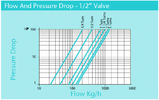
I'm hoping someone can help me get my head around understanding radiator valve pressure drop. As an example, from the attached chart, a lower pressure drop results in a lower achievable flow rate.

To my mind, a lower pressure drop (i.e. less resistance to flow) should give a higher flow rate, and vice versa.

I'm undoubtedly thinking of it wrong - any help appreciated!
 

Attachments

  • locksheildpressure-drop.png
    locksheildpressure-drop.png
    53.8 KB · Views: 94
Flow is proportional to the sqroot of dP. You can also assume litres = kgs, if you assume a flowrate of 1.0LPM, 60LPH per kW rad output then from the graph you can see that the dP through a lockshield valve, 1/4T open is ~ 1mbar? at 20LPH but ~ 9mbar at 60LPH. The converse is also true, dP is proportional to the sq of the square of flow. For example a pump head of say 3.0M would generally be sufficient to serve 8/10 rads but if you wanted to double the flow through them then a 9.0M pump would be required but most pumps are 6M so the flowrate could only be increased by a factor of sqlroot 2.0= 1.414?.
 
Thanks @Johntheo5 . So as you increase the flow rate your resistance increases? I.e. if I wanted to achieve high flow rate, I'm going to have to put up with a higher pressure drop in my system?

The query comes as I've just had a Heat Pump installed (running dT5), and the large radiators at the end of the circuit aren't really getting warm. They're 2kW 4 column rads, but both have Drayton 'auto balancing' valves which have tiny openings, so at wide open it's quite restrictive.

I'm wondering if I need to swap for something with less authority and a wider aperture.
 
Thanks @Johntheo5 . So as you increase the flow rate your resistance increases? I.e. if I wanted to achieve high flow rate, I'm going to have to put up with a higher pressure drop in my system?

The query comes as I've just had a Heat Pump installed (running dT5), and the large radiators at the end of the circuit aren't really getting warm. They're 2kW 4 column rads, but both have Drayton 'auto balancing' valves which have tiny openings, so at wide open it's quite restrictive.

I'm wondering if I need to swap for something with less authority and a wider aperture.
Well, a 2kW rad if its running with a 5C dT will require a flow rate of 5.73LPM so as little restriction as possible, are you sure all the air has been vented from these column rads especially if high?
 
but both have Drayton 'auto balancing' valves which have tiny openings, so at wide open it's quite restrictive.
So why are you worrying about the lockshield valve pressure drop? Assuming the ΔPs are in mbar (seems reasonable) at 5 turns, (effectively fully open) it's only 10 mbar, 100 mm water, at about 450 lph.
 
Also to bear in mind that even with flow/return temps of 45C/40C, a 2kW rad will only emit 0.7kW at a room temp of 20C. Rads should be oversized by a factor of ~ 2 when using a heat pump.
 
...and that output will struggle to heat anything but the smallest of rooms efficiently if it's a designer column/tube rad. The 2kw output would typically have been calculated with ΔT50 (F75/R65/20Deg room = 75+65/2 =70 - 20 = ΔT50)

Who installed the system, did they not survey the CH system and advise an increase in rad size to cope with the much lower flow temps, lower delta's and therefore much lower outputs?

One of the more helpful guides for calculating Deltas

 
To my mind, a lower pressure drop (i.e. less resistance to flow) should give a higher flow rate, and vice versa.
To get back to the original question - that would be true for a fixed pressure drop, but varying the orifice area, ie valve opening. The graph shows flow vs pressure drop for a range of fixed valve openings.
 

If you need to find a tradesperson to get your job done, please try our local search below, or if you are doing it yourself you can find suppliers local to you.

Select the supplier or trade you require, enter your location to begin your search.


Are you a trade or supplier? You can create your listing free at DIYnot Local

 
Back
Top