Water Penetration New Build

Joined
13 Jan 2025
Messages
61
Reaction score
7
Country
United Kingdom
On Friday evening, I noticed some slight discoloration and changes to the skirting board in one corner of the room, which prompted me to investigate further. I purchased a damp meter, and when it arrived, I tested the area. It gave a reading of 37% moisture at the point of concern, with the readings decreasing as I moved along the skirting board.

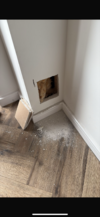
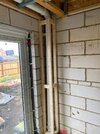
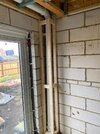
I've been in the bouse 9 months, (new build). I spoke to the site manager, who kindly came to inspect the issue. He suggested it could be a leak from the internal soil pipe, which runs from the main bathroom down the wall in the same corner. He arranged for someone to attend the same day. They cut a hole in the wall but found no visible leaks or signs of damp insulation. However, they did identify and fix a small leak from the bath, which they suggested might be the cause.

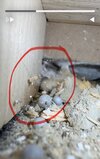
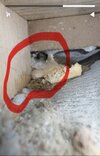
I’m not entirely convinced that a minor bath leak could result in damp spreading approximately 10 meters along the pipe. When I got home, I inspected the hole using my phone camera and torch and may have found signs of water ingress (please see attached image).

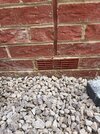
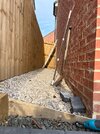
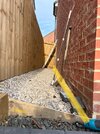
Interestingly, the damp area seems to align with an external airbrick. Could this be the source of the issue? I’m also aware that the ground slopes toward the house, which might contribute to the problem. However, if that were the case, wouldn’t I expect to see damp along the entire wall rather than just in isolated sections?

Should I be asking for the ground to be levelled, or for further inspection around the airbrick area internally?

Any advice or next steps you could suggest would be greatly appreciated.

Thanks
 

Attachments

  • IMG_8666.jpeg
    IMG_8666.jpeg
    356.4 KB · Views: 136
  • IMG_3240.jpeg
    IMG_3240.jpeg
    490 KB · Views: 135
  • IMG_3302.jpeg
    IMG_3302.jpeg
    550.6 KB · Views: 133
  • IMG_3303.jpeg
    IMG_3303.jpeg
    410.2 KB · Views: 131
  • IMG_3285.png
    IMG_3285.png
    1.2 MB · Views: 145
  • IMG_3301.jpeg
    IMG_3301.jpeg
    365.3 KB · Views: 138
  • IMG_3297.jpeg
    IMG_3297.jpeg
    317.1 KB · Views: 141
Keep the area well ventilated so it can dry out so you can get an idea of what’s going on.

Leaking water, how ever little will run to the lowest point before becoming obvious
 
A french drain would be a good idea along that wall for a start. That would take any water away from the bricks etc. Something like this:


Even a tiny leak can cause big issues over time.

Now that they have fixed 'a' leak, see if the area dries up. Water can travel great distances before it escapes and causes issues.

Would it be worthwhile removing the damp skirting board to get a better view and also to help the drying out.

I'd imagine if the MDF skirting board has 37% moisture in it, it's going to take some time to dry out!

Keep the area well ventilated so it can dry out so you can get an idea of what’s going on.

Leaking water, how ever little will run to the lowest point before becoming obvious

As above, maybe remove the skirting board or cut a portain of it out where damp?
Gotta love the movement joint. :p

What is that :)
 
Yes, remove the skirting...let it all dry out. Just maybe it was that leak from the bathroom. Keep an eye on the area and def think about putting those drains down the side where the ground slopes to your house...
 
Yes, remove the skirting...let it all dry out. Just maybe it was that leak from the bathroom. Keep an eye on the area and def think about putting those drains down the side where the ground slopes to your house...
Where is the water draining to if i install those drains? Do i need to do any further work or is it a case of creating a channel all the way down the side of the house, install the drains at the required level and leave as is?
 

Attachments

  • IMG_33033.jpeg
    IMG_33033.jpeg
    487.4 KB · Views: 35
this is also the planning details for my plot from council website.

Does anyone know off this if i have a drain channel already there?
 

Attachments

  • blue.JPG
    blue.JPG
    19.9 KB · Views: 35
It's a cavity wall. Damp does not get across it from the external ground and does not get across the DPM and DPC built in to the wall.

I'm not sure where you are but for the past 3 months in the UK there has been no ground damp enough to allow water to rise in a wall. And if the DPC and DPM were built with a defect, you would have been enjoying that damp last winter.

You could have the damp area tested - samples can determine if the moisture is from the ground, from the waste pipe or from condensation.

BTW, do not rely on your damp meter, or your own interpretation of the results.
 
It's a cavity wall. Damp does not get across it from the external ground and does not get across the DPM and DPC built in to the wall.

I'm not sure where you are but for the past 3 months in the UK there has been no ground damp enough to allow water to rise in a wall. And if the DPC and DPM were built with a defect, you would have been enjoying that damp last winter.

You could have the damp area tested - samples can determine if the moisture is from the ground, from the waste pipe or from condensation.

BTW, do not rely on your damp meter, or your own interpretation of the results.
I'm in Lancashire, Darwen.

I've been in since December last year and whilst we have had some terrible weather, there has been no signs of pooling water.

When we initially moved in, the garden was a mud bath so all out garden furniture, storage boxes for cushions and so on where stored down the side of the house as pictured. If i remember correctly and now i think about it the garden box was shoved agaisnt the wall, covering that specific air brick from maybe December to end of feb, beginning of March.

Pic attached, can just about see what i mean.

Do you think that could have been a possible cause? or possible peresisnt splashing/water run off entering the air brick?
 

Attachments

  • IMG_3356.png
    IMG_3356.png
    2.3 MB · Views: 43
Last edited:
From the information in this thread, the likelihood of that damp being caused by ground moisture would be less than it being caused by that waste pipe. That's not an absolute but based on probability.

The ground is bone dry. What wet weather have you had in the weeks or days before that photo to have caused that damp?

Compare with what usage of that waste pipe has occured in the same time period.

Unless blatantly obvious, investigation is going to be intrusive and may be imprecise. So it may be best to chemically test that damp moisture to identify if it is waste or ground water. The builder should pay, but the tester should be independent.
 
Just do nothing, see if it dries out. The horizontal pipe in the ceiling will have a couple of degrees slope on it, so if the bath pipe entering it was leaking then the water could have clung to the outside and tracked along the pipe rather than drip onto the ceiling, then it would have run down the outside of the vertical length before collecting at its base.

The concept of it being the bath waste is credible, you know that there was a leak and it's now been fixed so the best course of action is nothing. Just see if it dries out.
 
There shouldn't be a route for groundwater to get to the skirting board in any modern building. There would be at least one layer of plastic stopping this however wet the soil gets.
 
Just do nothing, see if it dries out. The horizontal pipe in the ceiling will have a couple of degrees slope on it, so if the bath pipe entering it was leaking then the water could have clung to the outside and tracked along the pipe rather than drip onto the ceiling, then it would have run down the outside of the vertical length before collecting at its base.

The concept of it being the bath waste is credible, you know that there was a leak and it's now been fixed so the best course of action is nothing. Just see if it dries out.
I've highlighted in red where the damp appears to be. Would it be highly plausable to say the insulation could have been wet but has since dried out and now the bit which I've seen when using my camera seems to be that section of wood next to the red spot which may be the last bit to dry out?
 

Attachments

  • IMG_8666.jpeg
    IMG_8666.jpeg
    431.8 KB · Views: 61

If you need to find a tradesperson to get your job done, please try our local search below, or if you are doing it yourself you can find suppliers local to you.

Select the supplier or trade you require, enter your location to begin your search.


Are you a trade or supplier? You can create your listing free at DIYnot Local

 
Back
Top