• Looking for a smarter way to manage your heating this winter? We’ve been testing the new Aqara Radiator Thermostat W600 to see how quiet, accurate and easy it is to use around the home. Click here read our review.

Why is my LED replacement for a flurescent tube not working?

Yes electronic equipment tends to either fail rather quickly, or last for ages, the main problem is the electronic capacitor.
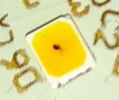
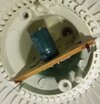
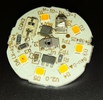
Sometimes you can see what has failed, bulb inner1.png the spot 1739890905485.png shows that LED has failed, this GU10-inside-1.jpgGU10-inside-2.jpg shows no reason why the output was much reduced. But what ever the reason why it has failed, there is little which can be done, I did find one lamp with a dry joint, which was corrected and put back into service, but that is unusual.
But the thread is about LED replacements for fluorescent, not stating clearly which are suitable for only magnetic ballasts, and which will work with electronic ballasts. Some do "Magnetic ballast compatible (fluorescent fittings fitted with a starter)""Fluorescent fittings with an Electronic Ballast (No starter) disconnect and by-pass the HF ballast, as per diagram supplied." Some say
1739892625728.png
but, most seem to say nothing, I know the type to work with electronic ballasts are made, but my attempts to find any has to this point failed.
 
Wylex boxes were available well into the 1990's as I purchased an 8 way to upgrade the installation in my home which Mrs Sunray points out we moved in November 1994.
 
You could well be disappointed, then :)

You say you have "considered all definitions" (which I take to mean the different types of averages), but you are actually only thinking about one, namely the mean. When you go on write ....


.... you would be correct IF the 25,000 hours 'listed' were a mean. However, it's not, it is a median, and that changes everything. One simply can't do that sort of arithmetic with medians, not the least because a median is not dependent on the actual values, only on what value separates 'the lower half' from the upper half'. A median of, say, 25,000 hours does not tell one whether those who didn't survive for 25,000 hours all survived for only 1 hour or whether they all survived for 24,999 hours - the median would be 25,000 h in either case. By treating the 'listed' figures as if it were a mean (which it isn't) you are effectively assuming a totally symmetrical distribution of the figures (in which case mean and median wou[kd be the same), which is likely to be very far from the truth.

Just taking your example above, if the median were 25,000 hours, then it could be that there were none which were significantly (or at all) above 25,000, so there wouldn't be any of 49,999 hours to balance '1 hour' ones

I haven't got time at the moment but, if you so wish, I'll try to explain in more detail 'in due course'.

Kind Regards, John
John. I would point out that its a slight nonsense to bring life expectancy of an LED down to median failure as you are taking a median of a mean. Sure it may work for catastrophic led failure but LED life expectancy is measured by their L70 and L50- times, ie the hours taken of use to have 70% and 50% of their original light output and that is a mean by definition. You cannot have a median of a mean...its one or the other.
 
Fair enough,but, for what it's worth, In terms of such matters, I can certainly trump GCSE-level knowledge in a very big way :)

Yes, the larger the sample, the closer will what one sees reflect how things 'really are' in the entire population.

However, what you are overlooking is the question of "how things 'really are' in the entire population". You seem to be assuming a nice neat symmetrical distribution centered on the mean (the 'bell-shaped-curve of a 'Normal' distribution). However, with most 'survival' data, that simply is not the case.

For many manufactured products (LEDs, hard drives or whatever) as well as biological survival (e.g. human survival) the common situation is what is often called a 'bathtub-shaped' survival curve - with quite a lot of very earth 'deaths' (due to manufacturing defects, congentital abnormalities or whatever), followed by a long period during which there are hardly any failures at all, until one eventually reaches the point at which failure/death gradually starts increasing (due to 'old age'/'wearing out' . Here is a typical curve that I have just pulled fromon-line ...

View attachment 373450

... so the 'very early failures' are not any sort of 'quirk' but, rather, they are "how it is", and that will become increasingly closely reflected in what you see in a sample as the sample gets larger. In the sort of situation we are talking about (with the LEDs), the median (which is what the manufacturer quotes) will often be much higher than the mean (which is what you have assumed)). In the example I used in post #22 (which may well be the sort of thing ine sees with LEDs etc.), if one assumes that all the values in the top half were exactly, 10,000 (rather than the " ≥10,000 " I put in that list), then the median (which the manufacturer would quote) would be 10,000 hours, whereas the mean (which is what you seem to be assuming) would only be 5,503 hours.

No time at the moment, but later I'll see if I can think of a better way of explaining.
No I'm not overlooking anything, I'm very aware of the 'bathtub curve', as we always called it, of failure rate and fully expect the first segment of your graph to be much steeper.

I estimate the history of the LEDs in the 3 new tripple fittings when we decorated our hall, stairs and landing to be something like this
1739899636597.png

Showing batches of 10 or 12 versus age and guess at actual usage. As can be seen not a single device in the first 4 batches achieved anywhere near 1K of use, for that matter nor have they acheived 25K of life. I've shown as straight lines as I didn't log individual dates. Batches 1 & 2 were cheap, 3 & 4 Philips and Energiser, 5 & 6 ar Home bargains own brand and by far the best longevity. I'm currently at 8 years or 65K hours with say 6500 hours of actual lit time from the beginning and have 4 spares,

My other real life experiences of electronics failure rates where they have been logged and plotted has almost invariably come up with very comparable figure when using any of the average formats. However getting back to my 9 lights Ihave no idea but it would have been lovely if one had achieved something near the 25,000 hours of service and I'm not even going anywhere near the light levels, just the actual failure..
 
John. I would point out that its a slight nonsense to bring life expectancy of an LED down to median failure as you are taking a median of a mean.
As below, I don't really understand why you say that.
.... LED life expectancy is measured by their L70 and L50- times, ie the hours taken of use to have 70% and 50% of their original light output
That's different, and is not what LED manufacturers mean by the 'expected life expectancy' figures they publish. Their figures are the median time taken for the products to be deemed to have 'failed' - either completely (no light output ) or when light output has fallen to an unacceptable extent (however defined) - i.e. the point at which a user would want to replace the item.
and that is a mean by definition.
Why do you say that? Each item will have an L70 and L50 (and a time to 'failure', as above). Any published figures will obviously relate to some sort of average of those figures (for a large number of items),and that average can be a mean or a median (or any other type of 'average') - so why do you say that it is "a mean by definition"?
You cannot have a median of a mean...its one or the other.
One can calculate the median of a number of means (or the mean of a number of medians), but that's very rarely useful, so let's not go into that. As above, I don't understand why you think I'm talking about "a median of a mean" -- I'm talking about the median of a piule of indivisual 'survival times'
 
No I'm not overlooking anything, I'm very aware of the 'bathtub curve', as we always called it, of failure rate and fully expect the first segment of your graph to be much steeper.
Yes,I agree that for LEDs (and, in fact very many other things, including human beings) I would expect the first segment to be much shorter and much steeper than in the curve I posted - which was the first one Mr Google offered me when I wanted to illustrate the concxept of a 'bathub curve'.
.... However getting back to my 9 lights Ihave no idea but it would have been lovely if one had achieved something near the 25,000 hours of service and I'm not even going anywhere near the light levels, just the actual failure..
You don't tell us the claimed life expectancies of the various batches, but if any were claiming (a median of) 25,000 hours (and that was true) then you would have been very unlucky to not have any last that long,since a median of 25,000 hours means that, in a big enough batch, half of them should last at least 25,000 hours.

One issue with a lot of products like this is that, for practical as well as 'marketing' reasons, quoted life expectancies usually relate to testing with continuous use, which may well result in longer survival than in the real-world 'intermittent' situation (with a lot more 'thermal cycling')
 
Reminds me of this video:
(Yes its Amercian but he makes good points)

I'm a big fan of these fittings: https://www.expertelectrical.co.uk/kosnic-blanca-ip65-bulkhead-with-white-trim-for-led-dd-lamps for rooms which need 2D style fittings. Its basically a 2D fitting with no gear in with just 240v on the lamp socket as you'd get if you converted an existing 2D fitting. You then use it with the conversion style lamps https://www.expertelectrical.co.uk/kosnic-led-dd-standard-4-pin-modules-cct and when you fail, you change them like any other style lamp. You can even get emergency packs, if you have one of those fitted, then to change the lamp it takes slightly longer as there is a 4 pin JST connector that goes into a socket on the side of all the kosnic lamps that powers a smaller array of SMD leds and a green charge LED that is always present on them, but only used if you plug into the connector. You can also buy the lamps with various types of detection on board. Its as close as you can get to a purpose designed LED fitting, that has a user replaceable lamp.
 
As below, I don't really understand why you say that.

That's different, and is not what LED manufacturers mean by the 'expected life expectancy' figures they publish. Their figures are the median time taken for the products to be deemed to have 'failed' - either completely (no light output ) or when light output has fallen to an unacceptable extent (however defined) - i.e. the point at which a user would want to replace the item.

Why do you say that? Each item will have an L70 and L50 (and a time to 'failure', as above). Any published figures will obviously relate to some sort of average of those figures (for a large number of items),and that average can be a mean or a median (or any other type of 'average') - so why do you say that it is "a mean by definition"?

One can calculate the median of a number of means (or the mean of a number of medians), but that's very rarely useful, so let's not go into that. As above, I don't understand why you think I'm talking about "a median of a mean" -- I'm talking about the median of a piule of indivisual 'survival times'
John, its already a mean of life expectancy as the actual life expectancy is not a real observed number it is a model of expected failure taken from the decay of the luminosity over a given period, this produces a mean figure of the rate of decay. For a median to be used the rate of decay would need to be only falling exactly on a straight line, however is that even possible or even probable ? Think of the variables that would need to be managed to achieve straight line decay.
 
Yes,I agree that for LEDs (and, in fact very many other things, including human beings) I would expect the first segment to be much shorter and much steeper than in the curve I posted - which was the first one Mr Google offered me when I wanted to illustrate the concxept of a 'bathub curve'.

You don't tell us the claimed life expectancies of the various batches, but if any were claiming (a median of) 25,000 hours (and that was true) then you would have been very unlucky to not have any last that long,since a median of 25,000 hours means that, in a big enough batch, half of them should last at least 25,000 hours.

One issue with a lot of products like this is that, for practical as well as 'marketing' reasons, quoted life expectancies usually relate to testing with continuous use, which may well result in longer survival than in the real-world 'intermittent' situation (with a lot more 'thermal cycling')
I think this started late in 2016. I would be able to look at accounts to see what and when purchased for accuracy but that is unlikely to include paperwork for the products. All I have to hand is the spare Home Bargains bulbs (e-Luminate brand) which shows "Upto 15 years Based on approx 2.7 hours use per day." which equates to 14,700 hours, I'm currently at 8 years & 4 months or 73,000 hours so assuming 10% use (which I feel is very much is over estimated: ie yesterday and today ~10 mins/day) 7,300 hours total and so far got through 14 of them

Something I have yet failed to mention is the landing light failed to adequately illuminate into the airing cupboard and was replaced with a pendant and CFL several years ago which probably makes my figures even worse. We're trying but failed to work out when that was. Potentially there could still be up to 6 from batch 5 still in service at 5,000 hours but I feel unlikely.
 

If you need to find a tradesperson to get your job done, please try our local search below, or if you are doing it yourself you can find suppliers local to you.

Select the supplier or trade you require, enter your location to begin your search.


Are you a trade or supplier? You can create your listing free at DIYnot Local

 
Back
Top