Willis Heating System

.... Imagine you have a tank full of water, and the whole lot is at 50 degrees.
....
Suppose the manufacturer had a choice of two different nozzles that could be fitted to the inlet. ... One was a 90-degree, single small hole that, at mains pressure, would spray a jet of water at high speed towards the top of the tank. .... The other is a large baffle with many parallel water paths that, at mains pressure, achieves a very gentle dribbling of water over its entire surface. ...
Which of these nozzles would you prefer fitted to your tank that supplies your shower? ... I would like the baffle, because it means that the cold water from the mains comes into the tank very slowly and gently and stays at the bottom, like a bartender pouring cream onto a cocktail. All the 50-degree water would come out and I’d have a nice hot shower .... The hardcore guys might choose the other nozzle that instantly and powerfully starts agitating the tank, stirring the whole thing when the shower is turned on. Very rapidly, my shower wouldn’t be a toasty 50 degrees, as all the hot and cold water is blended by the fast stirring.
I agree with you totally, but don't think it has much to do with what we're discussing - you are simply illustrating the desirability of avoiding an arrangement which encourages mixing of the entire contents of the cylinder. I would say the same if you were talking about installing a 'stirrer' in the cylinder, regardless of the method of water heating!

I agree that the Willis system certainly doesn't encourage such mixing but, as I see it, and given that real-world bottom inlets obviously don't use one of your hypothetical "90-degree, single small hole that, at mains pressure, would spray a jet of water at high speed towards the top of the tank", I don't think that my cylinder with a high-up immersion does, either [it's a vented system, so the cold water enters the bottom of the tank pretty 'gently' from the header tank (not 'at mains pressure')] , does it?
So, this idea of moving water slowly so very hot floats on top of very cold is a good thing
Indeed.
It’s like having a panel in the tank that can slide and stops cold and hot mixing. There isn’t a panel, because there doesn’t need to be if you introduce hot at the top and cold at the bottom slowly enough not to stir the tank.[
Indeed - but, as above, that's more-or-less as true with a 'top immersion' as with an external Willis heater, isn't it?
Putting an immersion at the bottom doesn’t do this. The water next to the heater might be at 80 degrees when it’s heating, but it doesn’t float up to the top of the tank and stay there at 80. When you turn your tank immersion on, it stirs the tank quite a bit as it heats.
Agreed - but I haven't been talking about the situation when I'm using my 'bottom immersion'. I'm talking about the situation when I use the top one, and still don't really see why the Willis system offers much, if any, advantage over that.
A Willis doesn’t do this. .... If you want 20 litres of hot water at the top of the tank, turn it on and wait X minutes. If you want 40 litres, turn it on and wait Y minutes.[/S]
Yep, although I very rarely have the need, that's exactly what I do with my internal top immersion. Why do you think Willis would be better?
If you have an immersion 3/4 of the way up a 300-litre tank, it heats 75 litres of water. If it’s the same power as a Willis and runs for the same time as a Willis, then both it and the Willis have made 75 litres of hot water. But you can’t choose to have 40 litres of 80-degree water with your fixed-position immersion that is in-tank, because of the stirring.
As above, I don't believe that there is appreciable 'stirring' with the 'gentle inflow' into my cylinder, so I would expect most of the 75 litres of hot water to remain essentially undiluted by colder water, at the top - and hence for most of the 75 litres to be available at a reasonable temp to be used.

Again as above, I do that very rarely, but it seems to work. More to the point (and the reason why I very rarely need to use the top immersion), 20 hours or so after the last nocturnal heating (hence 'nearly time for the next top-up') my very-well-insulated (140 L) cylinder still has plenty of hot water (heated the previous night by the 'bottom immersion') still available for use, despite the fact that it must be sitting on top of a fair bit of cold water that has been 'gently drawn in' to the cylinder during the course of the day. I therefore can but presume that 'stirring' is pretty minimal in my installation.

In view of the above, you may understand why, unless/until you can convince me otherwise, I remain of the view that a Willis system would offer me little, if anything, over what I already have - and that that may be the reason why one rarely sees the Willis system being used outside of Ireland?

Kind Regards, John
 
Last edited:
Again commercial systems are different to domestic with multiple sensors but basically the 'main' temperature of interest will be at the bottom of the heated water. Additional sensors will be on the HW draw off point and in the case of Willis style systems the cold draw point and hot return (the in and out 'pipes' of the heaters). There may very well be multiple sensors of each , such as for each heater (to monitor which are working etc), multiple heights of the main vessel may also be used to cater for shift patterns etc
Fair enough, but as you imply, and presumably accept, few, if any, domestic installations are going to be that complicated?
 
I think you you understand the situation as you ask the questions which I've already given answers to - now emboldened.
Fair enough, but you obviously wrote all that after I posted mine!

As I said, I suspect that conduction is very slow and feeble, so probably isn't much of a factor. However, perhaps the most crucial thing is that, as I have alluded to and as you have written:
All of this can only happen if the heater is running continuously and not tripped by a water temp stat.
There must be some thermostatic control and, as I've said, the position (and setting) of it seems crucial. In the case of a 'top (internal) immersion' (like mine, the stat is invariably integral with the element, and will therefore switch it off as soon as water at the level of the immersion is 'up to temp'. In the case of the Willis system, I don't know where the stat is, but presume that it is probably again integral with the element. If the Willis's stat turns it off as soon as the water within the Willis heater is 'up to temp', then I think we may need to re-visit some of the exchanges we've had about 'how Willis works' :-)

... and, as I've just written, I have some 'proof of the pudding' - 20+ hours after it was last heated, the water at the top of my cylinder is still hot (not much less hot than it was 20 hours previously), despite the fact that it must be sitting on top of a large volume of cold water that has been drawn into the bottom of the cylinder during the day. There therefore presumably cannot be any appreciable 'mixing' going on, nor appreciable transfer of heat from top to bottom of the cylinder by conduction or any other process?
The Willis system will provide 3KW worth of instant hot water (providing I understand the Willis system), which is the same as those feeble oversink hand wash instant heaters, an immersion heater in a large vessel cannot do that
True but, as I've said, a heater with a small under-sink hot water storage, a traditional cylinder with a top immersion and a Will system can all supply a modest amount of immediately-available hot water.
 
The stratification, in a Willis arrangement, is simply much more effective than in the usual, near vertical element arrangement. With the usual element, you get heated water rising, then falling again as it cools, around the outer edge of the cylinder. Hence, you get much more mixing of hot and cooler water. Compare that, with the Willis system, where the heated water, simply goes in the top of the cylinder, with no convection currents from an element to mix it.

Better than the near vertical element, is obviously the multi-element arrangement, where the element can be chosen, to better match the hot water demand.
In my experience (which I can not claim is particularly extensive although I have seen quite a few ) there are both double elements vertically or two single elements horizontally, I can not guess with any accuracy which type is likely to be the most common overall but I do suspect that it might well be the vertical type by something like approx 2 to 1 or thereabouts - if someone says around 35% of the total are horizontal it would not be a great surprise to me but I can not confirm it either. I just know that neither is particularly rare in my own experience.
 
As above, I don't believe that there is appreciable 'stirring' with the 'gentle inflow' into my cylinder, so I would expect most of the 75 litres of hot water to remain essentially undiluted by colder water, at the top - and hence for most of the 75 litres to be available at a reasonable temp to be used.

I'm sure you will know, that a 27" immersion heater, uses an 18" stat. The reason for that, is that an immersion heater, suffers mixing, and a gradient of temperature, near the bottom of the element - so it is deliberately designed to switch off before too much mixing takes place. You must have also noticed, that rather than the hot water, if you use all the hot, will quite gradually reduce in temperature?

That simply doesn't happen with a Willis system. As the all the hot water is used up, the water will much more suddenly become cold. The Willis enables a similar size of main cylinder, to store much more water, heated to the desired temperature, than does a normal immersion heater system.

A separate point.....
During Octopuses free two hours of power, I made a point of turning our immersion heater on, set to heat the water to 65C - and turning the gas boiler off, until after the two hours, then back on. On turning the boiler back on, having used no water, it fired up immediately, because it's thermostat hadn't been satisfied by the immersion heater being on. The water from the hot tap, after the session, was certainly hotter, but there was also obviously a wide gradient of temperature.

This, is a vertical immersion heater system. No doubt a system, with a horizontal element will suffer less graduation.
 
Fair enough, but you obviously wrote all that after I posted mine!
1771845261254.png
4 hours prior to you asking the question

1771845192857.png

But emboldened later, only in the quote
 
A separate point.....
During Octopuses free two hours of power, I made a point of turning our immersion heater on, set to heat the water to 65C - and turning the gas boiler off, until after the two hours, then back on. On turning the boiler back on, having used no water, it fired up immediately, because it's thermostat hadn't been satisfied by the immersion heater being on. The water from the hot tap, after the session, was certainly hotter, but there was also obviously a wide gradient of temperature.

This, is a vertical immersion heater system. No doubt a system, with a horizontal element will suffer less graduation.
I would not think the water would cool down enough to turn on the immersion heater for those two hours? It does raise the question about circulating central heating water temperature vs immersion heater water temperature.

I turn off the off-peak use to heat DHW in the winter, my controller allows me to set it to use off-peak in summer only. Off-peak costs 8.5p/kWh, and I get paid from March 12p/kWh for export, so better using off-peak to solar.

But before solar PV was installed, I thought (in error) it was cheaper to use oil to heat DHW, and there is no thermostat connected to DHW for the CH boiler, so only control was time. I found ½ hour every other day was about right, it only actually ran the boiler for 20 minutes, as the boiler would cut out, so it was either 3 days a week or 4 days a week, it needed somewhere between the two, with a 20 kW boiler non modulating.

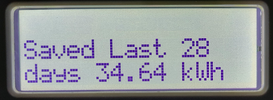
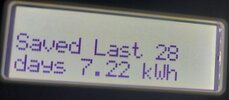
Cost with an immersion heater in summer to heat water, 1771847403957.png is approx 1.24 kWh per day, or 15p, it is not worth faffing about anyway. But to use the 6 kWh free from Octopus you would need to stop using the central heating to heat DHW at least two days before the free time.

I can't turn my central heating not to heat DHW even if I wanted to, C Plan does not have this option, I was surprised, I expected in winter to see no electric heating of DHW, it will only heat it if exporting, but Last 28 days Winter 21-2.jpg seems it has used some solar to heat the DHW that reading 22nd February £1.08 not worth worrying about.

Since changing the 11 inch to 27 inch immersion heater, I have not run out of hot water. I can see the theory that having multi thermostats one can set it to heat water depending on use and electric price, but same applies with my iboost+ the cost of the installation with never pay for its self, so the debate is of interest, but I will never install a Willis immersion heater, however if I had a cylinder without the immersion heater boss, then the Willis would be a good way to add an immersion heater.

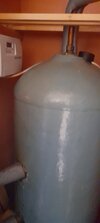
As to original installation, not sure? All those pipes will lose heat, and modern tanks are very well insulated, not like my old thing, Tank after lagging.jpg the extra lagging hardly made a difference Tank before lagged.jpg I was very disappointed, and I look at all the pipe lagging, and then when a bit of floor removed, found not a scrap of lagging where one normally can't see. I think iboost would have been better not to have included an energy monitor, as I now know how little is saved, well first 20 months of solar only, once I was being paid for export, it started costing me more with iboost+ to what a simple time switch would have saved. Off-peak is cheaper than export tariff.
 
I would not think the water would cool down enough to turn on the immersion heater for those two hours? It does raise the question about circulating central heating water temperature vs immersion heater water temperature.

It, both gas and electric, had been off for several hours. I brought it up to temperature on the immersion element + stat, and at the end of the two hours, switched the electric off, boiler back on. Rather than a stat, my system uses an actual temperature sensor, mounted under the insulation, around 1/3rd up from the base, but both stat, and sensor, were set for 65C.

Water heated by immersion, when drawn, was distinctly hotter than normal, when gas heated. My boiler when heating water, is preset to output at 75C.

From this, my assumption is that the immersion produces hotter water at the top of the cylinder, but the temperature falls rapidly further down the cylinder, and that the gas heating, produces a slightly lower temperature, but a greater quantity of consistently hot water - the advantage of applying heat at the bottom, rather than down the middle of the cylinder.
 
I'm sure you will know, that a 27" immersion heater, uses an 18" stat.
Yes, I do know that.
The reason for that, is that an immersion heater, suffers mixing, and a gradient of temperature, near the bottom of the element - so it is deliberately designed to switch off before too much mixing takes place.
I'm not as confident about "the reason" as you seem to be.

In any event, I've said absolutely nothing about vertical' 27" immersions. For comparison with Willis, I've been talking about systems like mine, with two horizonal (I think 11") immersions (one near bottom of cylinder and the other 'high') - so inevitably with the thermostat at the same height as the element.
You must have also noticed, that rather than the hot water, if you use all the hot, will quite gradually reduce in temperature?
On the contrary, as I've said, some 22 hours after the water last heated (by the 'bottom' element), the water at the top of my cylinder is usually still very hot, not appreciably cooler than it was 22 hours earlier, despite the fact that it is obviously sitting on top of a lot of cold water that has been drawn into the cylinder during the day.

So, no matter what you may regard as 'obvious', there clearly is no significant 'mixing' (or heat transfer by conduction) in my cylinder - and if it doesn't happen in mine, I don't see why it should happen in anyone else's.
That simply doesn't happen with a Willis system. As the all the hot water is used up, the water will much more suddenly become cold. The Willis enables a similar size of main cylinder, to store much more water, heated to the desired temperature, than does a normal immersion heater system.
I don't understand what you are saying there.
This, is a vertical immersion heater system. No doubt a system, with a horizontal element will suffer less graduation.
Exactly. I am still not at all convinced that the Willis system offers anything which a ('standard') cylinder with two horizontal elements (or even one with one horizontal 'bottom' immersion and one short vertical one at the top) doesn't offer - so I remain very open to 'education'/ 'explanations'.
 
In my experience (which I can not claim is particularly extensive although I have seen quite a few ) there are both double elements vertically or two single elements horizontally,
Indeed- and, as I've said, mine is the latter, and it's systems like that (two short horizontal immersions) that I have been talking about in comparison with Willis.
 
Yes, I do know that.

I'm not as confident about "the reason" as you seem to be.

In any event, I've said absolutely nothing about vertical' 27" immersions. For comparison with Willis, I've been talking about systems like mine, with two horizonal (I think 11") immersions (one near bottom of cylinder and the other 'high') - so inevitably with the thermostat at the same height as the element.

On the contrary, as I've said, some 22 hours after the water last heated (by the 'bottom' element), the water at the top of my cylinder is usually still very hot, not appreciably cooler than it was 22 hours earlier, despite the fact that it is obviously sitting on top of a lot of cold water that has been drawn into the cylinder during the day.

So, no matter what you may regard as 'obvious', there clearly is no significant 'mixing' (or heat transfer by conduction) in my cylinder - and if it doesn't happen in mine, I don't see why it should happen in anyone else's.
That doesn't tally with my experience.
Washing up after lunch the water from the tap will be too hot to put my hands directly into.

However if we have breakfast and wash up: Washing up after lunch the water from the tap will be noticely cooler but there will still be plenty for a bath.
I don't understand what you are saying there.

Exactly. I am still not at all convinced that the Willis system offers anything which a ('standard') cylinder with two horizontal elements (or even one with one horizontal 'bottom' immersion and one short vertical one at the top) doesn't offer - so I remain very open to 'education'/ 'explanations'.
Again I can only describe commercial systems but:
Instant hot water is available albeit at reduced flow or temperature
Maintenance is easier, ie isolate the valves both sides of the heater and have around 1L of water to catch rather than drain off an entire 50 gallons. (1000 gallon HW vessels plus the cistern are not uncommon in commercial installations)
 
That doesn't tally with my experience. ... Washing up after lunch the water from the tap will be too hot to put my hands directly into. ... However if we have breakfast and wash up: Washing up after lunch the water from the tap will be noticely cooler but there will still be plenty for a bath.
I guess it depends upon what one regards as "noticeably cooler" - under normal circumstances (i.e. unless we have 'a house full of visitors') the water late at night is 'well hot enough' for anything (well, I can't say about baths, since we don't really do them!)

Anyway, I'm acquiring some 'Chapter and Verse' for you all today. I measured the temp at the kitchen tap first thing this morning and, if I remember, will do the same late tonight - so 'watch this space'!
 
I guess it depends upon what one regards as "noticeably cooler" - under normal circumstances (i.e. unless we have 'a house full of visitors') the water late at night is 'well hot enough' for anything (well, I can't say about baths, since we don't really do them!)

Anyway, I'm acquiring some 'Chapter and Verse' for you all today. I measured the temp at the kitchen tap first thing this morning and, if I remember, will do the same late tonight - so 'watch this space'!
In my case the difference between too hot to run on my hand to not too hot to run on my hand so I'll make a stab at at least 5ºC
 
In my case the difference between too hot to run on my hand to not too hot to run on my hand so I'll make a stab at at least 5ºC
If that's true, I wouldn't really think that 5°C is really anything significant - given that (at least in my case) the temp would probably have dropped by at least 20°C or so had the heated water all mixed with the cold water that had been drawn into the cylinder during the day.

The water here is generally still "too hot to run on one's hand" late at night - which is good enough for me ;)

It is. as I've explained before, an extremely well-insulated (140L) cylinder. It's in a cupboard' with a floor area of about 1m x 1m and about 2m tall. It's roughly in the centre of the cupboard (both horizontally and vertically), and the entire cupboard around it is stuffed full of fibreglass insulation - so something like 250 mm of insulation on all sides (including top/bottom). That obviously explains a fair bit of the 'heat retention' but, even without any losses at all, the temp of the 'hot' water would have fallen dramatically had there been mixing with the cold water - so, whatever theory and people may say, I clearly am not getting significant mixing in my cylinder.
 

If you need to find a tradesperson to get your job done, please try our local search below, or if you are doing it yourself you can find suppliers local to you.

Select the supplier or trade you require, enter your location to begin your search.


Are you a trade or supplier? You can create your listing free at DIYnot Local

 
Back
Top