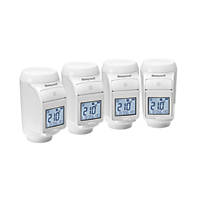
• Looking for a smarter way to manage your heating this winter? We’ve been testing the new Aqara Radiator Thermostat W600 to see how quiet, accurate and easy it is to use around the home. Click here read our review.

Economy 7

I suspect a large proportion of "plumbers" wouldn't know where to start with such calculations anyway.
I suspect you are right, and to be frank although I use the word Plumber to mean anyone who works with domestic pipes, I also know a Plumber is a worker of lead. So since sewage was for many years pot or steel or iron, the plumber is only concerned with supply of water or gas. Plus of course flat roofs. And the gas fitter took over gas bit, heating and ventilating engineers took over central heating. So what does a plumber do?

I suppose organ building and IT work, as that is only place were you are allowed to use lead. Don't think they would be really into IT so that leaves organ building, if you add to that what they did do when pipes were lead, and roofs were sealed with lead, then water supply to house and flat roofs.

But since the condensing boiler central heating has not been a plumbers job. You can get a NVQ Diploma (Levels 2 and 3) in plumbing and domestic heating, but not in just plumbing, in real terms there are very few real Plumbers left, I means some one who can wipe a lead joint in a pipe. It's a dyeing trade.

I have tried to get my head around how a modern central heating system works, with a opentherm enabled boiler with something like EvoHome yes I can understand how it works, the aim is to gradually alter flame height in boiler, and to gradually open and close thermostatic radiator valves and by-pass valves and to ensure boiler is running cool before it reaches the point where it needs to start cycling so as little as possible energy escapes through the flue. To do that the boiler is modulated from the eBUS.

However there are many boilers where there is no access to the eBUS so they can only be modulated using the return hot water temperature, meaning they are rather hot when they start to cycle which is not wanted.

Although there is nothing to stop a boiler being switched off when the return water is hot and flame height at minimum, once off there is nothing other than a connection to the eBUS that can tell the boiler when to switch on again. All it can do is every so often fire up and then after a time delay to allow water to circulate test the return water temperature. OK some anti-cycle software can adjust how long between test cycles, but without an eBUS connection the whole system is flawed. Yes you can fit thermostats to switch off the boiler, but where can you put it to ensure if any room gets cold the boiler starts and the boiler can modulate i.e. the wall thermostat does not turn it into a mark/space ratio.

Even the best heating and ventilating man can't set up a system when his hands are tied behind his back i.e. no access to the eBUS. All those great ideas, not heating unused rooms, geofencing etc. Don't work unless there is access to eBUS. However gas may now be with better systems analogue, but electric is still digital, the element is either on or off, the combi boiler is the problem with gas, use a storage tank and then it becomes a lot easier, heating in rooms can be analogue, but heating of the water store is digital. However with the exception of EvoHome, the eTRV head may tell the computer what the target and actual temperature is, and it may be simple in theory if target in any room is above actual then run pump to circulate hot water, actually finding software to do that is another thing. In practice it seems only EvoHome and maybe Tado actually can fire up a pump or boiler once target on any eTRV becomes above actual. This may change any day, as IFTTT apps are written every day, and it seems that is how the cheaper systems are controlled.

But can't blame the plumber, he can only work with what the manufacturers sell, his hands are tied.
 
That's what he teleswitch does - it switches the meter over to cheap rate.
That has always been my understanding, but ....
... The meter itself contains a pair of contacts which can be used to control your loads.
I must say that I'm not familiar with any sort of meter which requires an external signal to tell it to change tariff but which also contains what is effectively contains a contactor which enables the meter to provide a switched output for some loads as well as a permanent output for other loads. In fact, I'm not even sure that I've heard of meters with internal tariff-changing (clock- or remotely-controlled, including 'smart' meters) which provide a high-current switched output (i.e. to power loads, rather than just a 'signal' output to feed a contactor).
My reference to the teleswitch turning these loads on/off as load control was to using this mechanism to switch you to/from cheap rate and turn on/off your off-peak loads accordingly. So there is no question of switching on large loads to use peak rate lecky, just potentially giving you extra off-peak time ....
Fair enough, but if that is possible (see above), and despite what you previously wrote, I'm not sure that I can think of a reason why they would ever want to do that.

Kind Regards, John
 
Last edited:
Sorry back to the flat,
9263J_P
the storage unit say 210 litre costs £909.99, then EvoHome controller
ae235
£249.99 then the valves
5769H_P
another £237.99 radiator around £70 each so another £280 so looking at around £3000 to install, so will cost at lest £30 per year in interest charges on money used. (1%) so to pay back in 10 years it has to save at least £330 per year. Just can't see that being the case. To continue to use storage heaters already fitted may be a good idea, to fit any electric storage system today unless linked to solar panels or wood burners etc. Simply not worth doing, simple thermostat controlled oil filled radiators with time clocks will do a better job and be as cheap to run.
 
The maths is also a problem, we look at a house and we do the calculations and put them into an on line calculator and it tells us we need a 28 kW boiler, so that means since economy 7 only runs for 7 hours every 24 then we need 28/7x24= 96 kW or 417 amp, we know that must be wrong ...
As both you and Simon have gone on to say, such a 'calculation' is really a joke, since having undertaken a calculation of what size boiler would be needed to maintain the house temperature (the answer to which will be very much less than 28kW for any ordinary house), if it's a combi boiler one is talking about, the 'on-line calculator' will then think/say "...but forget those calculations, since you will need a 28k boiler for instant water heating". In other words, the answer it will give (for a combi) will always be at least 28kW, no matter how small the property.

If one remembers that 28 kW equates to 14 fan heaters, one can see how OTT such a figure is in relation to space heating of an average house.

Also, don't forget that stored hot water (heated slowly at off-peak times with a relatively modest amount of power) can service a shower - it's only if one wants 'instantly heated hot water' (as in a combi) that one needs the 'very high-speed heating' (i.e. high power heat sources).

Kind Regards, John
 
Sorry back to the flat, the storage unit say 210 litre costs £909.99, then EvoHome controller £249.99 then the valves another £237.99 radiator around £70 each so another £280 so looking at around £3000 to install, so will cost at lest £30 per year in interest charges on money used. (1%) so to pay back in 10 years it has to save at least £330 per year. Just can't see that being the case. To continue to use storage heaters already fitted may be a good idea, to fit any electric storage system today unless linked to solar panels or wood burners etc. Simply not worth doing, simple thermostat controlled oil filled radiators with time clocks will do a better job and be as cheap to run.
I must say that I am a bit confused ....

.... Even if the initial installation cost were zero, in the absence of cheaper/'free' energy sources (solar etc.), I can't see how anyone could believe that heating (space and/or water) utilising stored heat derived from off-peak electricity could ever offer any saving at all if piped natural gas were an alternative, since even off-peak electricity is more expensive (per kWh) than natural gas (and, if my electricity supplier is anything to go by, is increasing quite rapidly). Am I missing something, or are there just a lot of naive people (with money to spend) out there?

Kind Regards, John
 
are there just a lot of naive people (with money to spend) out there?

yes, there are.

some of them are dumb enough to fall for the vendor saying "this is cheaper than using full-price electricity" and not realising that energy from gas is about a quarter the price.
 
yes, there are. .... some of them are dumb enough to fall for the vendor saying "this is cheaper than using full-price electricity" and not realising that energy from gas is about a quarter the price.
That is obviously my fear, but the problem seems to be very pervasive .....

... I would certainly not classify eric as being 'dumb' or as being amongst the most naive of people but, even though his bottom line conclusions is that it is 'not worthwhile', he is talking about the very long 'payback period' to recoup an initial £3,000 investment - whereas, as far as I can see, as time goes by there will (due to the differential fuel prices) be an ever-increasing cumulative loss, which will add to, rather than subtract from, the initial outlay.

Even for the likes of me with no natural gas, bulk LPG, expensive though it is, is still a bit cheaper than off-peak electricity.

Kind Regards, John
 
eric hasn't been tricked, has he?

Look at this scam, for example
https://www.fischerfutureheat.com/
claim:
"Our 1.9kW Fischer elektrostore heater
is able to warm the same room space as an outdated 3.4kW night storage heater"

I suspect we all know how to calculate how much heat energy comes out of a heater that you put electrical energy into
 
eric hasn't been tricked, has he?
As I said, I feel sure that he is too intelligent and knowledgeable to have been 'tricked', but it does seem that some of the hype may in some way have influenced the way he thinks - otherwise he presumably would not be talking about the very small size of a 'cost saving' when there would almost certainly be a 'cost increase'.
"Our 1.9kW Fischer elektrostore heater is able to warm the same room space as an outdated 3.4kW night storage heater" I suspect we all know how to calculate how much heat energy comes out of a heater that you put electrical energy into
Indeed. However, to be fair, such ridiculous statements can sometimes be made by marketing people who simply don't understand what they should be saying. If the statement is not complete nonsense it could, for example, mean that the 1.9kW heater was able to warm the same room space at times of day when heating was required as could an 'outdated 3.4 kW night storage heater' (e.g. if the latter was not very good at retaining heat).

Kind Regards, John
 
I have tried to get my head around how a modern central heating system works
...
However there are many boilers where there is no access to the eBUS so they can only be modulated using the return hot water temperature, meaning they are rather hot when they start to cycle which is not wanted.

Although there is nothing to stop a boiler being switched off when the return water is hot and flame height at minimum, once off there is nothing other than a connection to the eBUS that can tell the boiler when to switch on again. All it can do is every so often fire up and then after a time delay to allow water to circulate test the return water temperature.
They basic way of doing it is fairly simple - regulate flow temperature<period>. As demand drops, flow temperature rises and the boiler can throttle back the gas. At some point it reaches the limit and the flow temperature continues to rise - so the flame is turned off. The circulating pump is kept running so the flow temperature can be monitored and the gas relit when needed. There is normally an anti-cycle timer to stop it cycling too quickly.
Obviously that's the "quick and easy way" and some boilers may do things differently.

Where (AFAIK) ALL current boilers fall down is in part load operation. Read the destruction books for them and they all specify that the minimum flow rate is that required to give a delta-T of 20˚C at full power - which is completely rubbish for driving a modern heating system, especially given how most are grossly over-rated. As load goes down, a bypass is needed to keep the boiler flow rate up - and this means feeding more and more hot water directly back into the return - thus raising the return temperature and killing the condensing function.

With all rads fitted with TRVs, the system (excl boiler) is naturally a variable rate system - as demand reduces (whether basic or electronic) so does the flow rate. With a modulating pump, the pressure is also reduced as flow reduces - and also the return temperature reduces and can get close to room temperature at low demand. Ideally the boiler would work at the reduced flow rate, condensing efficiently all the time - but unfortunately I have not found a boiler designed for such 21st century operation (does it show that I don't think much of boiler design :whistle:).
Instead, as demand reduces, boiler flow return temperature increases because of increased flow round the bypass that's needed to make these 19th century boilers work.

The thing is, it would be really REALLY easy for them to make the boilers variable rate and interface with the variable flow rate heating system. All it would take would be to separate the main and condensing heat exchangers and use an internal pump to maintain the main heat exchanger flow rate while using an external modulating pump to put a variable flow rate through the condenser heat exchanger - hardly rocket science :idea:

As it happens, I'll be writing to various manufacturers soon asking about options for this as I want to install a thermal store and re-heat it optimally. It will be interesting to see what excuses they come up with :rolleyes:

I must say that I'm not familiar with any sort of meter which requires an external signal to tell it to change tariff but which also contains what is effectively contains a contactor which enables the meter to provide a switched output for some loads as well as a permanent output for other loads.
Well where I used to work, that's what we had. The meters were basic two-register meters (still Farraris disk in our case) with an external teleswitch to change register (and hence tariff) - each teleswitch operated more than one meter. As well as the main full current output, the meter had a pair of terminals to a contact that closed when the meter switched to the cheap rate register - but I don't know what current rating these contacts are, we had loads switched by a contactor in the CU. In the past I've seen meters operated by an external time switch, but I didn't pay any attention to the wiring arrangement back then.
 
Well where I used to work, that's what we had. The meters were basic two-register meters (still Farraris disk in our case) with an external teleswitch to change register (and hence tariff) - each teleswitch operated more than one meter. As well as the main full current output, the meter had a pair of terminals to a contact that closed when the meter switched to the cheap rate register but I don't know what current rating these contacts are, we had loads switched by a contactor in the CU.....
Fair enough - but. as I said, I've personally neither seen nor heard of such an animal.
.... In the past I've seen meters operated by an external time switch, but I didn't pay any attention to the wiring arrangement back then.
I've certainly had dual-rate meters whose registers were switched by an external time switch - but, as above, I've never seen, let alone had, one in which the meter also provided a switched output for loads. I've seen plenty of installations in which the same was achieved with external contactors, but never with load switching happening within the meter itself.

Kind Regards, John
 
Interesting what SimonH2 says, however in danger of hijacking post. After Ronan Point having gas in flats is rare. And my point was not to complain about gas but to explain how the bits developed of gas can be used with an electric system.

There are three ways to use electric for heating.
1) Resistive.
2) Inferred.
3) Heat pump.
With resistive what goes in must come out. However energy can be wasted. The basic thing is not to heat a room when not in use, so the lower the mass of the heater, the better, that reduces the delay between switch on and room getting warm, so worst is storage heater, then underfloor heating, then oil filled radiators with the fan heater being best, however this does not take into account the price of fuel.

With inferred the problem is control, the heaters are on or off, you get immediate benefit when they switch on, but also immediately cold as they switch off, and the standard wall thermostat is useless, so these are manually switched on/off, good in a church, not so good in the home.

The heat pump has many advantages, including reversing so it can heat and cool, but on the expensive side.

Although you can get storage systems that don't lose much heat until wanted, the installation costs are silly. If looking at the ideal heating system then likely a combination of inferred and heat pumps, using inferred you don't need to pre-heat the room, so by combining it will reduce pre-heat time.

But although a heat pump could be powered with Economy 7 the cost of heat stores would be silly, best way to heat a tower block is likely a local power station so the gas makes electric and the other wise waste heat is used to heat the flats, and the gas is not actually in the tower block its self. But this does not help the individual flat owner.

We have no idea of the posters life style, or the type of flat, so we are simply giving ideas, however still down to installation cost, the storage heater will cost around £450 so assuming 4 the £1800 before they are wired in, OK all heaters cost so call it £1600 more than simple plug in heater. Assuming you need to borrow that money it is realistic to consider 4% so £64 a year in interest. So the big question is will Economy 7 save you £64 per year, then the flat is also heated when not required.

I failed 'A' level maths, so I'll let some one else do the number crunching.
 
eric: it's time you persuaded your 'speech to text' application to recognise 'infrared' and not say 'inferred'. It gets quite difficult to read, and I assume is reasonably easily fixable.
 

If you need to find a tradesperson to get your job done, please try our local search below, or if you are doing it yourself you can find suppliers local to you.

Select the supplier or trade you require, enter your location to begin your search.


Are you a trade or supplier? You can create your listing free at DIYnot Local

 
Back
Top