

- Joined
- 27 Jan 2008
- Messages
- 29,045
- Reaction score
- 3,559
- Location
- Llanfair Caereinion, Nr Welshpool
- Country

I suspect you are right, and to be frank although I use the word Plumber to mean anyone who works with domestic pipes, I also know a Plumber is a worker of lead. So since sewage was for many years pot or steel or iron, the plumber is only concerned with supply of water or gas. Plus of course flat roofs. And the gas fitter took over gas bit, heating and ventilating engineers took over central heating. So what does a plumber do?I suspect a large proportion of "plumbers" wouldn't know where to start with such calculations anyway.
I suppose organ building and IT work, as that is only place were you are allowed to use lead. Don't think they would be really into IT so that leaves organ building, if you add to that what they did do when pipes were lead, and roofs were sealed with lead, then water supply to house and flat roofs.
But since the condensing boiler central heating has not been a plumbers job. You can get a NVQ Diploma (Levels 2 and 3) in plumbing and domestic heating, but not in just plumbing, in real terms there are very few real Plumbers left, I means some one who can wipe a lead joint in a pipe. It's a dyeing trade.
I have tried to get my head around how a modern central heating system works, with a opentherm enabled boiler with something like EvoHome yes I can understand how it works, the aim is to gradually alter flame height in boiler, and to gradually open and close thermostatic radiator valves and by-pass valves and to ensure boiler is running cool before it reaches the point where it needs to start cycling so as little as possible energy escapes through the flue. To do that the boiler is modulated from the eBUS.
However there are many boilers where there is no access to the eBUS so they can only be modulated using the return hot water temperature, meaning they are rather hot when they start to cycle which is not wanted.
Although there is nothing to stop a boiler being switched off when the return water is hot and flame height at minimum, once off there is nothing other than a connection to the eBUS that can tell the boiler when to switch on again. All it can do is every so often fire up and then after a time delay to allow water to circulate test the return water temperature. OK some anti-cycle software can adjust how long between test cycles, but without an eBUS connection the whole system is flawed. Yes you can fit thermostats to switch off the boiler, but where can you put it to ensure if any room gets cold the boiler starts and the boiler can modulate i.e. the wall thermostat does not turn it into a mark/space ratio.
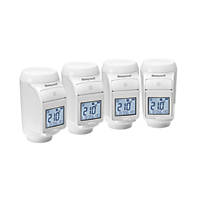
Even the best heating and ventilating man can't set up a system when his hands are tied behind his back i.e. no access to the eBUS. All those great ideas, not heating unused rooms, geofencing etc. Don't work unless there is access to eBUS. However gas may now be with better systems analogue, but electric is still digital, the element is either on or off, the combi boiler is the problem with gas, use a storage tank and then it becomes a lot easier, heating in rooms can be analogue, but heating of the water store is digital. However with the exception of EvoHome, the eTRV head may tell the computer what the target and actual temperature is, and it may be simple in theory if target in any room is above actual then run pump to circulate hot water, actually finding software to do that is another thing. In practice it seems only EvoHome and maybe Tado actually can fire up a pump or boiler once target on any eTRV becomes above actual. This may change any day, as IFTTT apps are written every day, and it seems that is how the cheaper systems are controlled.
But can't blame the plumber, he can only work with what the manufacturers sell, his hands are tied.



 ).
).


